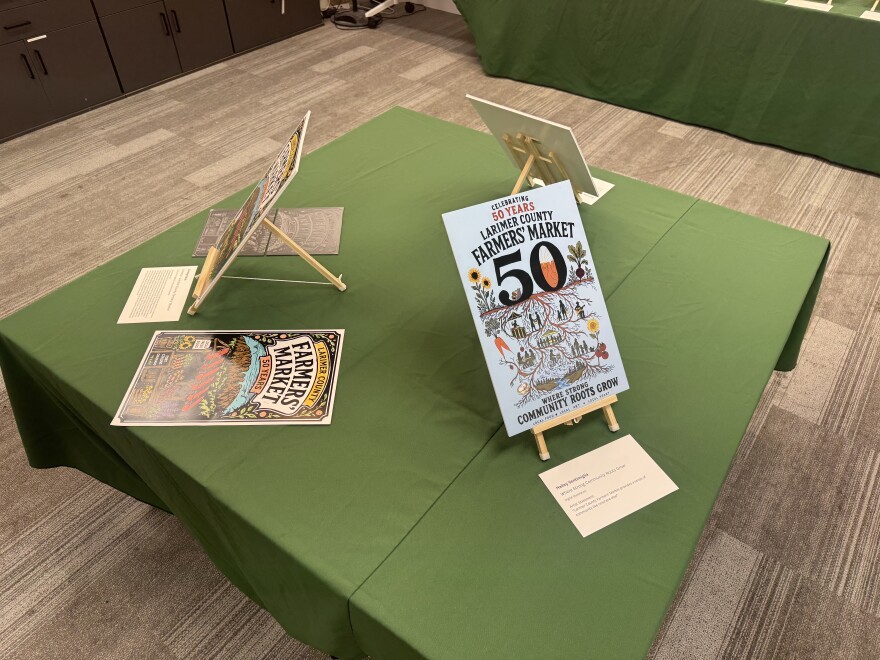
The Larimer County Farmer's Market launched a poster contest for its 50th anniversary. Local artists were invited to submit work highlighting the market's community role. Contest instructions required original artistic interpretations. The use of Artificial Intelligence was explicitly forbidden. Artists were to express the market's identity through their visual work. The only hard rule was the ban on AI tools. Submissions were displayed at the market before voting. The public voted to choose the winners. The contest aimed to celebrate the market's role. It also aimed to showcase local artistic talent.
Questions arose on social media after winners were announced in late July. Concerns were first raised by Fort Collins resident Sean Fazzini. He pointed out flaws in the first-place poster. That piece showed a produce stand under a mountainous landscape. Fazzini noted oddities in the design. He mentioned the awkward text phrasing on the sign. The sign read 'local fresh good.' The positioning of the stand's posts was inconsistent. He noted they were placed very unnaturally. One post was totally missing from the image. His comment gained quick attention. Another winning piece was by second-place winner Hailey Ventimiglia. Her poster showed a detailed root structure. It included human figures, vegetables, and Colorado nature scenes. Fazzini described Ventimiglia's poster in detail.
Ventimiglia's Poster Raises More Concerns
Ventimiglia’s poster also sparked additional claims. Online commenters noted text style similarities between the entries. They pointed to the style in the first-place winner. Some users claimed they used ChatGPT to reproduce the same font. This added weight to their belief about AI involvement. Comments were part of growing skepticism online. People speculated about AI in local art contests. The market's Facebook post was eventually taken down. Organizers cited receiving a large amount of negative feedback. The removal of the post only fueled the debate. People continued to question the contest's validity.
In response to the concerns, the Farmer's Market issued a statement confirming their efforts to ensure the artwork was created by human artists. They outlined their verification process, which included using online tools to check for AI-generated content and directly engaging with the artists to review their creative methods. Maggie Switzer, a representative for the Farmer's Market, explained that they had run the submissions through an AI detection website, though they acknowledged that such tools are not infallible. "We've learned (AI detectors) kind of have their own flaws inherently as well, but we did run them through an online verification site, and we went with the best one that we thought would do the best job," she said in an interview with KUNC News. In addition to the AI checkers, the market also reached out to each of the winning artists to confirm the originality of their work. The first-place artist, whose name was kept private at her request, provided physical evidence of their process, including a carved linocut that traced the stages of creation. Switzer noted that the artist had even visited the market office in person to display the linocut, providing what she described as "clear evidence" of human involvement.
For Ventimiglia's second-place poster, Switzer said the market reached out to the Museum of Art Fort Collins for further confirmation. Museum staff examined Ventimiglia's digital artwork and verified that it was created using ProCreate, a drawing and painting application used by professional artists. The museum also looked at the layers within the digital file to analyze its structure, concluding that the design was "human-made" and not the result of an AI tool. Josie Taylor, a representative from the Museum of Art, confirmed that they had taken the verification request seriously. She also inspected the linocut provided by the first-place artist and confirmed its authenticity, adding that it looked like a real, manually crafted piece.
Community Reaction and Continued Skepticism
Despite the market's efforts to address the concerns, some community members, like Fazzini, remained unconvinced. He argued that the market should have been more transparent, including releasing the names of the artists and allowing the public to view their entire creative process. He added that the market's decision to withhold both the artists' names and additional evidence of their process seemed like a lack of openness. Switzer admitted there had been an oversight in not initially disclosing the names of the artists but said this was due to their request for privacy. "The artists then requested to remain anonymous because they had seen a lot of that more negative feedback," she said, explaining that the artists had felt vulnerable after the initial controversy. She also defended the verification process, emphasizing that the market had taken the issue seriously and had used multiple methods to confirm the authenticity of the work. "We are inclined to believe this artist who also put a lot of time and effort into this piece," Switzer said about the first-place winner.
The market's response to the AI controversy highlighted the challenges of managing community expectations in creative contests. While organizers stood by their findings and the artists' claims of originality, the episode also exposed the growing unease around AI's role in art. For now, the Farmer's Market remains confident in the results of the contest, but the conversation around AI and artistic integrity is likely to continue in the local community.