
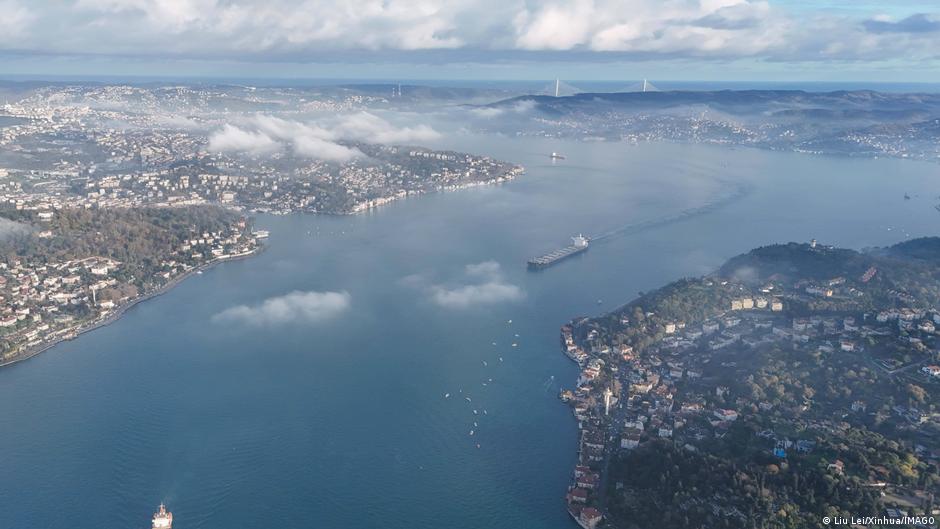
The choke point of the Bosporus
The Black Sea, a key waterway for energy and trade, is bordered by six countries. Three of these — Turkey, Bulgaria, and Romania — are part of NATO. But the true strategic core of the region is the Bosporus Strait. At its narrowest, it spans just 700 meters, making it one of the world’s most critical and dangerous maritime crossings. Every vessel traveling between the Mediterranean and the Black Sea must pass through this single, narrow route, often through the busy metropolitan heart of Istanbul.
Thomas de Waal, a senior fellow at Carnegie Europe, described the situation as
The reason for this, he explained, lies in the Montreux Convention — a treaty that has governed the region for nearly nine decades. It still determines exactly who may bring warships into the Black Sea and how long they can remain there.
The 1936 Montreux Convention
On July 20, 1936, representatives from almost a dozen nations met in Montreux, Switzerland, to resolve a long-standing issue: who would control the key Dardanelles and Bosporus Straits and under what rules. The outcome was the Montreux Convention, which restored Turkey's exclusive control over these waterways. The agreement was not just a gesture of sovereignty — it laid down the precise legal framework for maritime access to this day.
The treaty’s wording is clear and strict when it comes to naval movements. Navies from Black Sea states can move freely, but foreign military vessels must adhere to specific limits. During peacetime, they are allowed to stay no longer than 21 days, and their numbers and tonnage are tightly regulated.
When the region enters a period of war, however, the rules tighten further. Navies from any nation directly involved in the conflict are barred from passing through the straits unless their home port is located in the Black Sea itself. This restriction has had far-reaching consequences, particularly since Russia launched its full-scale invasion of Ukraine in February 2022.
Turkey’s leverage and NATO’s limits
Daria Isachenko, a visiting fellow at the German Institute for International and Security Affairs, emphasized that the Montreux Convention is more than just a legal document — it serves as a powerful strategic instrument. “It is an instrument to keep the balance in the Black Sea,” she said. This balance, however, has prevented NATO from maintaining a consistent naval presence in the region, unlike in the Mediterranean, where the alliance can deploy forces freely and at will.
As a result, Ukraine has had to rely heavily on its own Black Sea fleet and limited backing from nearby NATO members. For the alliance, the Montreux restrictions are a limiting factor — for Turkey, they are a source of political and military influence.
Thomas de Waal highlighted the strategic importance of Turkey’s enforcement of the Montreux Convention during the early days of the Ukraine war. He said the treaty has “been absolutely crucial in allowing Ukraine to survive.” By preventing both Russian and Ukrainian forces from reinforcing their navies through the straits, the convention has contributed to a sort of stalemate, keeping the conflict from escalating fully into a naval war in the Black Sea.
The Montreux Convention thus remains a central, if often underappreciated, factor in the region’s security dynamics. As the war in Ukraine continues, the world watches how these 90-year-old rules might be tested further — and whether Turkey’s role as a gatekeeper will remain unchanged or evolve.
For now, the Bosporus remains a narrow, powerful bottleneck — both literally and in terms of global geopolitics. Who controls its waters, and under what conditions, will likely shape the course of the Black Sea’s future for years to come.