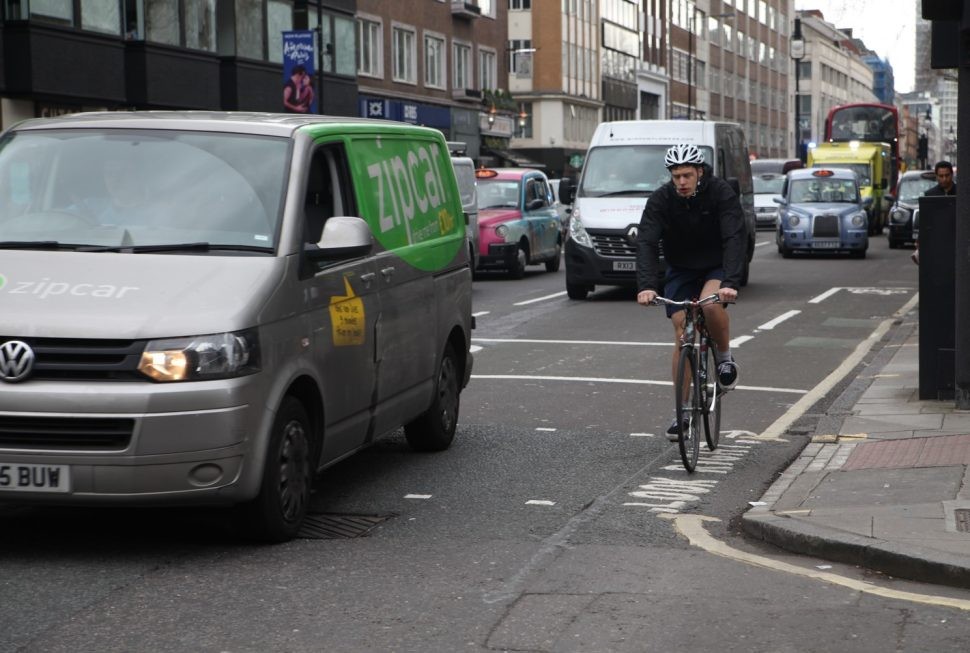
The popular belief that cars and the Tube rule the streets during rush hour in London may need a rethink. According to new data, cycling regularly outperforms both in terms of speed. Cyclists manage to beat tube journeys 92% of the time. They also beat road travel 75% of the time. This new study offers a fresh perspective on urban mobility. It challenges the traditional dominance of motorized transport in the city.
The study, conducted by Terra and Alistair Brownlee, looked at 2,168 weekday bike trips in which cyclists wore a tracking device. The findings reveal that over a range of 6km to 15km, the bike outpaces the Tube in 94% of cases and road journeys in 84% of cases. On 1,628 of these trips, cyclists saved a median of 15 minutes compared to the Tube and 5 minutes compared to driving. These results offer clear evidence that cycling is not only viable but often more efficient for daily commuting.
Cycling's Advantage Extends to Longer Trips
What adds to the intrigue is that this advantage does not simply vanish when it comes to longer journeys. For trips between 15km and 25km, cycling remains a close competitor to driving in many London routes. This suggests that, even for longer distances, cycling can rival car travel in speed. It can also rival car travel in efficiency, especially during peak traffic hours. Congestion brings road vehicles to a standstill during these times.
Sample Caveats
Brownlee acknowledges the research has limitations. The sample pool likely includes more dedicated cyclists, which may skew the results. The data also does not distinguish between regular and electric bikes, which could significantly influence travel times. While these cyclists may be more experienced or fit, their success suggests that even the average commuter could benefit from choosing two wheels over four for daily travel.
Real-World Route Comparisons
To understand how this plays out in the real world, the research team analyzed ten of the most common near-straight-line routes into London. They also looked at one route to Canary Wharf. A 15-minute time saving was recorded against TfL services on these trips. An average 8-minute lead over driving was also recorded. However, on that eastern London route, cars came out ahead. This suggests the terrain and route complexity can influence the outcome. This highlights the importance of route planning. It also highlights the importance of infrastructure in determining the effectiveness of cycling as a transport option.
While this data paints a compelling case for cycling, it is just another chapter in a growing story of transport comparisons. In the past, similar experiments have pitted e-bikes against Ubers and the Tube, with the bike prevailing once again. This latest evidence adds to a growing body of data that supports the case for cycling as a practical and efficient mode of transport in urban settings.
Historical Transport Comparisons in London
The research also brings to mind another high-profile comparison. It was conducted years ago by the motoring show Top Gear. The show famously demonstrated that cycling is the fastest form of transport in London. This was even when a speedboat was added to the mix. While the context is different, the results are strikingly similar. They point to a broader shift in how cities are rethinking mobility options.
As London and other major cities expand their network of cycle lanes and promote sustainable transport options, this data offers a compelling argument for policymakers to invest in infrastructure that supports cycling. With the potential to save time, reduce emissions, and improve public health, the case for two-wheeled commuting is stronger than ever.