
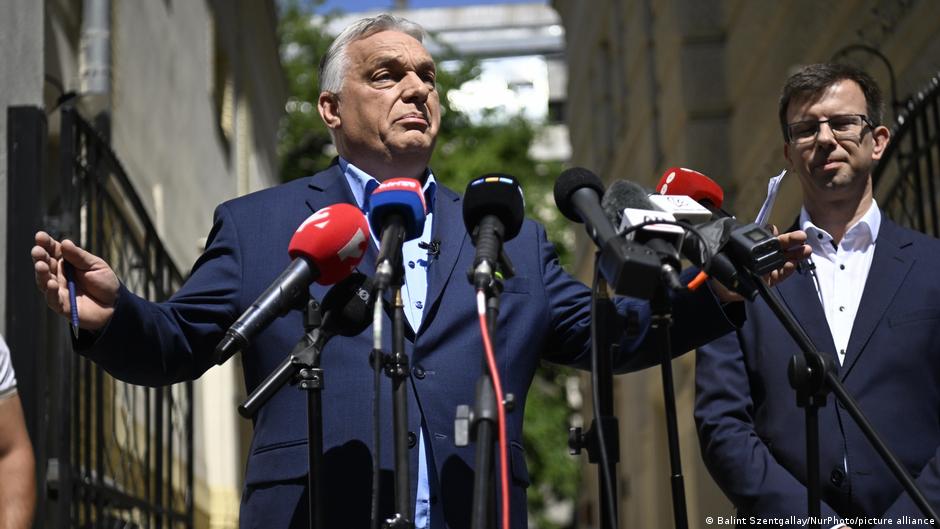
Viktor Orban, the once-dominant leader of Hungary, has sharply criticized the new government under Peter Magyar for what he calls a breakdown of legal order and an authoritarian style of governance. Orban, the former prime minister who ruled Hungary for over a decade, made his comments days after investigators conducted a search of the Fidesz party headquarters in the capital, Budapest. The operation, part of a corruption case involving a state-backed cultural fund, sparked his strongest response yet since leaving office.
A sudden shift in power
The dramatic change in political power began in April when Peter Magyar, a former ally of Orban from his Fidesz party, defeated the longtime leader in the general election. Magyar's new political party, Tisza, captured more than 55% of the vote and secured 141 of the 199 parliamentary seats, giving Magyar a supermajority despite the first-past-the-post system. Orban, who had been in power since 2010, lost the contest decisively. While the results were celebrated across much of Europe, the outcome was met with disapproval by the Trump administration.
Magyar's sweeping reforms
Since assuming office, Magyar has moved swiftly to undo what he describes as a culture of corruption that had developed under Orban's governance. Measures taken by the new administration include the removal of several high-ranking political figures and the reform of state media, particularly the national public broadcaster, M1, which many had accused of being a mouthpiece for Fidesz. Magyar also used his majority in parliament to pass a constitutional amendment ending the terms of two key Orban allies: the president and the head of the Constitutional Court.
Orban's response to the reforms
In response to these changes, Orban has accused the new government of launching a politically motivated campaign to weaken Fidesz and eliminate its influence. He denied any wrongdoing in the investigation into the National Culture Fund, which he claims is being used as a pretext to seize the party's assets. Orban believes that the new administration is acting in bad faith and that Fidesz is being singled out unfairly.
Orban has also claimed that Hungary no longer functions as a democracy under Magyar's government. He pointed to the constitutional amendment as an example of a move to remove checks and balances, calling the new political system 'illegitimate.' In a defiant tone, he pledged that he and his party would resist the changes through nonviolent means, vowing not to let Fidesz be erased from the political landscape.
The former prime minister's remarks came after a public statement posted on social media and a press conference at the Fidesz headquarters, where he outlined what he described as a coordinated effort to undermine his party. Orban claimed that the recent corruption probe was just the beginning and that the government's goal was to make Fidesz legally irrelevant.
Magyar, in contrast, has portrayed his efforts as a necessary response to a corrupt political system that Orban helped to create. He has opened up government buildings to the public to showcase what he calls the excesses and mismanagement of the Orban era. By removing certain political appointees and proposing term limits for all lawmakers, Magyar aims to reshape Hungary's political future and ensure that figures like Orban cannot hold power for extended periods.
Among the key figures removed from their roles under Magyar's leadership were President Tamas Sulyok and Constitutional Court President Peter Polt, both seen as close to Orban. Magyar has also considered naming chess star Judith Polgar for the mostly ceremonial role of president, although Polgar reportedly declined the offer. Additionally, the prosecutor general, Gabor Balint Nagy, resigned after Magyar accused him of being a puppet of Orban's.
The 12-year term limit for lawmakers, introduced by Magyar, has been particularly significant. He argues that this will prevent Orban and other Fidesz veterans from running in the next election, effectively ending their influence in Hungarian politics. While Orban sees these actions as a threat to his party's survival, Magyar insists they are essential to restoring public trust and ensuring transparency in governance.