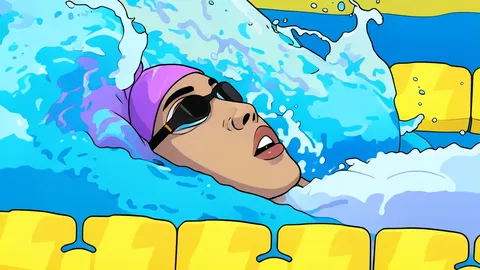
Yu Zidi Calls 200 Fly Gold 'so-So', Targets Faster Times
The 13-year-old Chinese star dismisses her Asian Games triumph, citing technical flaws and a personal idol who shaped her training.
Key points
- Yu Zidi won the 200 fly at the 2026 Asian Games with a time of 2:05.08.
- She set an Asian Record of 2:06.10 in the 200 IM, becoming the second-fastest ever.
- Yu attributes her drive to training daily with idol Li Bingjie and overcoming burnout in 2024.
The water settles into a rhythmic hum as Yu Zidi surfaces, her strokes trailing white foam in the lane. She has just clocked 2:05.08 in the 200-meter butterfly, a time that secures gold at the 2026 Asian Games and cements her status as arguably the fastest 13-year-old in the sport’s history. The crowd roars, a wall of sound that hits the pool deck with physical force, yet the teenager’s expression remains steady, focused on the water rather than the applause.
In the aftermath, the narrative shifts from victory to critique. Speaking to the South China Morning Post, Yu described the performance as merely "so-so." This assessment is not arrogance, but a precise diagnostic of her own mechanics. She identifies specific gaps in her technique, noting that her head position and leg drive have not yet reached their potential, leaving 0.9 seconds on the table for future improvement.
Technical flaws drive ambition
Yu’s self-assessment is granular and mechanical. She knows exactly where the speed leaks out. Her head comes up too late, disrupting the stream of the body. Her reach falls short of the optimal extension, shortening the effective stroke length. Her legs, the engine of the butterfly, lack the coordinated power that would unlock her true ceiling. These are not vague feelings of inadequacy; they are measurable deficits in a sport governed by fractions of a second.
This level of self-scrutiny is rare in an athlete of her age. Most swimmers at 13 are still discovering the water; Yu is already engineering it. She views her current Asian Record in the 200 IM, a 2:06.10 that places her second-fastest in the event, not as a milestone, but as a baseline. The gap between what she did and what she believes she can do is the only metric that matters to her.
Idols and daily discipline
Her drive is anchored in the presence of those who came before. While Olympic champions Ye Shiwen and Zhang Yufei serve as distant beacons for the next generation, Yu’s most profound influence is Li Bingjie. Training in the same elite camp, Yu shares the pool deck with her idol daily. This proximity transforms admiration into actionable data. When Yu struggles to interpret a drill, Li steps in, offering patient explanations and sharing the experiential knowledge of a seasoned competitor.
This dynamic creates a feedback loop of high performance. Yu trains with 200 percent effort, driven by the proximity of excellence. The daily ritual of swimming alongside a legend compresses years of learning into months. It is a rare educational opportunity, one that turns abstract technique into muscle memory through direct observation and correction.
Near the breaking point
The path to this level of precision is not without its cracks. In April 2024, leading up to the national championships, Yu teetered on the edge of quitting. The dual pressure of rigorous training and academic demands created a exhaustion that threatened to overwhelm her. The weight of expectation, the physical toll, the mental strain—it all converged into a moment where leaving felt like the only escape.
She stayed, buoyed by a network of support from coaches, teammates, and family. That decision proved pivotal. Swimming evolved from a duty into an indispensable part of her identity. As SwimSwam reported, she realized she could not live without the water. This realization transformed her relationship with the sport, turning endurance into a source of strength rather than a burden.