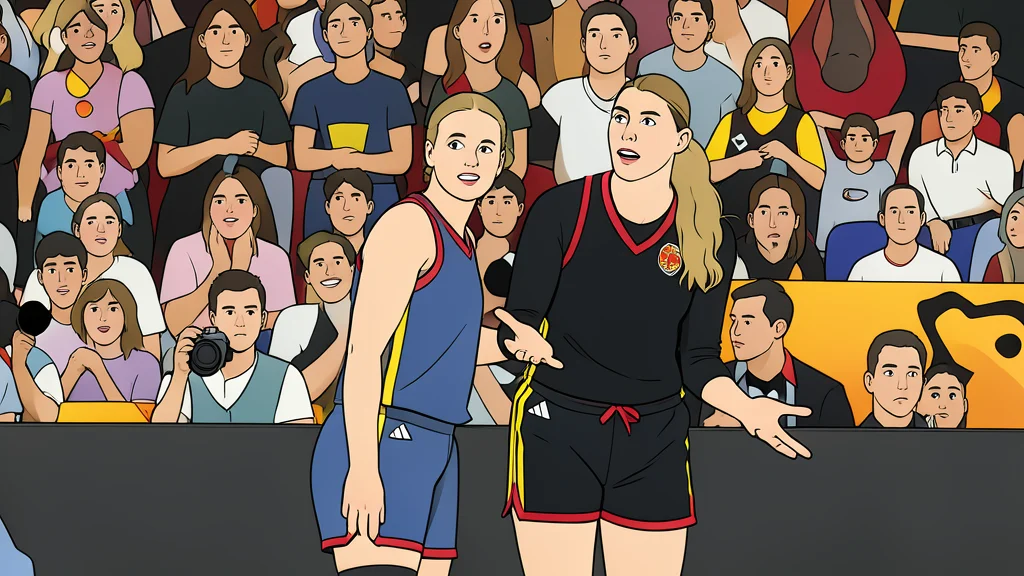
Whitlock Criticizes Clark's Solo Play After Spain Semifinal

Podcaster Jason Whitlock argues Caitlin Clark's bench role reflects a lack of trust in her decision-making, citing a quiet semifinal performance against Spain.
The hardwood gleamed under the arena lights as Team USA secured a 76-66 victory over Spain, but for Caitlin Clark, the night felt distant. She entered the game with just under four minutes left in the first quarter, only to sit out the majority of the contest. The Indiana Fever star finished with a single point, one rebound, one assist, and two turnovers, a sparse statistical footprint in a high-stakes semifinal. Her presence was a ghost in the machine, watching her teammates navigate the final stretches while she remained on the sideline.
This quiet outing ignited a firestorm of commentary, most notably from media figure Jason Whitlock. He dismissed the defense of Clark’s role as "content farm milking" and pointed to a specific first-quarter sequence where she retained possession while Angel Reese ran ahead of her. According to Whitlock, this moment encapsulates a deeper issue: a lack of trust in Clark’s decision-making when surrounded by elite talent. As reported by Yahoo Sports, the criticism hinges on the belief that she has not yet mastered the art of playing with other great players, a skill gap Whitlock claims hampers her on the international stage.
Bench Role Raises Questions
Coach Kara Lawson’s strategy kept Clark in a supporting role, relying heavily on Chelsea Gray and Jackie Young to direct the offense. Gray and Young recorded nine and ten assists respectively before the semifinal, establishing themselves as the primary architects of Team USA’s attack. Clark, despite leading the team with 28 assists throughout the tournament, was not tasked with controlling every possession. This division of labor suggests a deliberate tactical choice rather than a punitive measure, yet it fueled Whitlock’s narrative that Clark is viewed as a "solo act" who struggles to integrate into a collective system.
The critique extends beyond the immediate game. Whitlock argues that Clark’s time at Iowa, where she often operated as the undisputed focal point, left her ill-equipped for the collaborative demands of the WNBA and international basketball. Her decision-making, he contends, must improve to elevate her from a star to an all-time great. This perspective contrasts with the reality of her playmaking, where she continues to facilitate for teammates like Breanna Stewart and Paige Bueckers, who share creation duties in the second unit.
Decision Making Under Scrutiny
Clark’s statistical profile offers a mixed bag that Whitlock uses to bolster his argument. While she averages 8.5 assists per game in the WNBA, her turnover rate of 5.1 per outing is a recurring vulnerability. In the semifinal against Spain, her two turnovers stood out against a backdrop of limited offensive production. The podcaster suggests that these errors are not isolated incidents but symptoms of a broader inability to process the game at the highest level when pressure mounts and options proliferate.
However, the coach’s rotation choices complicate the narrative of distrust. By deploying multiple ballhandlers and playmakers, Lawson ensured that the offense remained fluid and unpredictable. Clark’s role was to provide spacing, finishing, and selective creation rather than constant initiation. This nuanced approach allows the team to leverage its depth, a strategic advantage that Whitlock’s binary critique of "trust" versus "solo act" may overlook. The effectiveness of this system will be tested in the upcoming final against France.
Final Chance for Redemption
Sunday brings the championship game against France, a stage where every possession carries weight. For Clark, this is an opportunity to silence the critics and demonstrate her ability to thrive in a collective framework. A strong performance would serve as a tangible rebuttal to Whitlock’s assertions, proving that her decision-making can adapt and elevate in high-pressure environments. The hardwood awaits, and the spotlight will be fixed on her every move.
As the dust settles on the semifinal, the debate over Clark’s legacy continues to unfold. Whether she is seen as a player still finding her rhythm or a star constrained by her own limitations, the narrative is shaped by these moments of tension and triumph. The outcome of the final will not only determine the gold medal but also influence how her journey is interpreted in the annals of basketball history.