Louis Knocks Out Pastor in 11th Round at Briggs Stadium
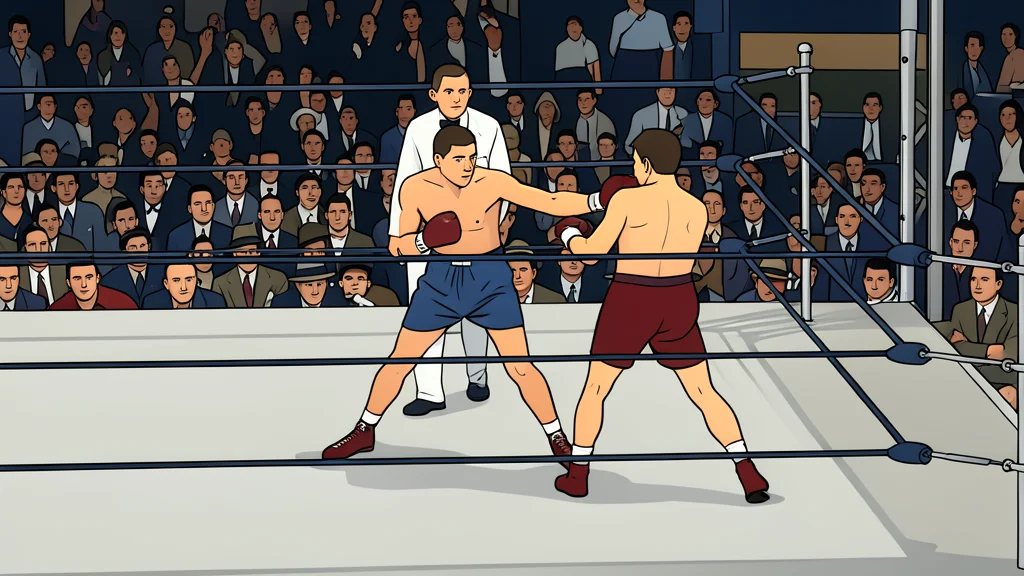
Joe Louis ended a two-year rivalry by dismantling Bob Pastor's escape tactics in a decisive 11th-round knockout.
Key points
- Joe Louis knocked out Bob Pastor in the 11th round on September 20, 1939, at Briggs Stadium in Detroit.
- Louis defeated Pastor's escape tactics by using diagonal steps to cut off his retreat and methodically attacking his legs.
- Pastor, a 10-to-1 underdog in their first fight, had survived by circling, but his planted combinations in the eighth round made him a stationary target.
The air in Briggs Stadium hung thick with the dust of 33,868 bodies on a September night in 1939. Joe Louis moved across the canvas with the precision of a mechanic, closing the gap that Bob Pastor had successfully widened two years prior. This was not a chase; it was an interception. The champion used short, diagonal steps to cut off the challenger’s retreat, waiting for Pastor to arrive into range rather than following him around the ring. The physicality of the moment was raw and immediate, a contest of geometry and weight where the heavier man dictated the space.
Pastor had survived their first meeting in 1937 by refusing to stay in range, a tactic that had turned a heavyweight bout into a footrace. Louis had resented that decision, viewing the unanimous verdict as a moral victory for the runner. Now, with both men at 25 and Louis holding a 17-pound advantage, the champion dismantled the old strategy. He did not seek a wild, reckless knockout early on. Instead, he lowered his output, recovered his breath, and methodically attacked the legs, turning the fight into a grind that Pastor’s stamina could not sustain.
Champion Dictates the Ring Geometry
Pastor’s camp had requested a 20-round fight, a miscalculation that exposed their belief in a marathon. Louis attacked from the opening bell as if the distance were irrelevant. In the first two rounds, he produced five knockdowns, a display of early destruction that tested his own endurance. By rounds three through six, the champion’s output dropped slightly, not from fatigue but from calculation. He realized that forcing a stoppage too quickly left him vulnerable to Pastor’s resilience. The strategy shifted to efficiency. Body punches in close exchanges reduced the challenger’s lateral bounce, neutralizing the movement that had previously kept Louis at bay.
Trainer Jack Blackburn turned Pastor’s preparation against him. The challenger had trained specifically to evade the left hook, a habit that became his undoing. Louis used the left as a visual distraction, occupying Pastor’s vision with throwaway jabs. As Pastor slipped outside the expected hook, his head drifted into the path of the right hand. The adjustment was subtle but devastating. Louis was no longer chasing; he was waiting. The ring became a trap where every escape route was monitored and blocked by the champion’s reach and positioning.
The Cost of Planting Feet
In the eighth round, Pastor found his footing. He planted his feet, backed Louis toward the ropes, and connected with sharp jabs and short combinations. For a brief moment, the challenger’s offense exposed a flaw in the champion’s defense. Louis held a high guard but offered limited upper-body movement, allowing Pastor to reach him before he regained his punching position. It was the most active Pastor had been all night, a surge of confidence built on the temporary success of his aggression.
But that success carried a hidden price. To back Louis up, Pastor had to abandon the movement that had protected him. Every planted combination turned him into a stationary target. Louis remained calm, absorbing the surge without trying to silence Pastor with a single wild counter. He continued the methodical work, attacking the body and measuring the distance. The challenger’s aggression had stripped away his own safety, leaving him exposed to the very power he had sought to evade. The balance of the fight tipped back to the champion as Pastor’s legs began to tire under the sustained pressure.
Final Round Ends the Rivalry
A short right badly staggered Pastor in the tenth round, a prelude to the end. By this point, the left hand had become a range finder and a visual distraction. Pastor was still reacting to the hook, while Louis was measuring him for the right. Back in the corner after the tenth, the champion told Blackburn that the next round would be the last. The statement was not a boast; it was a prediction based on the physical state of his opponent. The challenger’s body had been broken down round by round, his energy rationed too thinly to last the distance.
Pastor opened the 11th by jabbing and attempting to circle left along his familiar escape route. Louis extended the left to obstruct his view and close the lane. Pastor moved to evade the punch he expected, and the right hand came over the top. He never saw it. The impact was absolute. Pastor crashed to the canvas and remained there for referee Sam Hennessey’s count. The fight was over, the old score settled, and the champion’s dominance reaffirmed in front of the Detroit crowd. As reported by Boxing News 24, the knockout was the definitive end to a rivalry that had spanned two years and two distinct strategies. The physicality of the moment closed with a silence that replaced the earlier tension, the finality of the count marking the end of the challenger’s hope.