Caley’s Blueprint for the Texans’ Week 2 Battle
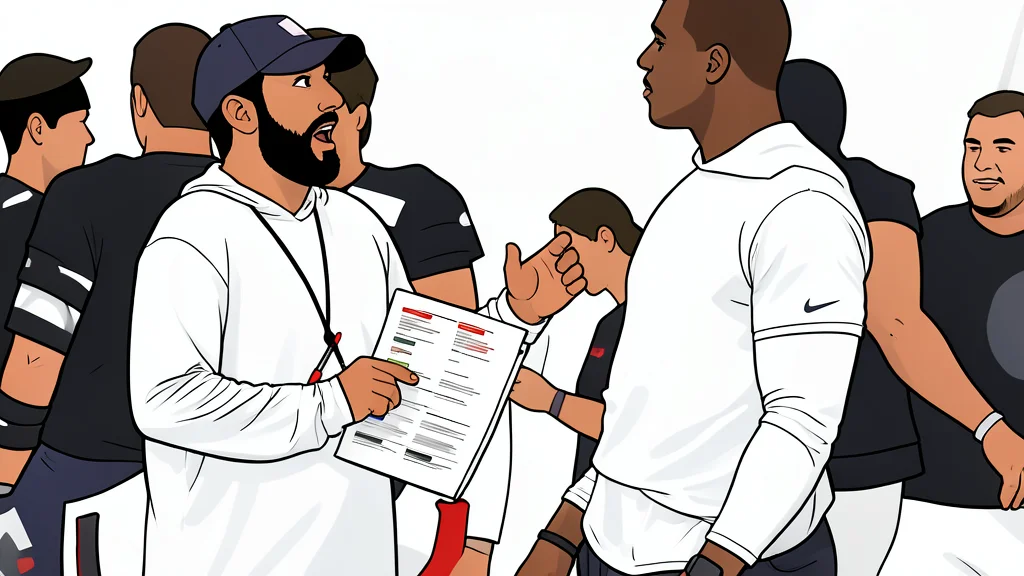
The air in the facility is thick with focus as Houston prepares for Cincinnati. Caley outlines a strategy built on trust and precision.
The weight room clangs, a rhythmic percussion that underscores the quiet intensity of the locker room. Houston Texans offensive coordinator Nick Caley stands near the whiteboard, his gaze steady. The upcoming clash with the Cincinnati Bengals is not merely a schedule item; it is a test of depth, discipline, and the mental fortitude required to sustain an offensive rhythm. The air smells of chalk and sweat, a sensory reminder of the physical labor that precedes every snap. Caley’s words cut through the background noise, sharp and deliberate, offering a window into the mind behind the play-calling.
According to Yahoo Sports, the coordinator’s primary message is one of collective responsibility. There is no single point of failure, no lone scapegoat for the fumbles that plagued the previous week. Instead, the focus shifts to a unified front, where every player shares the burden of ball security. The narrative moves away from individual blame and toward a shared mission. It is a stark, physical reality: the ball is a fragile object in the hands of giants, and its safety requires synchronized effort from the entire unit.
Trust in the Wide Receiver Room
The question of Nico Collins’ availability hovers over the offense like a low cloud, yet Caley dismisses the anxiety with a grounded confidence. He points to the depth chart not as a list of names, but as a network of trusted relationships. C.J. Stroud’s arm is described as a distributor of opportunity, finding the open lane regardless of who occupies it. The wide receiver corps is portrayed as a cohesive entity, where experience and instinct guide the ball to its destination. It is a system that breathes, adapting to the presence or absence of star talent without losing its pulse.
Kayshon Boutte emerges in this discussion as a pillar of stability. Caley describes him with a tone of quiet admiration, highlighting a player who operates with a professional’s precision. Boutte’s catch point is sharp, his routes run with a geometric exactness that cuts through defensive schemes. He is the steady hand in a storm of variables, a player who embodies the grind of the game. His presence on the field is a testament to the team’s commitment to consistency, a counterbalance to the flashier elements of the offense.
Rhythm and Collective Ball Security
Reflecting on the final drive of the previous week, Caley rejects the notion that the offense lost its footing. He recalls the moment with a sense of internal clarity, asserting that the rhythm was intact. The decision to continue the passing attack was not a mistake of judgment but a commitment to the flow of the game. This perspective shifts the narrative from error to execution, a subtle but crucial distinction in a high-pressure environment. The offense was moving, and the plan was to keep it moving, trusting the process over the panic.
The fumble, however, remains a raw nerve. Caley addresses it with a blunt refusal to assign individual guilt. He describes ball security as a communal duty, a shared responsibility that spans the entire unit. From the quarterback’s pocket presence to the wide receivers’ route precision, every action contributes to the safety of the football. This is not a platitude; it is a tactical reality. The team has drilled this concept since the offseason, reinforcing the idea that the ball’s journey is protected by the collective effort of every player on the field.
Dependable Ground Game and Grouping Fluidity
On the ground, the narrative shifts to the unglamorous but vital work of the running backs. Woody Marks is highlighted for his selflessness, a player who finds himself in the right place at the right time, not just for the carry, but for the block. His progress is noted as a steady climb, a reflection of a player who understands the broader impact of his role. David Montgomery’s performance is similarly framed, emphasizing the tough yards that build the foundation of a successful drive. These are the players who clear the path, allowing the offense to breathe and expand.
Caley also offers a glimpse into the strategic flexibility of the lineup. The groupings are not static; they shift and change based on the flow of the game. Players like Boutte and Jaylin Noel are moved between positions, their identities fluid as they transition from Z to F to X. This adaptability is a key component of the offensive philosophy, designed to keep defenses guessing and off-balance. The unit is a mosaic, with each piece capable of fitting into a different slot, creating a puzzle that is difficult to solve.
The overall assessment is one of cautious optimism. While the offense is far from its ideal state, the foundation is solid. Communication on the sideline and at the line of scrimmage is praised as a strength, a sign of a team that is connecting on a deeper level. The penalties and false starts are acknowledged as areas for improvement, but they are viewed as part of the process, not the product. Caley’s tone is one of a coach who is pleased with the progress but driven by the promise of what is yet to come. The battle with the Bengals is the next step in this ongoing construction, a test of the principles that have been laid down in the quiet hours of preparation.