Chargers Stumble in Season Opener Despite New Scheme
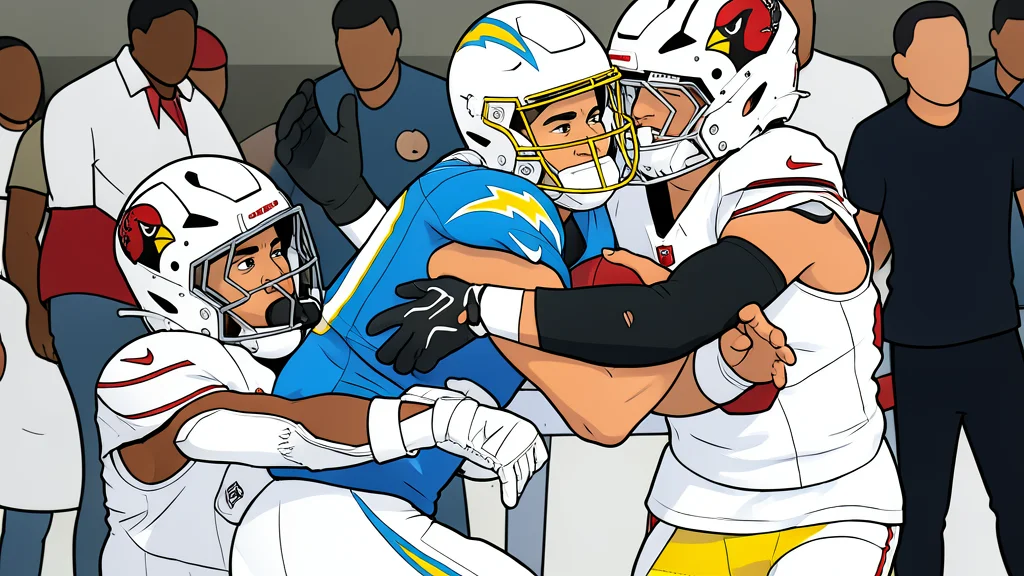
The Los Angeles Chargers' new-look offense sputtered in a 28-16 loss to the Arizona Cardinals, plagued by turnovers and a missing key target.
Inglewood, Calif. — The green turf at SoFi Stadium felt heavy under the boots of the Los Angeles Chargers as their season-opening drive stalled. What began as a promising 77-yard surge that ended in a touchdown for Omarion Hampton quickly dissolved into a series of mechanical failures. The Arizona Cardinals, a team that had lost nine straight games last season, did not just hold their ground; they dismantled the rhythm of the new offense with surgical precision. By the time the fourth quarter arrived, the air in the stadium had turned thick with frustration, the Chargers’ new coordinator Mike McDaniel watching from the sideline as his unit fumbled the ball, threw interceptions, and ran out of time.
It was a day of sharp contrasts and brutal realities. Justin Herbert, the franchise quarterback, found himself isolated in the pocket, facing a defense that seemed to anticipate every motion. The offense, rebuilt in the offseason to fix longstanding deficiencies, instead produced a cascade of errors. Head coach Jim Harbaugh stood near the sideline, his face a mask of stoic disappointment, acknowledging that the team had been sloppy. The Cardinals, led by rookie Jeremiyah Love’s early touchdown run, capitalized on every mistake, turning the Chargers’ miscues into points and ultimately securing a 28-16 victory.
Early Promise Fades Quickly
The first possession of the game offered a glimpse of what the new scheme could achieve. The ball moved downfield with purpose, the linemen finding their gaps, and Hampton breaking through for an eight-yard score. For a moment, the narrative of improvement felt tangible. But that single bright spot was immediately dimmed by the Cardinals’ response. Love, the rookie, carved through the Chargers’ defense for a five-yard touchdown, tying the game at seven. The momentum shifted, and the Chargers’ offense, which had looked fluid in the opening minutes, began to show cracks. Nine more possessions followed, yet only one additional touchdown resulted. The efficiency that had been promised in the offseason press conferences was nowhere to be found.
Ladd McConkey, Herbert’s favorite target, provided a brief burst of brilliance midway through the third quarter with an eight-yard reception. It was a highlight that offered a momentary reprieve, a sign that the connection between quarterback and receiver was still intact. But that moment was short-lived. Six minutes later, McConkey left the field with a chest injury, never to return. His absence was felt immediately. Without his reliable hands, Herbert was left scrambling for options, the offensive rhythm breaking down as the game entered its final stretch. McConkey’s five receptions for 82 yards were the only silver lining in a day of gray skies for the Chargers.
Turnovers Define the Narrative
The fourth quarter became a graveyard for the Chargers’ hopes. A blocked punt ended one drive, a fumble ended another, and an interception sealed the fate of the game. The offense, which had struggled to gain yards all day, found itself in a death spiral of mistakes. Herbert, who was sacked a career-high 54 times last season, faced three more sacks on Sunday. The pressure was relentless, the pocket collapsing before he could even set his feet. The Cardinals’ defense, led by a disciplined line, kept the ball in the air, creating turnovers that the Chargers simply could not recover from. The new offense, designed to be dynamic and explosive, instead looked disjointed and vulnerable.
The red zone became a place of failure. The Chargers crossed the Cardinals’ 20-yard line only three times, scoring on two but coming away empty on the third. In that third instance, Herbert was sacked for a 10-yard loss on fourth down, a moment that encapsulated the day’s struggles. The Cardinals, sensing the weakness, capitalized on the mistake, driving 61 yards on eight plays to set up a 44-yard field goal. Chad Ryland’s kick gave Arizona a 13-7 halftime lead, a cushion they would never relinquish. The Chargers’ inability to convert in the red zone was a stark reminder that the new offense still has a long way to go.
Coaches Acknowledge the Gaps
Jim Harbaugh, speaking to the media after the loss, did not shy away from the criticism. He credited the Cardinals for making the Chargers look bad, but he was clear that the mistakes were uncharacteristic and unacceptable. "I would call it sloppy at times. Too sloppy. That's something we need to get fixed," he said. The head coach emphasized the need for accountability, a theme that resonated throughout the team’s post-game comments. Herbert, for his part, pointed to the lack of execution as the primary issue. "We just have to execute," he said, his voice tinged with frustration. "It's on us as an offense not to have penalties. We got to score points in the red zone."
The loss to the Cardinals serves as a harsh lesson for the Chargers as they enter the season. The new offensive scheme, while promising on paper, has yet to translate into consistent production on the field. The team’s struggles in the red zone, their inability to protect the ball, and their lack of consistency in the passing game are all areas that need immediate attention. As reported by Yahoo Sports, the Chargers’ offense took a step backward in their season opener, and the road to recovery will require not just talent, but discipline and focus. The next game is already on the horizon, and the Chargers must find a way to turn their mistakes into momentum, or risk falling further behind.