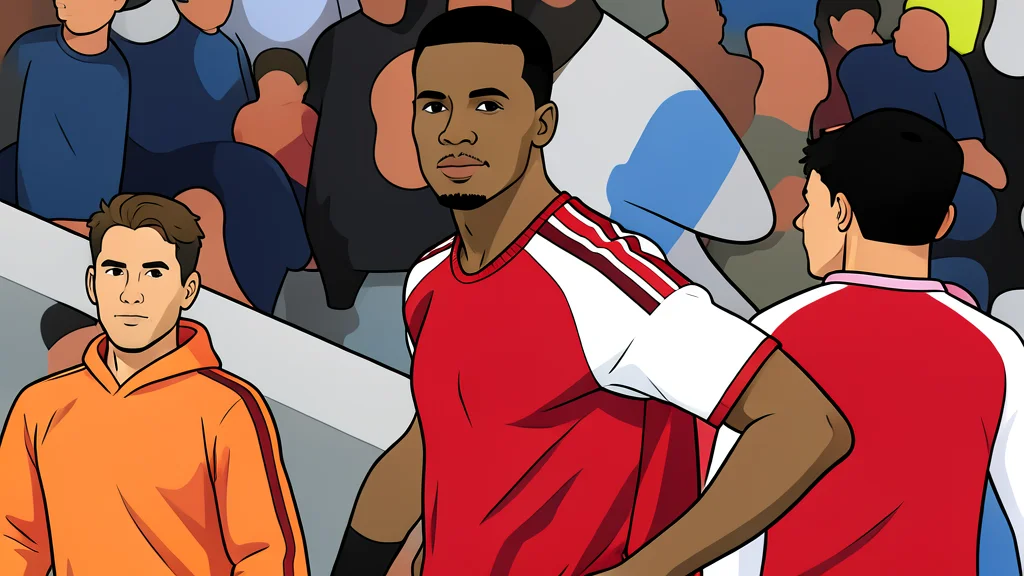
Gerrard Warns Gabriel Against Rushing His Career

The 15-year-old striker’s request to leave Manchester United has sparked a fierce defense from Steven Gerrard, who argues the teenager is being pressured by outside forces rather than guided by football logic.
The silence of the training ground feels heavy now that the 15-year-old striker has asked to walk away. JJ Gabriel, a name that already echoes with promise, has requested his release from Manchester United, citing dissatisfaction with his current standing. It is a quiet rebellion, but one that has rippled through the football world, catching the attention of Steven Gerrard. The Liverpool icon does not see a player seeking greener pastures; he sees a child being pushed into a storm before the rain has even begun to fall.
Gerrard’s warning cuts through the noise of transfer speculation. He argues that the modern game is too quick to rush young talents, forcing careers forward before the foundations are set. For Gabriel, whose senior debut was limited to a brief cameo against Atletico Madrid during pre-season, the frustration is palpable. Yet, Gerrard insists that the move away, particularly to a high-pressure environment like Real Madrid, could be a mistake. The grass is not necessarily greener; it is often just drier, and harder to run on.
Pressure builds in the dressing room
The decision to omit Gabriel from the Champions League A-list in favor of the injured Manuel Ugarte appears to have been the final crack in the dam. Michael Carrick, the English manager, chose a path that prioritized immediate tactical stability over long-term development in the eyes of the teenager and his family. This exclusion, reported by Yahoo Sports, highlights a disconnect between the club’s internal calculus and the player’s desire for relevance. For a young striker, the bench is not just a seat; it is a statement.
Outside influences distort the path
Gerrard points a finger not at the player, but at the entourage. Agents, parents, and outside voices create a cacophony that drowns out the quieter, more prudent advice of club staff. "These talents, they have parents, they have agents, outside influences that force and rush too soon," Gerrard noted. The pressure to perform, to sign, to move, creates a bubble that isolates the teenager from the reality of professional football. It is a trap set by ambition, often mistaken for opportunity.
The comparison to Jose Mourinho at Real Madrid serves as a stark reminder of elite management styles. Gerrard questions whether a young player would be immediately integrated into such a demanding environment. Elite managers play kids when they are ready to contribute, not when they are loud enough to demand it. The risk is not just physical but psychological; the weight of expectation can crush a career before it truly begins. United, with its history of nurturing talent, offers a different kind of protection.
The fragile bridge to return
Even if the situation is salvaged, the rapport between player and management is fractured. The awkwardness of a return to Carrington is inevitable, a tension that does not dissipate with a handshake. Carrick now faces the added pressure of fielding a striker who has publicly expressed his dissatisfaction. It is a dynamic that feels almost irreversible, a knot that time may not untangle.
Gabriel holds all the cards, with the ability to walk away at the end of the season or earlier if he utilizes specific passport regulations. But with power comes peril. The choice to leave is not just a contractual decision; it is a bet on his own resilience. Gerrard’s fear is not for the club, but for the kid. In a game that often moves faster than life, the slowest path is sometimes the only one that leads to the top.