Kai Havertz: The Geometric Puzzle of Arsenal's Floating Forward
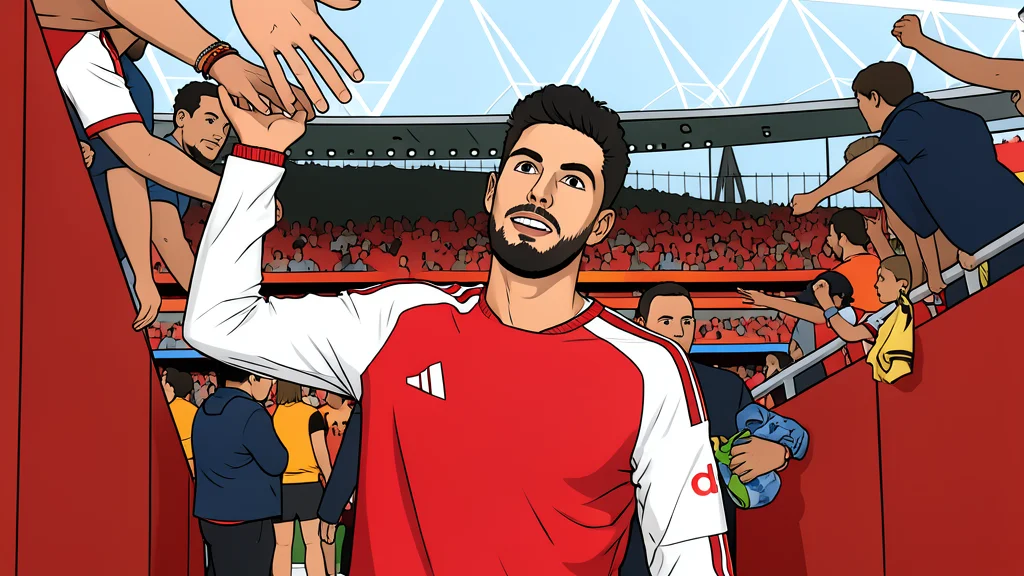
In the silence before the whistle, Kai Havertz maps the geometry of the pitch. His position shifts not just with the ball, but with the foot of the goalkeeper who holds it.
The grass is slick with morning dew, the white lines sharp against the green. Kai Havertz stands just left of center, his weight balanced on the balls of his feet. He is not chasing a player; he is watching a hand. The goalkeeper’s right foot is tucked under his body, a subtle tell that dictates Havertz’s next move. This is the invisible architecture of Arsenal’s attack, a system where intelligence outweighs speed. Mikel Arteta calls him the glue, but in these moments, he is the lock and the key. His role is not fixed; it is fluid, reacting to the microscopic cues of the opposition’s defensive structure. The air hums with anticipation, a held breath in a stadium that knows every shift of his weight matters.
For two seasons, injury kept Havertz on the sidelines, his body broken by hamstring tears and knee troubles. Now, he has returned not just to play, but to orchestrate. In the early weeks of this campaign, he has become the central pivot of a team that demands more than just goals. It is a reminder of why Arteta values him so highly. He creates space for Bukayo Saka, Martin Odegaard, and Ben White to breathe. His presence pulls defenders out of their positions, opening lanes that did not exist a moment before. The chaos of the modern game finds order in his movement, a calm center in the storm.
Reading the Goalkeeper’s Foot
Arteta speaks of Havertz’s intelligence as his greatest asset. It is not just about where he is when the ball is in play, but where he is when it is not. The manager points to the nuances of set pieces, transitions, and the specific threat of a goalkeeper’s kicking ability. If the keeper is right-footed, Havertz shifts his shadow to block the natural passing lane to the right. It is a calculated denial of options, forcing the opposition into long, risky balls rather than controlled distribution. This is a game of chess played in real-time, where every move is a response to a previous one. The detail is so fine-grained that only the most attentive eyes can see the pattern.
The Athletic’s analysis of recent matches reveals the depth of this strategy. Against Manchester City, Havertz stood as a wall, his body angled to cut off Gianluigi Donnarumma’s preferred route. With Odegaard and Noni Madueke pressing high, the Italian goalkeeper was left with no short options. He was forced to kick with a closed body, lacking the open stance needed for a precise pass. This pattern repeated itself, time and again, allowing Arsenal to control the tempo even without possession. The result was a 3-0 victory, a testament to the power of positioning and pressing intensity. Havertz’s role was not just defensive; it was strategic, shaping the entire flow of the game.
Dynamic Shifts Against Chelsea
The match against Chelsea offered a different puzzle. Emiliano Martinez, also right-footed, presented a similar challenge, but the surrounding dynamics were more complex. Havertz cut off the pass to the right, forcing Gabriel to push up and mark Cole Palmer. Palmer had dropped deep to occupy the space Havertz left, a tactical trap that Havertz saw and exploited. Myles Lewis-Skelly monitored Romeo Lavia, the deepest midfielder, while Havertz forced Martinez into long balls. Arsenal won the aerial duel, the ball falling into the hands of a teammate. The coordination was seamless, a dance of movement and counter-movement.
Later in the half, the roles shifted again. Havertz took on Lavia directly, while Lewis-Skelly dropped deeper. Christos Tzolis and Saka squeezed in narrow, leaving no gaps for Chelsea to exploit. Martinez attempted to go over the top, but Arsenal made first contact, the ball bouncing back into their control. Havertz returned to his station, ready for the next phase. This flexibility is rare. It requires a player who can read the game at a level that transcends individual skill. It is a testament to the evolution of modern football, where the space between players is as important as the players themselves.
The Irreplaceable Floater
Havertz’s role as a floater is close to irreplaceable. He is not tied to a specific zone; he is tied to the needs of the team. Whether he is pressing high, holding his position, or dropping deep, his presence changes the geometry of the pitch. Opponents struggle to mark him because he is always moving, always reacting. His intelligence is his weapon, a quiet power that disrupts the rhythm of the game. As the season progresses, his impact will only grow. He is the thread that connects the defense to the attack, the bridge that allows Arsenal to flow. In a sport dominated by speed and strength, Havertz offers something rarer: clarity.