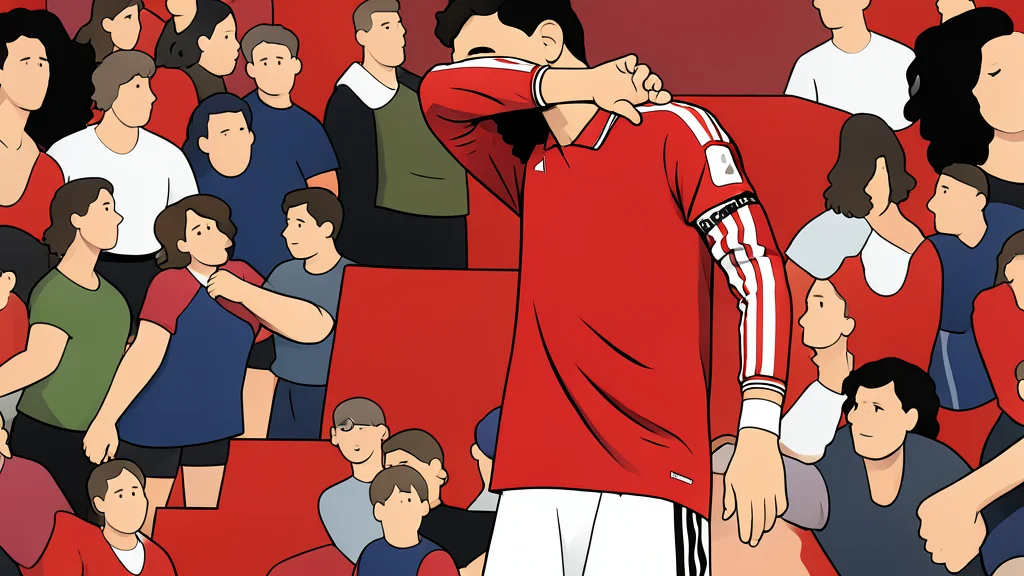
Koke Joins Immortal Company of One-Club Legends

A bench appearance in a sun-drenched stadium etches a new line into football history, linking a modern Spanish midfielder with a British icon of the 1950s.
The stadium air hums with the residual heat of a Sunday afternoon, the green pitch stretched taut under the Spanish sun. In the stands, the noise is a low, steady roar, a physical weight pressing against the glass. On the field, the game has ended, the final whistle cutting through the air like a sharp blade. But for one player, the match is just a vessel for something much larger, a quiet moment where history bends to accommodate the present.
Koke, the Atletico Madrid midfielder, steps away from the fray. He is not the star of the day in the traditional sense, yet his presence carries the gravity of stone. This was his 746th appearance for the club, a number that has not shifted in decades. It is a figure that belongs to a different era, a time when loyalty was measured in years and not seasons. By reaching this milestone, he has erased a record that stood as a monument to Bobby Charlton, the man who defined elegance and resilience for Manchester United.
Echoes of a Bygone Era
Charlton’s path to this number was paved with tragedy and triumph. He joined Manchester United as a schoolboy, a raw talent in 1953 who would become the spine of a dynasty. His career was not just a collection of stats; it was a narrative of survival. He was part of the Busby Babes, a group of young men who won three consecutive FA Youth Cups before the world stopped on February 6, 1958. The Munich air disaster took his teammates, but it did not take his spirit. He returned to the pitch 23 days later, his body healed, his will unbroken.
For 17 years, he danced between defenders, his shooting explosive, his vision clear. He formed a trio with Denis Law and George Best, a lethal combination that swept the Ballon d’Or in successive years. Charlton’s 746 appearances were not just games played; they were statements of intent. He never received a red card, a testament to a style that was as much about grace as it was about power. His record, set at the end of the 1972-73 season, became a benchmark for devotion, a measure of how deep one’s roots could grow in a single soil.
A Modern Standard of Loyalty
Koke’s achievement places him in a rarefied air, a group of players who have dedicated their entire professional lives to a single badge. As reported by Yahoo Sports, he now stands alongside giants like Paolo Maldini, Javier Zanetti, and Ryan Giggs. These are names that resonate with a specific kind of fidelity, a refusal to let go, to move on, to seek new pastures. In an era of fluidity and constant movement, their careers are anchors, holding the sport’s history in place.
The 34-year-old’s journey to this point has been defined by consistency. He came off the bench for the win against Real Sociedad, a moment that might seem small in the grand scheme of a 3-0 victory. But in the ledger of football, it is significant. It is the final piece of a puzzle that took a decade to complete. He is not just a player; he is a symbol of a club’s identity, a thread that connects the present to the past, the local to the global.
The Weight of Seven Names
To be among the seven players with the most appearances for a single club is to carry a heavy crown. It is a title that cannot be bought, only earned through repetition, through sacrifice, through the daily grind of training and competition. Koke’s name is now written in the same breath as Totti, Akinfeev, and Bergomi. They are the architects of their clubs’ legacies, the ones who stayed when others left, who built the foundations upon which the modern game stands.
As the lights dim and the stadium empties, the significance of the number 746 lingers. It is a testament to the human capacity for commitment, for love of a cause that transcends the self. Koke has joined a pantheon of legends, not through a single moment of brilliance, but through a lifetime of quiet dedication. The record is no longer Charlton’s alone; it is a shared heritage, a bridge between two eras, two continents, and two men who understood that the game is about more than just winning.