Seoul and Vienna: Two Nations Secure Davis Cup Finals Berths
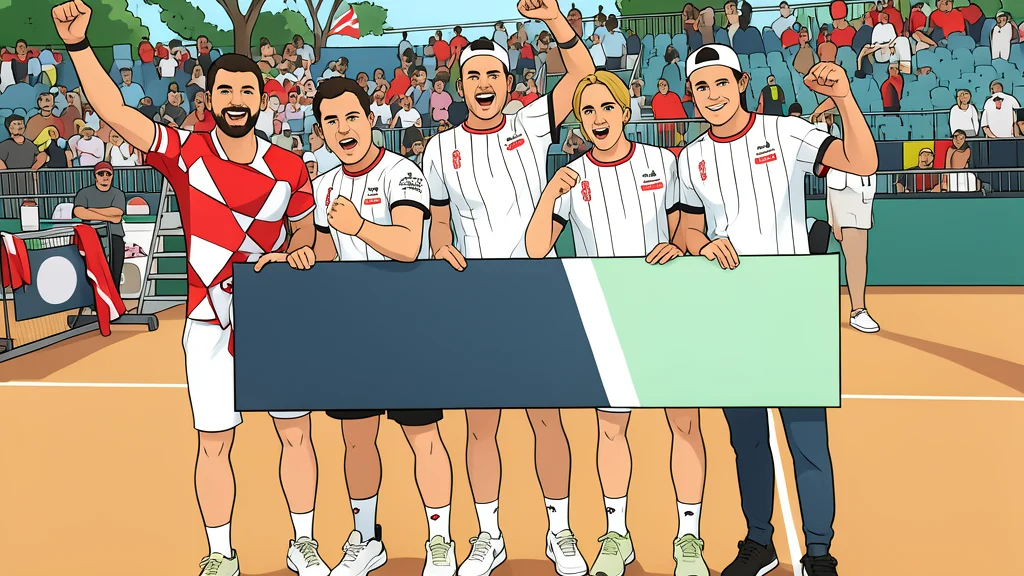
Red clay dust hangs in the air as Kwon Soon-woo serves, the ball slicing low and fast. In Seoul, the roar is deafening. In Vienna, the tension is a physical weight. Two tickets to Bologna are claimed, and the Davis Cup field narrows.
The red clay of Seoul’s court glows under the lights, a vivid canvas for a historic breakthrough. South Korea has punched its ticket to the Davis Cup quarter-finals for the first time in its history. The final point landed with the thud of a hammer on an anvil, silence breaking into a wave of sound that shook the stands. It is a moment that rewrites the nation’s tennis ledger, a door kicked open after years of knocking.
Across the continent, Vienna hums with a different energy. Austria has seized the other seat in the eight-team finals, securing a 3-1 victory over Belgium. The air in the Austrian capital is thick with anticipation, the scent of fresh paint and damp grass mingling with the smell of victory. Both teams now join the elite, preparing for the November showdown in Bologna where Italy defends its throne.
Kwon’s Power Breaks the Stalemate
Kwon Soon-woo did not merely play; he dismantled. Facing Sumit Nagal, the Korean star moved with predatory grace, his strokes crisp and decisive. The scoreline of 6-1, 6-2 speaks to a dominance that felt almost effortless. There was no hesitation, no doubt, only a relentless forward momentum that left India’s best player struggling to find his rhythm.
The path was not smooth, however. India claimed the doubles rubber, a reminder that the battle was hard-fought. But Kwon’s performance in the decisive singles was the defining stroke, a clean cut that separated the victors from the defeated. The Korean team had won both singles rubbers on Friday, building a foundation that Kwon now fortified with concrete.
Vienna’s Dramatic Tie-Break Victory
In Vienna, the drama unfolded in increments. Jurij Rodionov started the charge, taking the opening singles to put Austria ahead. But Belgium’s Zizou Bergs, stepping in for the absent Alexander Blockx, answered with a forceful return. The tie hung in the balance, a knife-edge standoff that demanded precision and nerve.
The doubles pair of Lucas Miedler and Neil Oberleitner provided the spark, sweeping Sander Gille and Joran Vliegen in straight sets to reclaim the lead. The atmosphere shifted, the crowd’s energy turning from anxious to electric. The final rubber was a test of will, but Rodionov’s 7-6, 6-3 win over Bergs was the final, decisive blow.
Zverev’s Return Amidst Global Ties
While the qualifiers settled, the broader Davis Cup landscape churned with high-stakes drama. In Halle, Alexander Zverev, fresh from his US Open triumph, made a swift return. He brushed aside Matej Dodig, his serve a weapon of precision, giving Germany a 1-0 lead over Croatia. The German team, dormant since their 1993 triumph, shows flickers of old fire.
In Prague, the United States and the Czech Republic engaged in a gritty duel. Christian Harrison and Austin Krajicek saved four match points, their resilience shining through a 5-7, 6-3, 7-6 thriller. Ben Shelton, the US Open runner-up, now faces a critical task to seal the tie. Meanwhile, in London, Toby Samuel opened the scoring for Britain against Ecuador. The global stage is alive, every court a battlefield for legacy and glory, as reported by Yahoo Sports.