Korea, US, and Japan Issue Joint Statement on China and Taiwan
Three nations issued a unified statement on security and economic resilience just days before the Trump-Xi summit.
Key points
- South Korea, the U.S., and Japan issued a joint statement on security and economic stability before the Trump-Xi summit.
- The nations agreed to strengthen supply chain early warning systems and oppose economic coercion and non-market policies.
- The meeting reaffirmed U.S. extended deterrence for allies and condemned North Korea's nuclear and missile advancements.
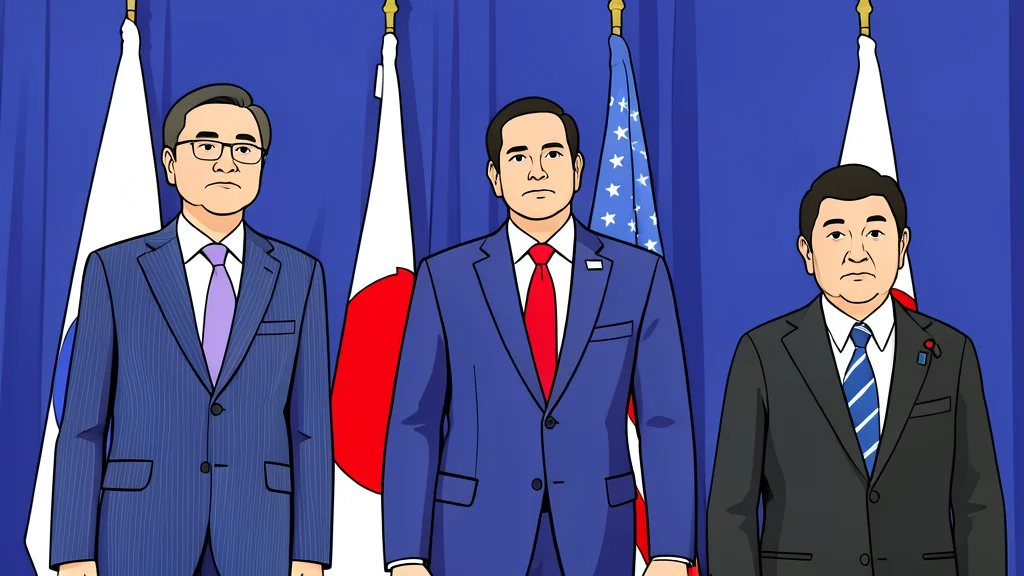
Foreign ministers from South Korea, the United States, and Japan convened in New York to issue a joint statement addressing regional security and economic stability. The meeting took place on the sidelines of the United Nations General Assembly, occurring just three days before a scheduled summit between U.S. President Donald Trump and Chinese President Xi Jinping.
According to reports from chosun.com, the trilateral dialogue aimed to reaffirm collective commitments to peace in the Taiwan Strait and the complete denuclearization of North Korea. The coordinated message was interpreted as a strategic move to solidify allied positions ahead of high-level bilateral talks between Washington and Beijing.
Reaffirming Security Commitments in the Region
U.S. Secretary of State Marco Rubio emphasized the extended deterrence commitment that the United States holds for the defense of South Korea and Japan. This pledge is grounded in the overwhelming military and nuclear capabilities of the United States. The three nations also condemned North Korea for advancing nuclear and ballistic missile programs in violation of international sanctions, while noting that the door to dialogue remains open.
Countering Economic Coercion and Supply Risks
The joint statement explicitly opposed economic coercion and non-market practices that lead to harmful overcapacity. To counter strategies involving the weaponization of critical minerals, the three countries agreed to strengthen an early warning system for supply chains. They also launched a new economic security consultative body to monitor and mitigate these risks.
Strategic Timing Ahead of Bilateral Summit
Analysts suggest this trilateral alignment serves as a preemptive measure to forestall potential geopolitical compromises at the upcoming U.S.-China summit. Concerns have been raised that the United States might offer concessions on trade and Taiwan to secure economic gains. By moving early, the allies sought to unite their diplomatic principles and reaffirm cohesion before bilateral negotiations begin.