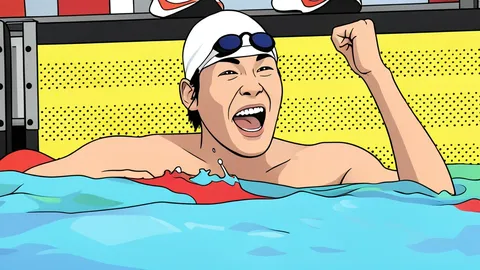
Qin Haiyang to Face Ohashi in Tokyo Asian Games 100m Breaststroke

China leads the medal table after Day One, setting up a clash between Qin Haiyang and Shin Ohashi in the men's 100m breaststroke final.
Key points
- China leads the overall swimming medal table after claiming nearly all golds on Day One of the 2026 Asian Games.
- Shin Ohashi of Japan will face Qin Haiyang of China in the men's 100m breaststroke final, a clash of record holders.
- Ji Yu-chan of Korea aims to defend his 50m freestyle title, while Siobhan Haughey seeks another win in the 200m free.
The water at the Tokyo Aquatics Centre still holds the heat of the first night's competition. China swimmers left the pool deck with nearly every gold medal in hand, their dominance a heavy, humid weight in the air. The lane ropes, taut and bright against the deep blue, wait for the next surge of bodies to shatter the surface.
Now, the pressure shifts. Japan, Singapore, and Hong Kong prepare to challenge the reigning champions in the evening session. The stakes are high, the water is cold, and the only thing that matters is the time on the clock. SwimSwam reports that the agenda is packed with finals that could rewrite the Asian records book.
Breaststroke Clash Defines The Evening
The men’s 100m breaststroke is the centerpiece. Qin Haiyang of China holds the Asian and Games records, having set them in 2023. Opposite him stands Shin Ohashi of Japan, the holder of the World Junior Record. This is not just a race; it is a collision of two distinct powers. Ohashi brings speed and explosive drive, while Haiyang relies on consistent, relentless rhythm.
The water will tell the truth. Who holds their line longer? Who finds the extra push in the final ten meters? The lane ropes will see it all, vibrating with the force of every kick. It is a physical duel, stripped of noise, leaving only the sound of water parting and the sharp crack of a hand against the touchpad.
Defending Champions Face New Rivals
Beyond the breaststroke, the night is dense with history. Ji Yu-chan of Korea seeks to defend his 50m freestyle title from three years ago. The Asian record for that event sits at 21.64, a mark set by Shuya Matsumoto in 2025. Yu-chan’s Games record of 21.72 from 2023 is a target, but the field is deep. Every fraction of a second counts in a sprint where reaction times decide the podium.
In the women’s 200m freestyle, Siobhan Haughey of Hong Kong looks to repeat her 2023 triumph. Her Asian record of 1:53.92 stands as a benchmark. The water is long, the turns tight. It is a test of endurance and pacing, a swim that builds slowly before exploding in the final fifty meters. The crowd will feel the tension before the gun even fires.
Relay Pace Sets The Tone
The men’s 4x200m freestyle relay closes the night’s action. South Korea holds the Games record from 2023, a time of 7:01.73. China’s Asian record of 7:00.91, set in 2025, looms larger. This is a race of four swimmers, four bursts of energy. The exchange touches must be seamless, the rhythm unbroken. It is a mechanical dance, precise and powerful.
The Tokyo Aquatics Centre is a temple of speed. The water is clear, the lanes straight. Every stroke is a statement. As the finals unfold, the air grows thick with anticipation. The medals are there, waiting in the shadows of the pool deck. All that is left is to reach for them, to cut through the water, and to claim the moment.