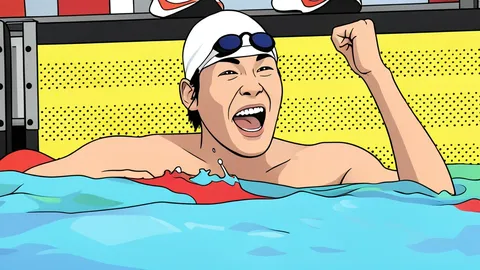
Tokyo Aquatics Hosts Day Two Asian Games Swimming Finals

Swimmers compete in seven finals at the Tokyo Aquatics Centre, with record holders from China, Japan, and South Korea taking the water.
Key points
- South Korea's Kim Youngbeom holds the new Asian Games record of 21.71 seconds in the 50m freestyle.
- Siobhan Haughey of Hong Kong defends her Games record of 1:54.12 in the 200m freestyle.
- China leads the overall medal table after the first night, with Yu Yiting holding the 200m IM record.
The Tokyo Aquatics Centre hums with the low, electric buzz of anticipation. Lane ropes stretch taut across the deep blue surface, cutting the water into precise, parallel channels. The air is thick with chlorine and the scent of damp concrete. Athletes move with mechanical grace, their bodies glistening under the bright arena lights as they prepare for the second night of the 2026 Asian Games. The pool is a stage set for high-stakes precision, where every millisecond counts and every ripple tells a story of effort.
China’s dominance from the opening night hangs heavy in the room. The reigning team champions have already claimed nearly every gold medal, establishing a formidable presence in the overall standings. Tonight, the challenge shifts to the specialists. Swimmers from Japan, Singapore, and Hong Kong line up to test their limits against the leaders. The agenda is packed with seven distinct finals, each a different test of speed, endurance, and technical mastery. The water waits, silent and still, for the first dive to break its surface.
Sprint specialists target top seeds
The men’s 50m freestyle final promises a fierce duel within South Korea’s own ranks. Ji Yu-chan returns to defend a title won three years ago, his experience a quiet weapon in the water. Standing in his way is teammate Kim Youngbeom, who surged to the top of the seed list this morning. Kim’s preliminary time of 21.71 seconds set a new Asian Games record, a benchmark that now looms over the final. The race will be a blur of motion, a chaotic burst of power where the difference between gold and silver is measured in fractions of a second.
In the women’s 50m backstroke, the field looks to the established hierarchy. The Asian record of 26.98 seconds, held by Liu Xiang since 2018, remains a distant target for most. The 2023 champion, Wang Xueer, knows the pressure of defending a podium finish. Her time of 27.35 seconds in the previous cycle sets a realistic pace for tonight’s contenders. The backstroke lane is a narrow corridor, where body position and underwater dolphin kicks determine the early lead. Every athlete knows that the first five meters are the most critical, a silent battle fought beneath the surface before the first breath is taken.
Endurance tests in long distances
The women’s 200m freestyle final centers on Siobhan Haughey of Hong Kong. She is the current Games record holder, having clocked 1:54.12 in the previous edition. Her Asian record of 1:53.92 from 2021 stands as a testament to her consistent excellence. Tonight, she faces the challenge of maintaining her rhythm over two full lengths of the pool. The water is cold and resistant, demanding a steady, efficient stroke. Her competitors know that any slight deviation in pace will be punished by the accumulating fatigue in the final 50 meters.
The men’s 4x200m freestyle relay offers a different kind of tension. It is a battle of team cohesion and individual endurance. South Korea holds the Games record of 7:01.73, a mark they set as the 2023 champions. China’s Asian record of 7:00.91, set in 2025, hangs just out of reach. The relay is a continuous stream of energy, where each swimmer must hand off to the next with perfect timing. The pool becomes a single, flowing entity, driven by the collective effort of four athletes working in unison. The final touch is a moment of pure, unadulterated relief.
Technical precision in mixed events
The women’s 200m individual medley requires a mastery of four different strokes. Yu Yiting of China holds the Games record of 2:07.75, a mark she established as the 2023 champion. Her Asian record of 2:06.82, set in 2026, shows her current form is peaking at the right time. The medley is a test of versatility, where a swimmer must shift gears from the explosive butterfly to the steady breaststroke. The transitions are the most dangerous moments, where a second lost in the turn can cost a medal. It is a dance with the water, requiring both power and grace.
Shin Ohashi of Japan brings a unique profile to the men’s 100m breaststroke. He holds the World Junior Record of 58.54 seconds, a mark that highlights his explosive start. His teammate Mio Narita, a World Championships medalist, is also in the water, adding depth to Japan’s squad. The breaststroke lane is a study in rhythm, where the kick must be synchronized perfectly with the arm pull. Any mistiming results in a loss of momentum, a subtle drag that can be felt in the final stretch. The athletes focus on the wall, the ultimate goal of every lap, every stroke, and every breath.