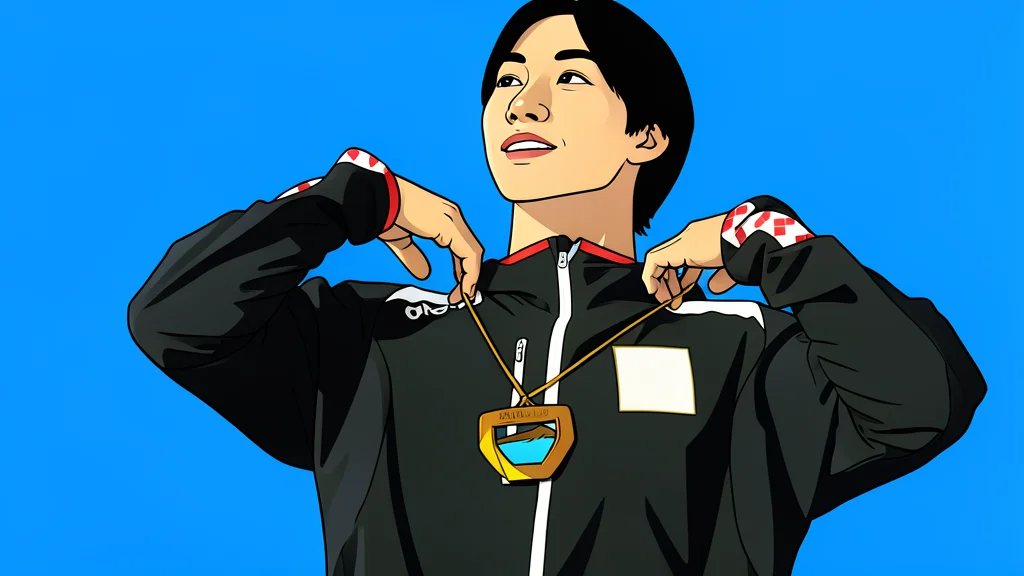
South Korea and China Target Seven-Minute Break in Relay

The water is still, the lanes white and stark, stretching into a vanishing point where time seems to suspend. Two nations stand on the precipice of history, their swimmers poised to shatter a barrier that has resisted all but the world's elite.
The pool surface mirrors the ceiling lights in a shimmering, undisturbed expanse. White lane lines cut through the blue like surgical incisions, leading the eye toward the far end of the basin. In this hushed arena, the only sound is the faint hum of filtration systems and the distant echo of a coach’s voice. The air smells of chlorine and anticipation, a sharp, metallic tang that clings to the skin. Here, the water does not just hold athletes; it waits for them, a liquid stage set for a performance that could rewrite the record books.
Only three nations have ever dipped under the seven-minute mark in the 800-meter freestyle relay. Great Britain has done it four times. The United States has matched that feat. Russia crossed the line once. Now, South Korea and China are knocking on the door, seeking to join this exclusive, six-something fraternity. As reported by GN auto sports/multisport: Asian Games, the potential exists. A fourth member would not just add a name to a list; it would inject raw intrigue into the buildup toward the 2028 Los Angeles Olympics, turning a regional contest into a global statement of speed and depth.
Depth and Precision Define Success
Breaking seven minutes is not a sprint; it is a marathon of precision. It demands extreme depth in the 200-meter freestyle, a hammer blow of talent that can mask any wobble in the form. Getting four athletes to fire in perfect, simultaneous synchrony is a rare alchemy. Great Britain mastered this consistency, with James Guy as the linchpin, Duncan Scott and Matt Richards providing the muscle, and Tom Dean flashing his individual brilliance. This coordination is the key, and it is the exact trait that could play in South Korea’s favor this month in Tokyo.
Korean Speed Meets Rising Chinese Power
South Korea holds the Asian record, a time of 7:01.73 set in 2023, a victory that tasted of gold. Yang Jae-hoon led off, Lee Ho-joon followed, and the back half ignited with Kim Woo-min and Hwang Sun-woo. But the bar has been raised. China now holds the mark at 7:00.91, a time set last year in Singapore by Pan Zhanle and Zhang Zhanshuo. The gap is narrow, measured in hundredths of a second, a sliver of time that separates victory from history. For Korea, the ingredients are there. Hwang Sun-woo has a career best of 1:43.92, one of only nine swimmers in history to break 1:44. If he anchors the relay, the math works.
China’s threat is fresh and ferocious. Xu Haibo, an 18-year-old with a June split of 1:45.83, brings considerable upside. Zhang Zhanshuo is a rising power in both the 200 and 400 freestyles, and a split in the 1:43 range is not a dream; it is a projection. The question is not whether they have the talent. They do. The question is whether the water will hold them, whether the timing will click, and whether the barrier will break. The answer will be written in the ripples of the pool, in the splash of the final turn, in the breathless silence of the crowd holding its collective breath.