The Unrepeatable Force: Magic Johnson's Unique Era
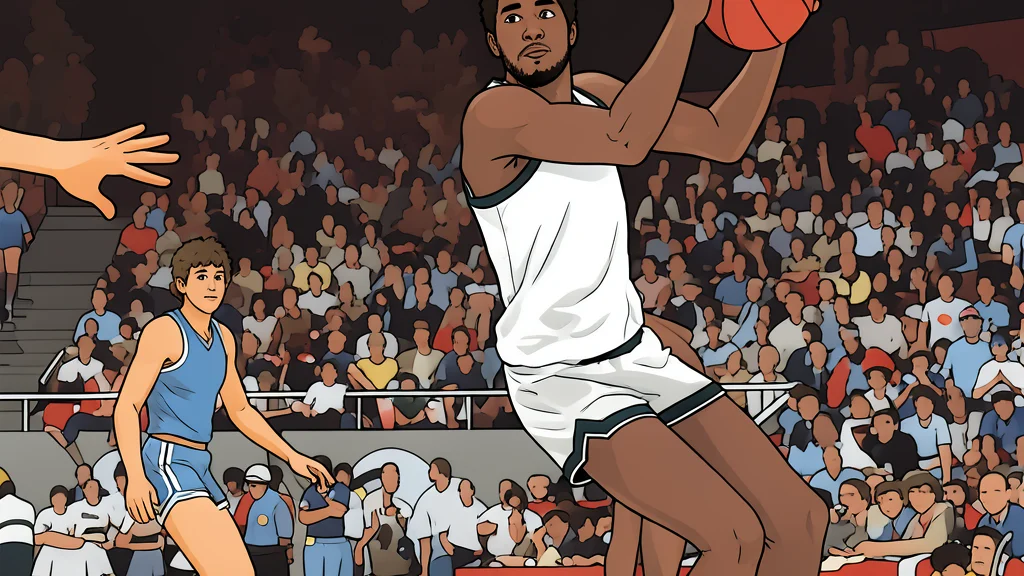
In the amber glow of old footage, a 6-9 point guard moves with a grace that defied the geometry of the court. Magic Johnson did not just play basketball; he redefined the physical limits of the game.
The grain of the video shimmers like heat haze over a summer court. There is no scoreboard in sight, just the rhythmic thud of a leather ball against hardwood. Magic Johnson stands out in that frame, a tall silhouette cutting through the crowd. He is not merely playing; he is conducting. At six feet and nine inches, his presence on the point guard position feels less like a tactical choice and more like a natural law. The movement is fluid, a long, sweeping arc of the arm that releases the ball with effortless precision. It is a spectacle that transcends the era, captured in the warm, saturated tones of archival footage.
This was not a sudden eruption. In the late 1970s, the basketball world was already buzzing with talent. Albert King and Gene Banks were household names, destined for Maryland and Duke. Yet, Johnson, choosing Michigan State, carved a path that felt singular. As reported by GN sports/basketball (en-US), his emergence was a quiet revolution before it became a thunderclap. He did not arrive with a bang, but with a steady, undeniable rhythm that pulled the eye and held it.
Defying the Height Hierarchy
Playing point guard at that height was a radical act. It challenged the rigid structures of the game, where size dictated position. Johnson ignored those rules. He handled the ball with a dexterity that seemed impossible for his stature, weaving through defenders with a grace that belied his power. In 1978, his Michigan State team reached the Elite Eight, only to fall short to Kentucky. The loss, 52-49, was a temporary setback in a narrative of inevitable greatness. The court was his stage, and he was learning the choreography of dominance.
The following year, the stage was set for a collision of titans. The 1979 championship game pitted Johnson and the Spartans against Larry Bird and Indiana State. It was a battle of styles, of visions. The Spartans won, 87-75, securing their first title. The victory was not just a score on a board; it was a statement. Johnson’s play in that moment cemented his status as an icon, a figure who belonged to a different league than the ones he played in.
A Solitary Peak in History
Basketball is a sport of comparisons. We see echoes of Michael Jordan in Kobe Bryant, or the ghost of Larry Bird in Luka Doncic. But Johnson resists these parallels. He is a category of one. His uniqueness is not just in his skill, but in his impact. He changed the way the game was played, the way it was seen, and the way it was felt. There is no template for Magic Johnson. He is a singular point in the timeline of basketball, a star that burns with a light no other has matched.
Perhaps the greatest testament to his versatility came in his rookie NBA season. With Kareem Abdul-Jabbar sidelined, Johnson, the point guard, moved to the center position. In Game 6 of the Finals, he delivered a performance that defied logic. Forty-two points, fifteen rebounds, seven assists. It was a statistical anomaly, a testament to his all-around mastery. He did not just fill a role; he transcended it. The court, the ball, the opponents—all became secondary to his presence. He was the center of the universe, and the universe orbited his will.
The Unmatched Legacy
To watch Johnson play is to witness a rare alignment of talent and timing. His career was a brief, brilliant flash in the history of the sport. He did not just participate in the game; he elevated it. His legacy is not measured in trophies, though he won many. It is measured in the way he made the game look. He made the impossible look easy, the difficult look elegant. In the end, Johnson is not just a player. He is a feeling, a moment suspended in time, captured in the grain of old video, still vibrant, still alive.