Oregon's Stance Tells Exposed in Oklahoma State Upset
Oklahoma State linebacker Tate Romney claims the Cowboys decoded Oregon's offensive line footwork, turning a subtle visual cue into a dominant defensive performance.
The grass in Stillwater was wet with the weight of a 39-31 victory, but the real battle had already been fought in the silence of the film room. Oklahoma State linebacker Tate Romney stood with the quiet confidence of a hunter who has tracked his prey, crediting a specific, almost invisible detail for the Cowboys' success. It was not brute force that held Oregon to a sluggish 50 yards in the first half, but a keen eye for the position of two heavy boots.
The Ducks, accustomed to a high-octane offense, found their rhythm broken by a defensive line that seemed to know exactly where the ball would go before the snap. Romney described the advantage as stemming from the stance of Oregon's offensive linemen, a subtle shift in footwork that acted as a beacon for the Cowboys. This was not a guess; it was a pattern, identified on tape and exploited on the field, turning the complex chess match of college football into a series of predictable moves.
Footwork as a Tactical Map
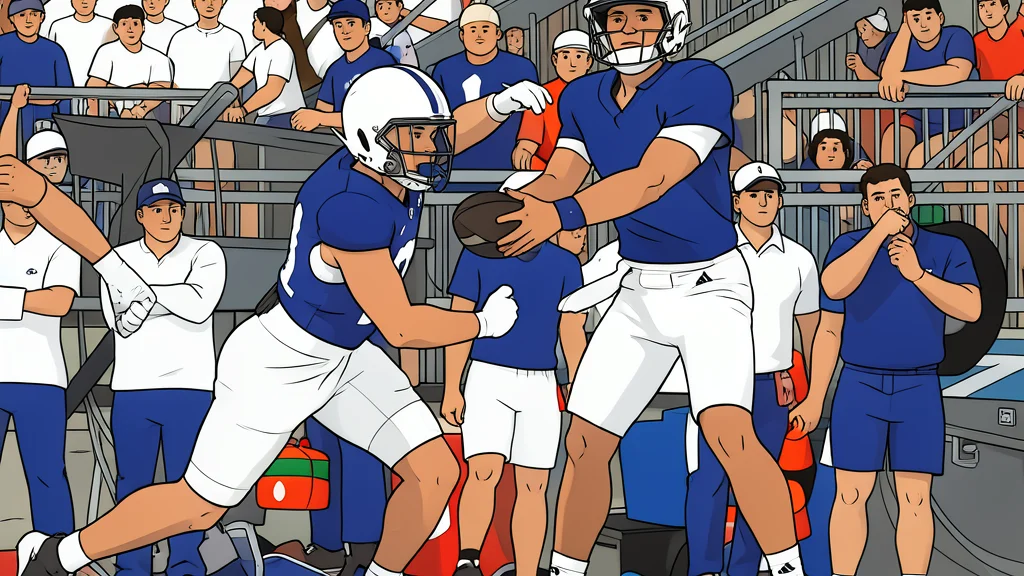
Romney explained that the Ducks' linemen displayed distinct tendencies that allowed the defense to key in on the play type. If the edge linemen had their outside feet positioned behind their inside feet, the Cowboys prepared for a pass or a run-pass option. When those same feet moved closer to the line of scrimmage, the defense shifted its focus to a designed run. This binary signal created a clear path for the Cowboys' defensive line to win their one-on-one battles, collapsing the pocket or stuffing the hole with pre-snap certainty.
The broadcast footage, specifically the aerial SkyCast view, confirms this mechanical nuance. Across multiple drives, the footwork of Oregon's tackles served as the primary indicator. It was a physical language of the body, a silent code of intent that the Oklahoma State defense read like text. The result was a first half where Oregon's offense, usually a chaotic storm, was reduced to a series of short, controlled plays, averaging just 4.8 yards per attempt.
The Cost of Visual Cues
Yet the system was not infallible. On the first play of the fourth quarter, Oregon capitalized on a momentary lapse in the Cowboys' reading. With the score tight at 31-30, the Ducks' tackles kept their outside feet close to the line, a posture Romney linked to run plays. Instead, the ball flew 38 yards to Evan Stewart, a wide-open target who caught the pass and secured the lead. The defenders, primed for a run, were caught out of position, a stark reminder that even the best-read schemes can be broken by a single, misread signal.
This incident highlights the fragility of relying on such specific tells. While the Cowboys dominated much of the game, that single turnover in reading allowed Oregon to seize momentum. The discrepancy between the expected run and the actual pass exposed the limits of the tactic, proving that while patterns can be exploited, they cannot be relied upon as absolute guarantees in the high-pressure environment of a late-season clash.
Historical Precedent for Early Fixes
According to Yahoo Sports, such early-season tells are not unprecedented in the history of college football. Last season, Notre Dame quarterback CJ Carr faced a similar scrutiny when his footwork in the shotgun gave away the play type to Texas A&M. The Irish quickly corrected the issue, and the rest of their season unfolded without such a glaring vulnerability. This historical parallel suggests that Oregon's coaching staff will likely address the stance issue before facing Portland State in Week 3.
The ability to adapt and refine these mechanical details is a hallmark of elite coaching. The lesson for Eugene is clear: the body speaks, and opponents are listening. By refining the footwork of their offensive line, the Ducks can restore the element of surprise that defines their offense. The Stillwater loss serves as a sharp reminder that in the modern game, every inch of movement is data, and every data point can be weaponized by a prepared adversary.