India's Hockey Gold Quest Faces Crucial Test
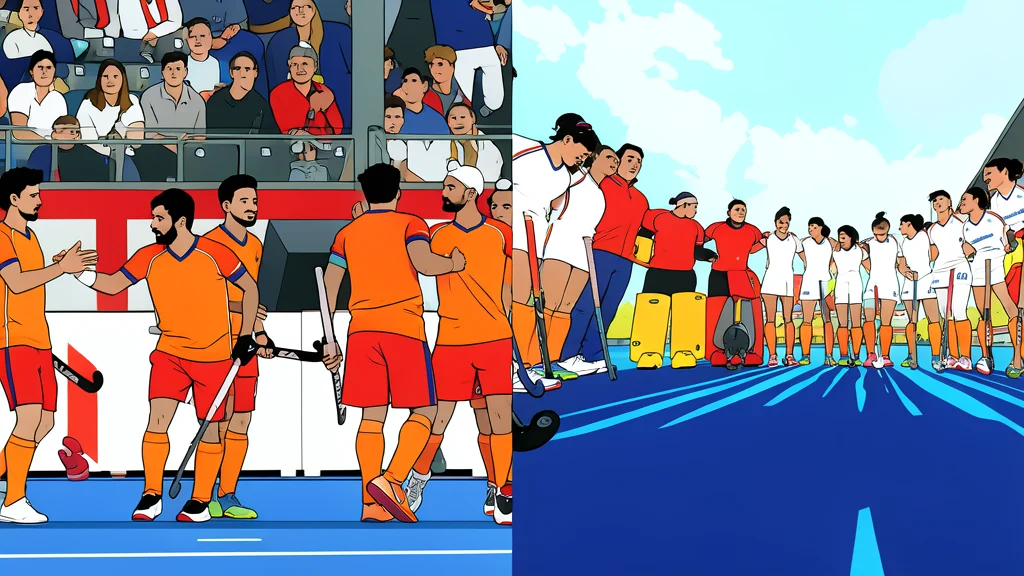
The green turf of Kakamigahara awaits, where India's men and women seek redemption and glory after turbulent World Cup runs.
The air in Kakamigahara is thick with anticipation, a physical weight pressing down on the shoulders of players who have just returned from a bruising World Cup campaign. The artificial turf, a stark green expanse marked by crisp white lines, lies quiet beneath the summer sun, waiting to absorb the impact of skates and the thud of hard balls. For the Indian men, this is not merely a tournament; it is a reckoning. They arrive as the undisputed continental kings, having swept every major Asian title since 2023 without a single defeat. Yet, the shadow of their recent eighth-place finish at the World Cup looms large, a dark stain on an otherwise pristine record that demands immediate erasure.
Across the gender divide, the women’s squad carries a different energy, one forged in the fires of a commendable fifth-place finish. Sjoerd Marijne’s team has shaken off the dust of inexperience, infusing their play with a vibrant mix of youthful aggression and seasoned calm. They have kept clean sheets against giants like England and Australia, proving their defensive spine is hard to break. Now, with the gold medal within reach and a 44-year drought staring them in the face, the stakes have never been higher. This is the moment where potential transforms into legacy, where the lessons of the past few months must be converted into tangible victory on the field.
Men Seek Continental Supremacy
Craig Fulton’s men enter the Asian Games as overwhelming favorites, yet the path to a second successive gold is riddled with obstacles. No team has managed this feat since 2006, a historical barrier that adds psychological weight to every pass and tackle. The squad is still processing the shock of a tournament where they conceded nineteen goals, a defensive record that stands out as the fifth-worst in the competition. Even Pakistan, a familiar opponent, found ways to score three times, capitalizing on sloppy handling and momentary lapses in concentration. The memory of those failures is fresh, a sharp sting that could either sharpen their focus or paralyze their confidence.
The burden of rescue falls heavily on Harmanpreet Singh, whose dragflicks from penalty corners remained a beacon of hope amidst the storm. Despite battling a crocked back, his world-class finishing repeatedly dragged India into contention when open-play goals eluded them. However, Fulton knows that individual heroics are not enough. The forward line, outside of Abhishek Nain’s consistent scoring, has shown signs of fatigue and diminished returns, with senior players like Manpreet Singh contributing fewer goals than in previous cycles. The challenge now is to rekindle the collective fire, ensuring that the attacking engine runs smoothly across all four quarters, not just in bursts of brilliance.
To address these gaps, Fulton has made calculated changes, opting for experience over youth in key areas. Aditya Lalage has been replaced by Raj Kumar Pal, a veteran who was part of the World Cup traveling group, signaling a desire for stability and leadership in the knockout stages. Early group matches against host nation Japan and South Korea will serve as critical diagnostic tools, testing whether the team has truly learned from its misadventures. If India can navigate these initial hurdles with composure, they stand a strong chance of reaching the final, where the true measure of their resilience will be judged.
Women Defy Historical Odds
Sjoerd Marijne’s women’s squad radiates a renewed spirit, having exceeded expectations with a disciplined and composed World Cup showing. The team’s ability to keep clean sheets against top-ranked opponents like England and Australia is a testament to their defensive solidity and tactical discipline. With only six goals conceded against five higher-ranked teams, India has proven it can compete with the best in the world. The experience of facing such high-pressure matches has instilled a confidence that will carry them into the Asian Games, where the competition, while fierce, may offer slightly more breathing room for their attacking talent to flourish.
The attack is led by Navneet Kaur and Deepika, both of whom are capable of scoring from open play and penalty corners. Their ability to convert pressure into goals will be crucial, especially in tight group stage matches against lower-ranked opposition. Meanwhile, the goalkeeping duo of Savita Punia and Bichu Devi provides a safety net that could prove decisive in the medal rounds. Their reflexes and command of the area will be tested in potential clashes with China, a team that India drew with during the World Cup. That match revealed both the team’s potential and its vulnerabilities, particularly in defensive composure under pressure.
Legacy On The Line
For the women, the Asian Games represent a chance to end a 44-year gold medal drought at this level. Senior midfielder Neha speaks with unwavering determination, declaring that the team will win the gold medal no matter what. Her confidence is infectious, a rallying cry for a squad that has already proven it can match up with the best. The young debutants, who made up a significant portion of the World Cup squad, will look to these veterans for guidance, drawing on their experience to navigate the high-stakes environment of the Games.
The coming days in Kakamigahara will be a crucible, testing the mettle of both teams and their coaches. The men must overcome their defensive frailties and reignite their attacking fire, while the women must translate their World Cup confidence into continental dominance. With the support of fans and the weight of history, India’s hockey teams stand at a crossroads. The green turf awaits, and the only direction is forward, toward a gold medal that defines not just a tournament, but a generation.