Korea’s Delegation Takes Flight for Nagoya Games
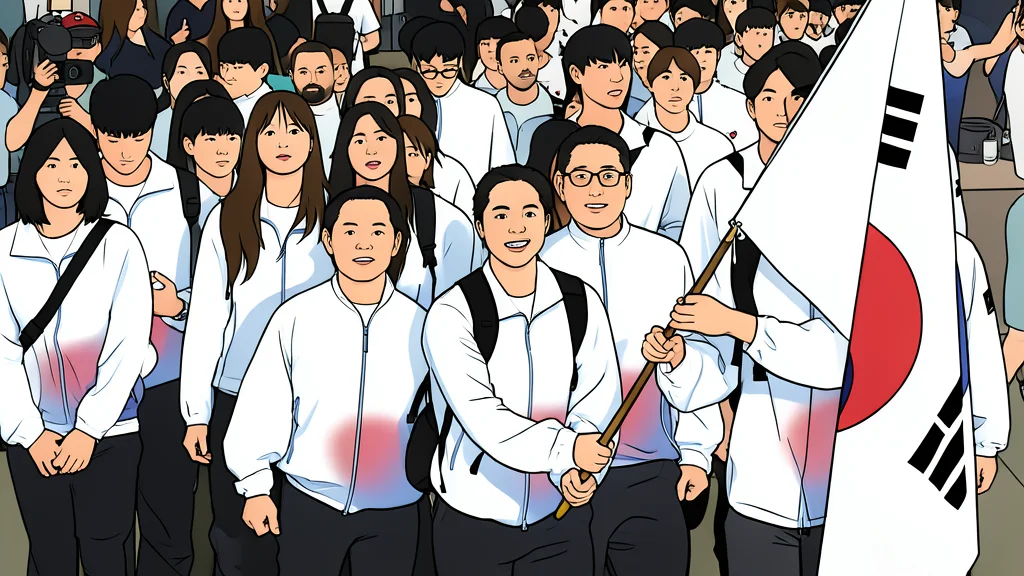
The tarmac at Incheon glitters under the afternoon sun as the first wave of South Korea’s athletes steps onto the tarmac, heading toward a fortnight of competition in Japan.
Incheon International Airport hums with the low, electric buzz of departure gates. A 122-member delegation, bound for Nagoya, moves through the terminal with the focused silence of a synchronized machine. The air is conditioned, crisp against the humid heat outside, carrying the faint scent of jet fuel and polished floor wax. This is not just a flight; it is the opening act of a 16-day sporting festival that will span 71 disciplines across the Japanese archipelago.
At the center of the group, table tennis star Shin Yu-bin carries the Korean flag. The fabric snaps in the terminal’s draft, a vivid splash of red and blue against the sterile white of the departure lounge. Behind her, the ranks of badminton players, road cyclists, and karateka form a quiet line. They are led by chef de mission Lee Sang-hyun, who walks with the steady, measured pace of someone who has seen this ritual before. The journey to Nagoya begins here, on the tarmac, where the ground shakes softly under the weight of departing jets.
A Festival Spanning Nineteen Cities
The destination is not a single arena but a sprawling network of venues. The Asian Games Aichi-Nagoya 2026 will unfold across 19 cities in Aichi Prefecture, stretching as far as Tokyo, Osaka, and Shizuoka. Nagoya serves as the anchor, hosting the opening ceremony at Paloma Mizuho Stadium on Saturday. The scale is immense: roughly 15,000 athletes from 45 national Olympic committees will converge to contest 469 gold medals across 43 sports. The logistics are a web of trains, buses, and flights, all converging on this single, pulsing event.
Some competitions have already ignited. Men’s basketball kicked off on September 10, followed by football and volleyball. The rhythm of the Games is already beating, a pulse that will grow louder as the opening ceremony approaches. This is the third time Japan has hosted the Summer Asian Games, following Tokyo in 1958 and Hiroshima in 1994. The history is layered, a palimpsest of athletic achievement written in sweat and score.
Racing Against the Pandemic’s Shadow
The timeline is compressed, a direct consequence of the global health crisis. The previous edition, held in Hangzhou, was postponed from 2022 to 2023. This leaves a gap of only three years between games, a tight squeeze on the four-year cycle that usually allows for a full generation of training and recovery. The athletes on the plane from Incheon are racing against this compressed clock, carrying the weight of a shortened preparation window on their shoulders.
The delegation includes specialists in beach volleyball, women’s handball, and road cycling. Each sport demands a different physicality, a different relationship with the body and the environment. Yet they are united in this moment of transit, suspended between the departure gate and the distant stadiums of Nagoya. The air outside the terminal windows is thick with the promise of competition, a heavy, tangible thing that hangs in the air like the scent of rain before a storm.
Carrying the Flag Across Borders
Shin Yu-bin’s grip on the flag is firm. The symbol she carries is more than fabric; it is a standard, a point of reference for the 122 people moving through the terminal. According to GN auto sports/multisport: Asian Games, the delegation’s departure marks the official start of Korea’s campaign. The image of the flag bearer, centered and steady, captures the essence of the event: a national identity in motion, propelled by the quiet, collective determination of its athletes.
As the plane taxis down the runway, the tarmac blurs into a streak of gray and white. The engine’s roar swallows the ambient noise of the airport, a deep, resonant thrum that vibrates in the chest. The journey to Nagoya is a bridge between two worlds: the familiar home ground and the foreign arena. For the next two weeks, the focus will be singular, absolute, and unyielding.