North Korea's Delegation Heads to Nagoya for Asian Games
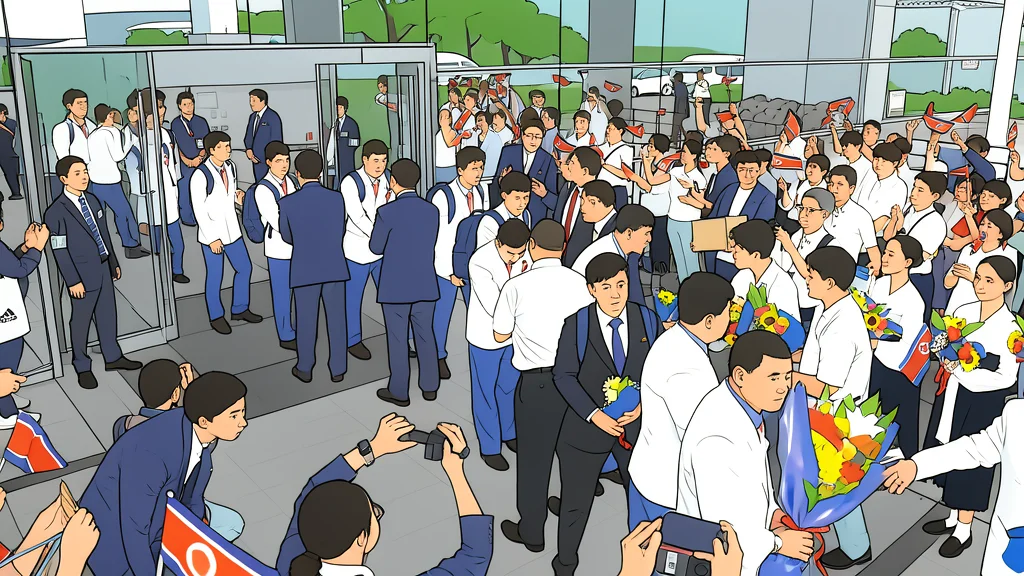
The delegation has departed Pyongyang, carrying the weight of national expectation toward the Aichi-Nagoya venue.
The jet lifted off from Pyongyang International Airport, leaving the humid capital behind for the coastal heat of Japan. Kim Il-guk, the minister of physical culture and sports, stood at the front of the group, his posture rigid against the vibration of takeoff. First Vice Minister Kim Yong-gwon watched the tail lights fade into the morning haze, a silent gesture of farewell that marked the start of a high-stakes diplomatic and athletic journey.
They are not traveling alone. One hundred and seven athletes travel with the leadership, their bags packed with the specific gear of fourteen different disciplines. The list is long: football boots, weightlifting belts, table tennis paddles, and wrestling mats. This is a substantial contingent, a physical manifestation of North Korea’s intent to dominate specific arenas at the 20th Asian Games, which runs from Saturday through October 4.
Women's Football Dominance
The momentum began before the minister even boarded the plane. The North Korean women’s football team arrived in Osaka last week, their boots already scuffed from training on unfamiliar turf. Their campaign opened Monday with a performance that left little to discuss. Against Bangladesh in Group F, they delivered a 10-0 rout. The scoreline is a stark statistic, but the image is of overwhelming control, a team that moved through the opposition with mechanical precision and unyielding speed.
That victory set the tone for the delegation’s arrival. It signals a team that is not just present, but asserting dominance. The air in Osaka felt different for them, charged with the expectation of a clean sweep. The ball rolled true, the net shook, and the scoreboard told a story of absolute superiority before the main games even formally kicked off.
Men's Matchup Looms
The men’s team faces a different kind of pressure. Their scheduled match against China was set for Wednesday evening at Wave Stadium Kariya. Located southeast of Nagoya, the stadium sits in a landscape of flat rice paddies and industrial hum. The fixture is not just a game; it is a confrontation between two regional powers with deep historical and sporting rivalries. The tension in the air was palpable, a static charge waiting for the first whistle to break the silence.
Broader Athletic Scope
While football grabs the headlines, the breadth of the North Korean effort is its true strength. Weightlifters will test the limits of human strength on the platforms. Table tennis players will engage in rapid-fire exchanges where millimeters decide victory. Wrestlers will grapple for leverage in close quarters. This diversity ensures that North Korea is not a one-trick pony. As reported by GN auto sports/multisport: Asian Games, the delegation is a comprehensive showcase of their athletic infrastructure, designed to secure medals across a wide spectrum of competition.