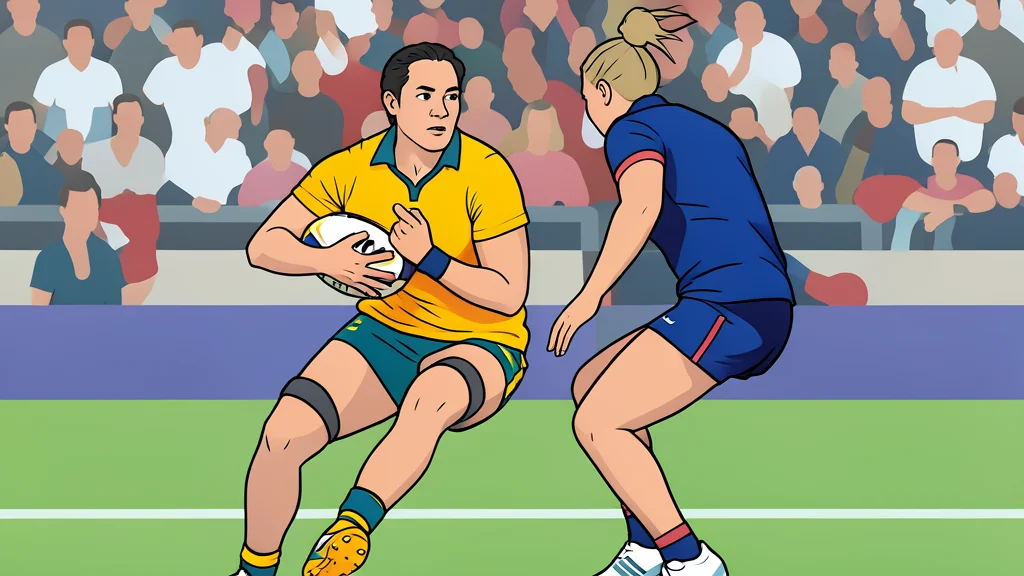
Ireland Hooker Faces Challenge with New Smaller Rugby Ball

Cliodhna Moloney-MacDonald describes the new size 4.5 ball as tricky to control, especially in windy conditions, ahead of Sunday's match against the United States.
The leather oval sits on the grass, slightly smaller than the one players have known for years. It is a subtle change, just three percent in size, yet it carries the same weight as the traditional size five. For Cliodhna Moloney-MacDonald, the Irish hooker, this shift is more than a technicality. It is a tangible disruption to the rhythm of the game. As the women’s rugby world trials this new standard during the WXV Global Series, the transition period feels less like a minor adjustment and more like a friction against the grain of established skill.
Sunday’s match against the United States at Dublin’s Tallaght Stadium marks the start of this experimental phase. The ball does not hold as true in the air, a detail Moloney-MacDonald has noted with professional concern. It is not just about the feel in the hand; it is about the physics of flight, the behavior in the wind, and the precision required at line-outs. The athlete acknowledges the difficulty without apology, framing it as a necessary part of the sport’s evolution.
Wind and Weather Test the New Standard
Rain and wind are the great equalizers in rugby, but they become amplifiers of difficulty with the smaller ball. Moloney-MacDonald, a 33-year-old veteran of the front row, points out that the finer sweet spot for handling is harder to find. In wet conditions, the ball slips more easily. In gusts, it can die off at the end of long kicks or be taken by the wind in ways that defy expectation. Kickers have already reported that the ball loses momentum unpredictably, a phenomenon that requires immediate adaptation.
The trial is part of a broader experiment by World Rugby during the September and October series. Players from other nations have voiced similar concerns. England’s May Campbell and Helena Rowland raised issues before their recent win over Australia, while Wales’ Lisa Neumann noted a positive impact on passing. The feedback is varied, but the consensus is clear: the ball behaves differently. It demands a relearning of instincts that were built over years of domestic competition where the size five remains the norm.
Irish Teams Could Join English League
Beyond the immediate challenge of the ball, Moloney-MacDonald sees an opportunity for structural growth. Having spent most of her career in England’s Premiership Women’s Rugby, she understands the intensity of that competition. She believes that inviting Irish sides into an expanded PWR would be brilliant. It would provide a regularity of high-level opposition that the current Celtic Challenge, while valuable, does not fully replicate. The travel burden would be significant, but the athletes would relish the challenge.
The league’s expression of interest process signals a willingness to expand. For players, this means more difficult games and a higher competitive standard. Moloney-MacDonald argues that the girls in Ireland would love to be part of such a league. It would not just benefit the clubs; it would elevate the entire ecosystem of women’s rugby in the region. The prospect is exciting, a tangible step toward a more unified and competitive landscape.
Upcoming Schedule Includes Japan and South Africa
After the opener against the United States, Ireland will face Japan in a double-header in Galway and Cork. These matches, including one WXV game, will test the team’s ability to adapt to the new ball under varying conditions. The journey continues to Cape Town, where two more WXV matches are scheduled for late October. Each game is a data point in the trial, a chance to refine technique and gather feedback for World Rugby.
The process is ongoing. Players will provide their insights, and the sport will evolve accordingly. As reported by Yahoo Sports, this is not a one-time change but a period of transition. The ball is what it is, and the players will meet it with skill and resilience. The outcome of these trials will shape the future of women’s rugby, setting the stage for a new standard of play.