Edison Manages Coastal Risks at San Onofre Nuclear Site
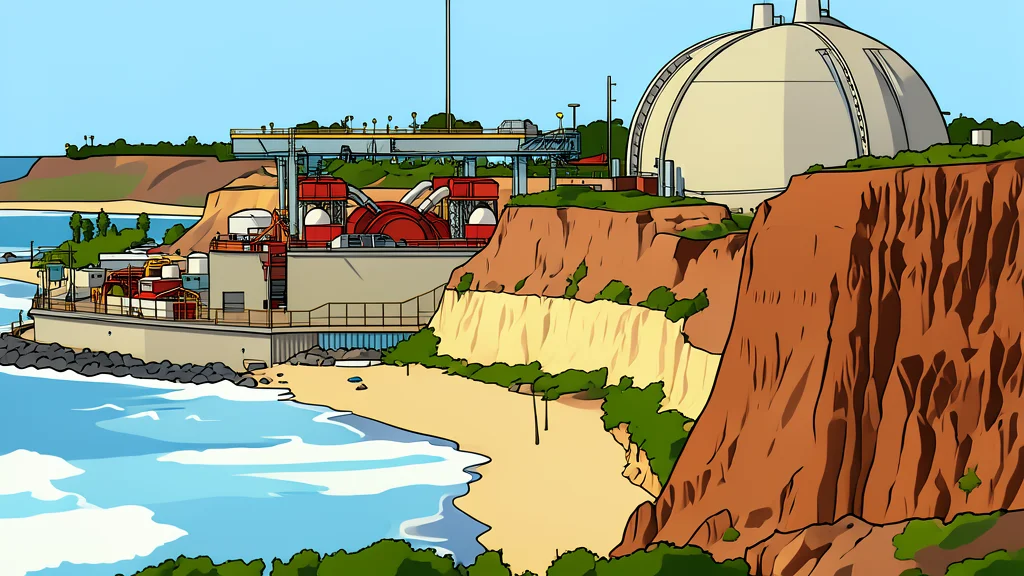
Southern California Edison maintains a critical asset at San Onofre, where 3.6 million pounds of spent fuel are stored 100 feet from an eroding coastline, requiring continuous monitoring and long-term capital planning.
Intense wave action along the Southern California coast has heightened scrutiny on the decommissioned San Onofre Nuclear Generating Station. The site holds 3.6 million pounds of high-level radioactive waste in steel canisters positioned just 100 feet from the shoreline. This proximity creates a specific operational risk for Southern California Edison, which must ensure the integrity of the concrete pad and seawall protecting the inventory.
Former wave dynamics researcher Kim McCoy warned that rising sea levels and El Niño storm surges could compromise the walkway protecting the seawall. While most experts cited in recent reports indicate no immediate threat, the physical distance between the waste storage and the ocean remains a focal point for regulatory oversight and public concern.
San Onofre Site Status and Decommissioning
The plant ceased operations in 2013 following steam generator failures, triggering a multi-year dismantling process. Most lower-level rubble has been removed, and the twin domes are scheduled for demolition in early 2027. However, the spent fuel pool contents remain on-site indefinitely, representing a long-term liability and maintenance burden for the utility.
Geological factors add complexity to the risk profile. UC San Diego geology professor James Day described the area as seismically active with relatively young rock formations. In response, Edison states its storage system is engineered to withstand these specific seismic and hydrological threats, though former NRC head Greg Jaczko suggested the company could increase monitoring frequency to ensure long-term safety.
Engineering Resilience and Threat Assessment
Manuel Camargo, principal manager of decommissioning for Edison, provided specific engineering parameters to address safety concerns. He stated that the maximum credible tsunami would not overtop the seawall. Furthermore, a 7.0 magnitude earthquake, considered the maximum credible seismic event for the region, would generate forces approximately half of what the storage system is designed to withstand.
The utility asserts that the current infrastructure is sufficient to protect the waste canisters against projected environmental changes. This assessment relies on rigorous design standards intended to isolate the high-level waste from coastal erosion and seismic activity for the foreseeable future.
Long-Term Storage Obligations and Costs
Edison is required to transfer fuel into new canisters by 2103 if a permanent disposal site is not established. The collapse of the federal Yucca Mountain project has left spent fuel stranded at approximately 80 reactor sites nationwide. Consequently, utilities are filing annual claims against the federal government to recoup storage expenses, a process that currently costs taxpayers an estimated $2 million per day.
In July 2026, the U.S. Department of Energy announced agreements with five states to examine interim storage options. Despite these developments, local opposition remains strong. Carmen Valdez of Heal Utah emphasized community resistance to becoming a waste repository, highlighting the political and financial challenges Edison faces in resolving the San Onofre waste inventory.