CERN Data Confirms Entanglement in Heavy Z Bosons
Researchers at CERN have found strong evidence that quantum entanglement persists in heavy Z bosons created during high-energy collisions.
Key points
- Physicists detected entanglement in Z bosons produced during Higgs boson decays at the Large Hadron Collider.
- The study confirms that quantum entanglement persists in massive, short-lived particles at extreme energy levels.
- Researchers reconstructed the spin states of fleeting Z bosons by analyzing the decay angles of their electron and muon products.
Physicists have found strong evidence that quantum entanglement survives in some of the heaviest and shortest-lived particles ever produced. The discovery, reported by ScienceDaily, confirms that this counterintuitive phenomenon holds up even under the extreme conditions of CERN’s Large Hadron Collider.
The results suggest that the strange connections between particles are not limited to delicate laboratory setups. Instead, they appear to be a robust feature of nature that persists even when protons collide at nearly the speed of light, generating energies of thirteen trillion electron volts.
Entanglement in fleeting heavy particles
Quantum entanglement allows two particles to share properties such that measuring one instantly reveals information about the other. Albert Einstein famously dismissed this as spooky action at a distance because it defies classical intuition. While previously observed in photons and electrons, its presence in massive particles like Z bosons was a major open question.
Z bosons are incredibly short-lived, existing for only a tiny fraction of a second before decaying. This makes them much harder to study than long-lived quantum systems. The new study demonstrates that the quantum link remains intact even in these fleeting, high-mass particles, expanding the known boundaries of quantum mechanics.
Detecting quantum clues in decay
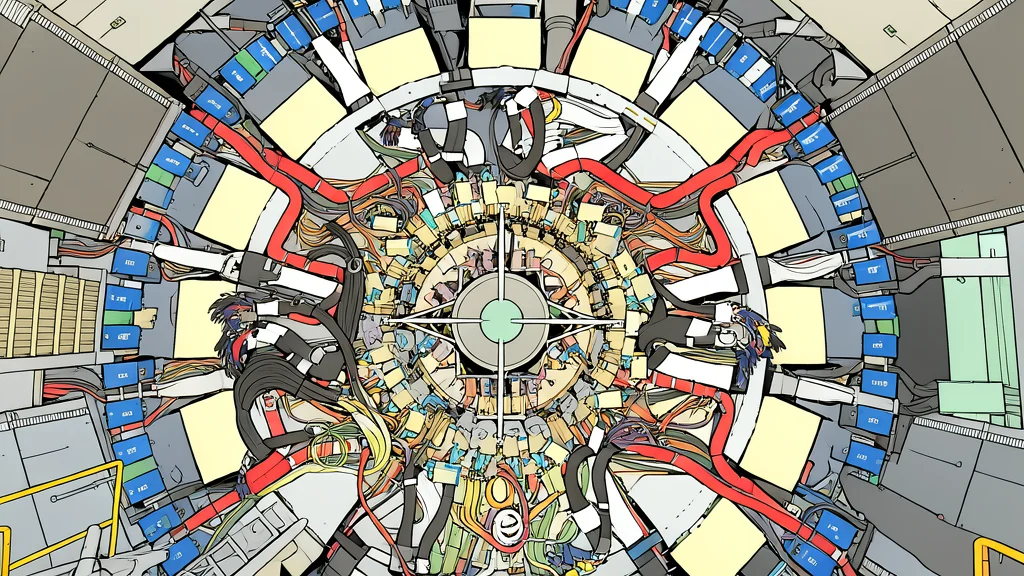
The research team used the ATLAS experiment at CERN to analyze data from Higgs boson decays. When a Higgs boson breaks down, it can produce a pair of Z bosons, which then decay into electrons or muons. Because the original Z bosons vanish almost immediately, researchers had to reconstruct their properties using the particles they left behind.
By measuring the precise angles at which the decay products emerged, the scientists could infer the spin states of the original Z bosons. The correlations in these angles provided strong evidence that the pair was entangled. This method allows physicists to probe quantum behavior at energy scales far beyond traditional quantum computing experiments.
Implications for quantum technology
Entanglement is the core mechanism behind emerging technologies like quantum computers and secure communication networks. In these systems, it allows multiple qubits to be manipulated simultaneously, enabling complex calculations. Confirming its presence in heavy particles validates the fundamental principles that underpin these future technologies.
However, the practical application of these findings remains distant. The extreme energies required to produce these particles are not easily replicable in standard tech labs. The primary value of this discovery is scientific, offering a new way to test the limits of quantum theory in conditions that are impossible to achieve in conventional settings.