Local AI Mini PC Enables Offline Smart Home Control
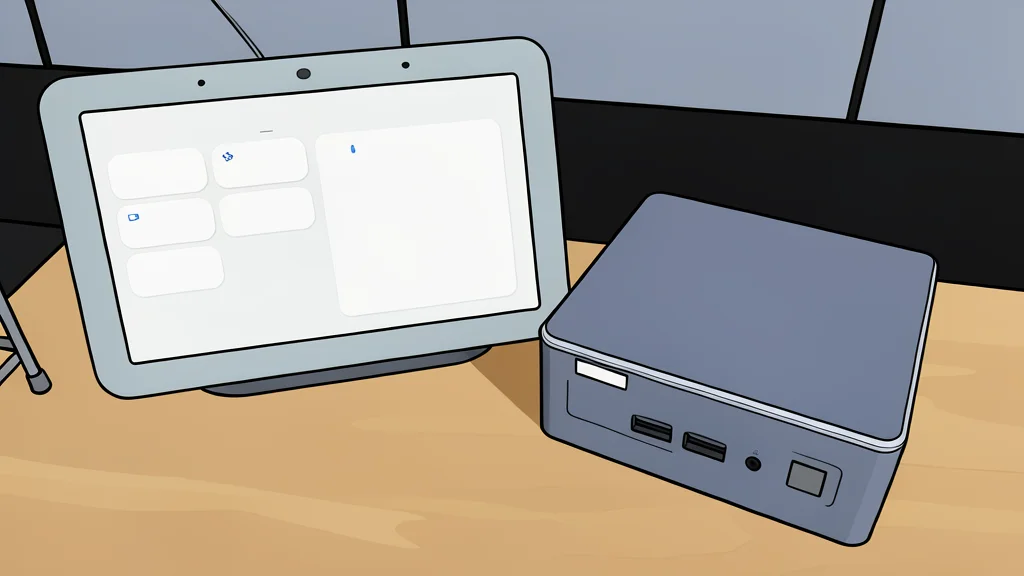
A compact PC running open-source tools processes voice commands locally, removing cloud dependency and latency from smart home setups.
Key points
- Local voice assistants use open-source tools like Whisper and Piper to process commands without cloud access.
- A mini PC with a modern CPU and 15-25W idle power can handle the AI inference load for 24/7 operation.
- Separate satellite microphones are often required to ensure clear audio capture since mini PCs are not designed for sound collection.
Most mainstream voice assistants rely entirely on internet connectivity to function. When you speak to a device like Alexa or Siri, your audio is sent to corporate cloud servers for processing. This means that if your internet connection drops, your smart home controls stop working. Additionally, this reliance on external servers introduces latency and raises privacy concerns regarding where your voice data is stored.
A new approach uses a mini PC to run the entire voice assistant pipeline locally. By processing speech-to-text, intent recognition, and response generation on-device, users can maintain full control over their data. This setup allows for a smart home that responds instantly to commands without ever sending information to the cloud, effectively decoupling home automation from internet availability.
Open-source tools replace cloud servers
The core of this local setup relies on a specific stack of open-source software. The process begins with Whisper, an open-source model that converts raw audio into text with high accuracy. Unlike proprietary services, Whisper runs directly on the local hardware, meaning no data leaves the device during transcription. This ensures that the initial step of understanding your command remains private.
Once the text is generated, Home Assistant Assist handles the interpretation of the command. It maps natural language phrases to specific actions, such as adjusting thermostat settings or turning on lights. For the response, Piper generates synthesized speech locally. This neural text-to-speech engine is optimized for lower-power hardware, producing clear audio without the need for external API calls. As reported by XDA Developers, this combination eliminates the multi-second delays typical of cloud-based systems.
Hardware requirements for local inference
Running these models locally requires a mini PC with sufficient processing power. The hardware must handle AI inference tasks efficiently without excessive heat or power consumption. A modern mobile CPU with strong multi-threading capabilities and support for accelerated instructions is ideal. These processors can manage the matrix multiplication required by speech models while maintaining a low idle power footprint, typically between 15 and 25 watts.
Memory capacity is also a critical factor for future-proofing the system. While basic voice commands require modest resources, hosting lightweight large language models for more conversational interactions demands more RAM. Systems with upgradable memory options up to 64GB can support these additional workloads. This allows the mini PC to evolve from a simple command executor to a context-aware assistant, all while staying within the energy limits of a desktop computer.
Practical setup challenges remain
Despite the technical benefits, physical placement presents a challenge. A mini PC is not designed to be a primary audio capture device. If the unit is hidden behind a television or in a closet, it may not pick up voice commands clearly from across the room. To solve this, many users pair the mini PC with separate satellite microphones. These devices capture the audio and stream it over the local network to the PC for processing, ensuring reliable coverage throughout the home.