Deployed Nuclear Warheads Rise as SIPRI Reports Shift in Global Balance
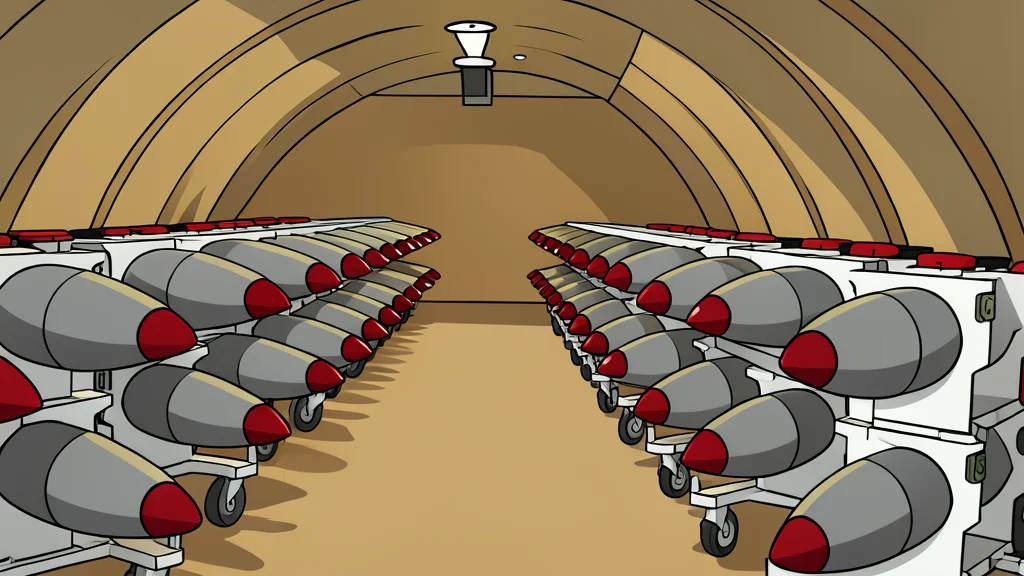
The number of nuclear warheads ready for immediate use has increased for the first time in several years, driven by expansions in Russia, China, and North Korea, while NATO members maintain steady totals.
Global nuclear dynamics have shifted toward increased readiness, with the total number of deployed warheads rising for the first time in years. According to the Stockholm International Peace Research Institute, nine nations now possess approximately 12,187 warheads, of which 4,012 are deployed on missiles or with operational forces. This marks a divergence from the long-term trend of overall disarmament, as the total stockpile continues to decline due to the dismantling of older systems, yet the active, deployable fraction is growing.
The increase is primarily attributed to actions by Russia, China, and North Korea, while NATO allies have largely held their numbers steady. Russia’s deployed inventory has reached its highest level since 2017, marking the fourth consecutive year of expansion. Meanwhile, the United States has maintained a stable count, and European powers are focusing on modernization rather than numerical growth. This divergence highlights a complex strategic environment where some actors are prioritizing immediate offensive capability while others emphasize deterrence through technological upgrades.
Russia and China Expand Deployed Inventories
Russia currently holds the largest number of deployed warheads, with SIPRI estimating the figure at 1,796 as of early 2026. This represents a significant portion of its total arsenal, which stands at approximately 5,420 warheads. The institute notes that Moscow has increased its deployed numbers for four straight years, signaling a sustained commitment to enhancing its immediate strike capacity. The remaining warheads are either in storage or slated for dismantlement, but the rise in the active stockpile is a key indicator of shifting strategic postures.
China’s nuclear program has also continued its steady expansion. Estimates suggest the country now possesses approximately 620 warheads, an increase from the previous year’s count of 600. More notably, the number of deployed Chinese warheads has risen from 24 to 34. This modest but consistent growth in the deployable fraction suggests Beijing is enhancing the operational readiness of its forces. The data, cited in reports from GN geopolitics/nato, underscores a broader trend of non-NATO powers increasing their immediate nuclear capabilities while Western allies maintain existing baselines.
NATO Allies Maintain Steady Nuclear Posture
In contrast to the expanding inventories of Russia and China, the United States has kept its deployed warhead count stable at 1,770, with a total arsenal of approximately 5,042. European NATO members have also remained largely static in their numbers. France’s stockpile is estimated at 290 warheads, while the United Kingdom holds about 225. Although London has expressed intent to raise its ceiling to 260, current figures remain unchanged. This stability suggests that NATO’s focus is not on numerical expansion but on maintaining the reliability and modernization of existing deterrents.
Strategic adjustments are nonetheless underway within the Alliance. The United Kingdom has announced plans to acquire 12 nuclear-capable F-35A aircraft and to join NATO’s nuclear-sharing arrangement, which would make it the sixth European host for U.S. nuclear weapons. France is similarly modernizing its submarine and airborne components of its deterrent. These moves indicate a continued emphasis on flexibility and technological superiority, even as the overall number of deployed warheads in the West remains flat.
Shifting Deterrence Strategies and Modernization
The data reveals a bifurcation in global nuclear strategy. While some states are increasing the number of weapons ready for use, others are investing in the quality and delivery platforms of their existing arsenals. India, for instance, has been noted for the first time with an estimated 12 deployed warheads out of a total arsenal of 190. This highlights the growing complexity of the global nuclear landscape, where even smaller nuclear powers are formalizing their deployable capabilities.
The forward-looking question centers on whether these trends will lead to further escalation or a new equilibrium. With Russia and China expanding their deployed forces and NATO allies refining their delivery systems, the balance of deterrence is undergoing a subtle but significant recalibration. Observers will likely monitor whether the increase in deployed warheads leads to more frequent tactical posturing or if it remains a symbolic shift in strategic signaling. The coming years will test the stability of this new configuration, particularly as modernization programs in Europe and Asia reach completion.