US Announcement of Space Control Weapons Raises Security Concerns
The US Air Force has publicly declared the deployment of orbital weapons, a move that experts warn validates long-standing accusations from rivals and risks accelerating a destabilizing arms race in space.
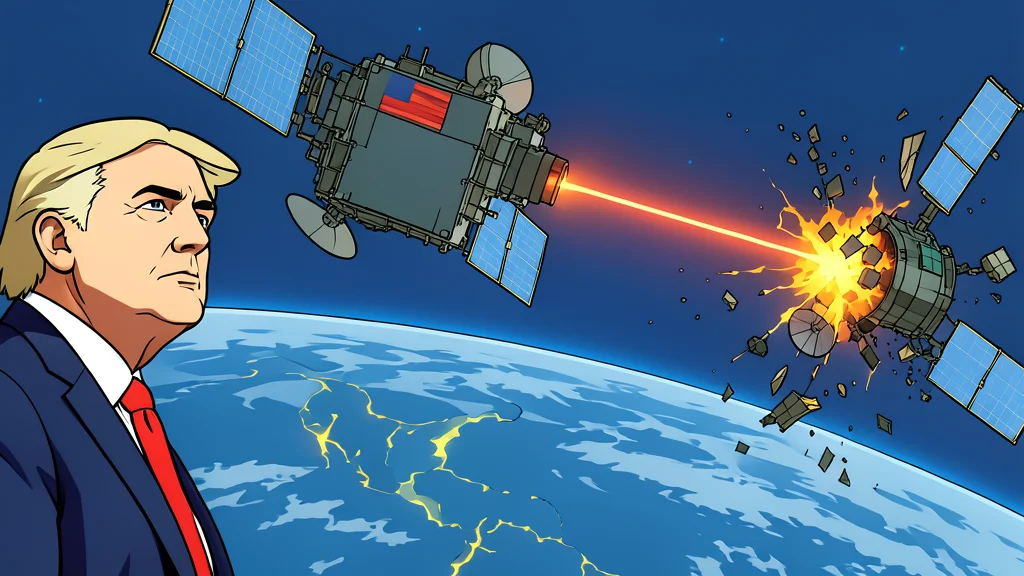
US Air Force Secretary Troy Meink announced this week that the United States has deployed what he described as “on-orbit space control weapons.” While the statement surprised many observers, it aligns with years of mutual accusations between Washington, Beijing, and Moscow regarding the weaponization of the orbital domain. For decades, the US has maintained a posture of denial even as it developed capabilities to interfere with adversary satellites. By explicitly labeling these assets as weapons, the administration appears to be conceding the validity of criticisms previously leveled by China and Russia.
The declaration carries significant geopolitical weight, as it may provide other nations with perceived justification to expand their own anti-satellite capabilities. Such an escalation threatens the stability of the space environment, which underpins critical global infrastructure including GPS, telecommunications, banking, and international shipping. According to analysis from GN auto geopolitics/global: arms race, this public admission could inadvertently hand strategic advantage to US rivals by framing the United States as the primary aggressor in a domain previously treated as a shared resource.
Defining the Scope of Orbital Capabilities
The term “space control” is rooted in long-standing US military doctrine, which asserts a goal of dominance and superiority in the orbital domain. The 2025 US Space Force Doctrine Document defines space control as encompassing both offensive and defensive actions, collectively referred to as counterspace operations. These capabilities are not new; many nations already possess tools to disrupt satellite functions through signal jamming, GPS spoofing, cyberattacks, or electronic warfare. Recent conflicts in and around Ukraine have demonstrated the regular use of such techniques to degrade enemy satellite communications.
However, the specific nature of the newly declared weapons remains ambiguous. Secretary Meink declined to provide technical details, leaving analysts to speculate about the exact capabilities involved. The terminology suggests a shift from passive defensive measures to active offensive tools, potentially marking a distinct escalation in the strategic posture of the United States regarding its assets in high orbit.
Analyzing Potential Weapon Types and Constraints
Experts identify three plausible categories for these systems, each with distinct legal and technical implications. The first possibility, nuclear weapons in orbit, is considered highly unlikely. The 1967 Outer Space Treaty explicitly prohibits the placement of weapons of mass destruction in Earth orbit. Historical tests in the early 1960s by both the US and the Soviet Union demonstrated that nuclear detonations in space created long-lasting radioactive debris that damaged friendly satellites, making such weapons strategically counterproductive and easily detectable by intelligence services.
A second possibility involves kinetic weapons or physical projectiles. While not banned by the Outer Space Treaty, the development of such systems would be surprising given the limited utility of conventional explosives in a vacuum. Historical experiments with satellite-to-satellite projectiles in the 1960s and 1970s suggest that while technically feasible, such weapons are rarely seen as a primary strategic asset. A third option is the use of grappling mechanisms to physically remove or disable active satellites, a capability demonstrated by China in 2022. There is currently no public evidence that the US has deployed such specific systems.
Strategic Implications and Future Risks
The most probable interpretation, estimated by global space security experts, is that the announcement represents a rebranding of existing counterspace capabilities as “weapons” for deterrence purposes. If the US possesses advanced jamming or electronic warfare tools similar to those attributed to China and Russia, labeling them as weapons serves to assert power and discourage interference with US assets. However, this posturing is dangerous. It provides Beijing and Moscow with a clear narrative of American aggression, potentially justifying their own acceleration of weapon development and testing.
The forward question now centers on how rival nations will respond to this explicit declaration. Watch for increased satellite maneuvering, unexplained signal disruptions, or diplomatic protests from China and Russia. The stability of the space domain depends on maintaining a degree of ambiguity and restraint; by removing that veil, the US may be triggering a cycle of escalation that threatens the safety of the orbital environment for all states.