US, South Korea, Japan Warn Against China's Economic Coercion
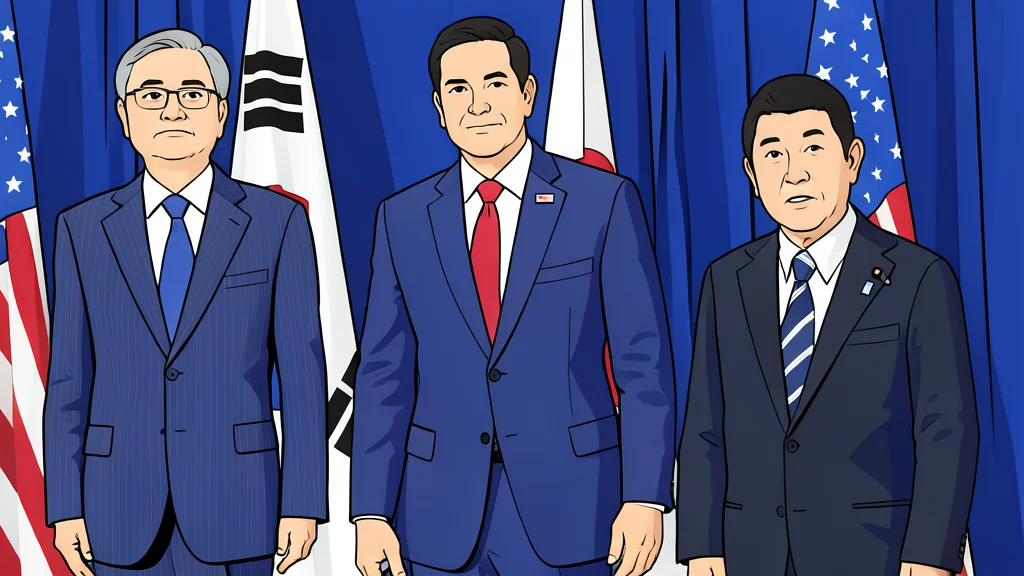
Trilateral foreign ministers issued a joint statement in New York days before the US-China summit, criticizing supply chain disruptions.
Key points
- US, South Korea, and Japan issued a joint statement opposing economic coercion and supply chain disruptions ahead of the US-China summit.
- The statement urged North Korea to resume dialogue while reaffirming the goal of complete denuclearization in line with UN resolutions.
- Diplomats softened language regarding the South China Sea and Taiwan compared to last year to manage tensions before bilateral talks.
In New York, the foreign ministers of the United States, South Korea, and Japan released a joint statement three days before the scheduled US-China summit. The document expresses firm opposition to economic coercion and non-market practices that disrupt global supply chains. Although China is not explicitly named, the language aligns closely with recent American concerns regarding Beijing's industrial policies and export controls, signaling a coordinated diplomatic stance ahead of high-level bilateral talks.
According to sbs.co.kr, the statement reflects a strategic effort to rally allies while managing tensions. The trilateral meeting took place in the context of the United Nations General Assembly, providing a multilateral stage for these nations to articulate shared positions. By emphasizing the need to counter harmful overcapacity and arbitrary export restrictions, the ministers aimed to pressure China on economic grounds without immediately escalating rhetoric on other sensitive geopolitical issues.
Diplomatic Balancing Act in New York
While the economic critique was sharp, the ministers adopted a slightly softer tone regarding the Taiwan Strait and the South China Sea. The joint statement reaffirmed the importance of peace and stability in the region and opposed unilateral attempts to change the status quo. However, it omitted specific references to dangerous behavior in the South China Sea that appeared in last year's version, likely to avoid provoking a strong negative reaction from Beijing just before the summit.
This calibrated approach suggests an attempt to maintain dialogue channels while asserting firm positions on core interests. Analysts note that Beijing has previously expressed strong dissatisfaction with similar trilateral statements. By softening certain phrases, the US, South Korea, and Japan may be seeking to create space for constructive engagement on other fronts, such as regional security and trade, while still pushing back against what they view as coercive economic tactics.
North Korea Dialogue Prioritized
The joint statement also placed significant emphasis on the necessity of resuming dialogue with North Korea. The ministers urged Pyongyang to return to talks, reflecting President Donald Trump’s expressed willingness to engage with Kim Jong-un within the year. This diplomatic push aligns with the South Korean government's intent to play a proactive role in facilitating communication, while simultaneously reaffirming the commitment to the complete denuclearization of the North in accordance with UN Security Council resolutions.
Forward Watch on Summery
The coming days will reveal whether this trilateral coordination influences the tone of the upcoming US-China summit. Observers will watch for any direct responses from Beijing regarding the economic criticism and whether the softened language on territorial disputes holds. The ability of these three nations to maintain a unified front while navigating complex bilateral relations will be a key indicator of the broader geopolitical trajectory in the Indo-Pacific region.