Stonkfly Simulates Fly Nervous System for Crypto Trading
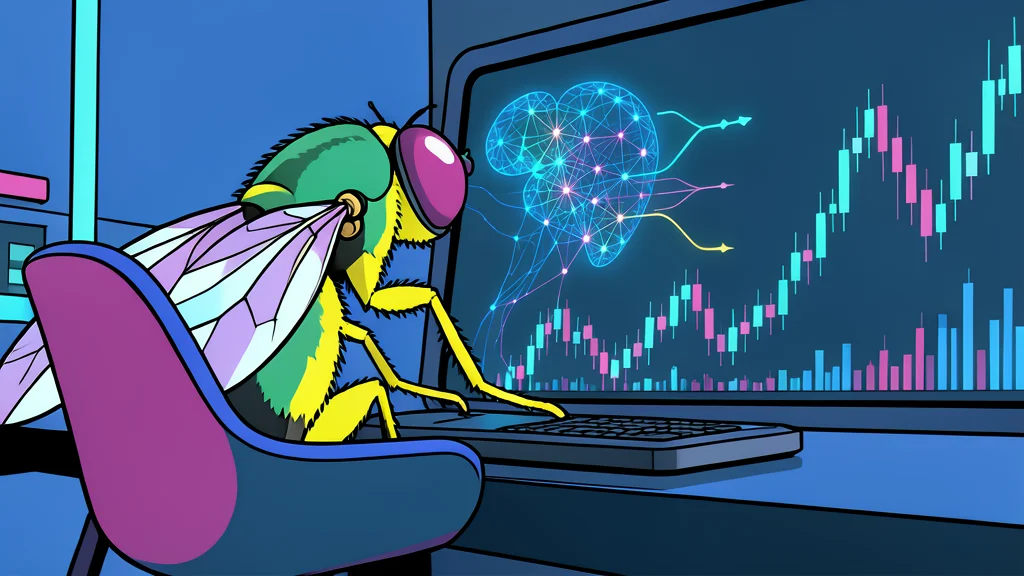
A virtual fruit-fly brain processes market data into trading signals.
Stonkfly routes 166,700 simulated neurons through a digital market interface. The system generates buy, sell, or hold proposals from visual price data. The project defaults to a paper trading setup with a $100 simulated balance. No profitable trading performance has been demonstrated.
The model relies on the MaleCNS v1.0 graph. This is a structural simulation of a male fruit-fly nervous system. It is not a biological organism. The simulation processes RGB candlestick charts rather than raw numerical price streams. The output is limited to three discrete trading actions.
Neural architecture processes visual market data
The connectome contains 25,582,938 directed connections. It also includes 124,177,617 synaptic contacts. These figures define the graph’s size. They do not constitute a validated physiological replica. The system receives public BTC-USDC prices from Coinbase. These prices are rendered as a 320 by 180 pixel candlestick chart.
The visual input uses 3,335 brightness channels. It also uses 811 color channels. A fixed neural readout maps activity to trading proposals. No large language model drives the decision process. The simulation treats the market as a visual stimulus rather than a data table.
Engineered feedback replaces biological emotion
Portfolio gains stimulate 15 identified PAM11 dopamine cells. Portfolio losses stimulate two PPL101 aversive cells. These signals are part of the software design. They do not model pain or pleasure. A gain does not prove the previous proposal caused the result.
The feedback mechanism allows the simulation to respond to outcomes. It does not establish learning or market prediction. The system operates on a defined reinforcement loop. This loop is distinct from biological emotional responses. The design focuses on signal processing rather than sentient behavior.
Paper trading limits financial proof
The default mode executes trades against a simulated $100 balance. This setup functions as a software experiment. It is not evidence of financial performance. The project documents a path to Coinbase Advanced. The existence of an order pathway does not validate a trading strategy.
A program can generate order proposals without proving profitability. The simulation connects to trading interfaces. It does not demonstrate a validated edge. The current state of the project remains a technical simulation. It lacks the empirical backing required for live financial deployment.