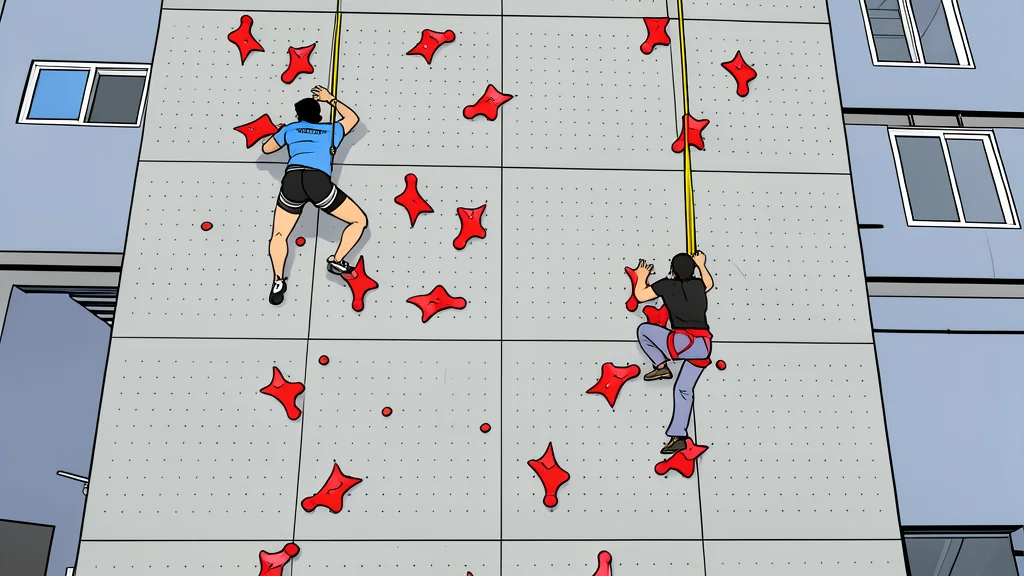
AI Reshapes the Vertical World of Climbing

Sensors and algorithms are creeping up the wall, turning muscle memory into data streams and challenging the raw instinct of the climb.
The air in the climbing hall is thick with the scent of rubber and sweat, a physical reality that no server can replicate. Yet, a digital ghost hovers over every move. Athletes no longer just feel the friction of the holds; they watch it, measure it, and decode it. The wall is becoming a screen, a responsive interface that judges every millimeter of deviation. This is not a distant sci-fi scenario. It is happening now, in gyms from Oslo to Munich, where the boundary between human effort and algorithmic insight is dissolving.
According to GN sports/climbing (de), the integration of artificial intelligence is no longer a niche experiment but a structural shift. From personalized training plans to real-time motion analysis, the technology is rewriting the rules of engagement. The question is no longer if AI will change climbing, but how deeply it will rewrite the very definition of performance. The stakes are high, balancing the promise of peak efficiency against the loss of intuitive, unquantified flow.
Digital mirrors for the body
In the training room, the most visible change is the rise of motion analysis tools. Apps like Climbalyzer and Belay AI act as digital mirrors, capturing video feeds to dissect technique with surgical precision. They track center of mass, velocity, and joint angles, offering feedback that was once reserved for elite teams with expensive motion capture rigs. For the average climber, a smartphone camera is now enough to generate a biomechanical profile. The feedback loop is instant, turning a vague sense of clumsiness into hard data points.
This shift is significant because it democratizes high-level analysis. Previously, such insights were locked behind the paywalls of professional sports science. Now, a hobbyist can see exactly why their hip position is inefficient or why their footwork is slipping. The technology promises to make the invisible mechanics of climbing visible, offering a new layer of understanding that complements, rather than replaces, the physical grind. It is a tool for refinement, turning trial and error into a calculated process.
The limits of algorithmic wisdom
Yet, the algorithm has blind spots. Climbing is arguably one of the most biomechanically complex sports, a chaotic dance of balance, strength, and intuition. AI models struggle to capture the full nuance of this movement diversity. They can measure the angle of a knee, but they cannot feel the subtle shift in weight that saves a fall. The output of these tools is always subject to human interpretation. A coach’s eye, honed by years of experience, still holds a value that a database cannot replicate.
There are also serious concerns about data privacy. Video analysis requires the upload of sensitive biometric information. Users must navigate the fine print of terms of service, aware that their physical data may be stored, analyzed, or shared by third parties. While regulations in the European Economic Area offer some protection, the landscape is complex. The convenience of a smarter training plan comes with the cost of surveillance, a trade-off that climbers are only beginning to weigh.
Redefining the route builder’s craft
The influence of AI is also seeping into the creative side of the sport. While it is unlikely that route setters will soon take direct instructions from a generative model, the technology is finding its way into the process. Experiments have shown that AI can generate useful starting points for route construction, particularly for beginners. It can suggest sequences of holds that create specific challenges, acting as a brainstorming partner rather than a dictator.
This suggests a future where the wall itself is more intelligent. Tracking systems could analyze how climbers interact with specific sequences, identifying which moves are too hard, too easy, or poorly placed. This data could feed back into the design process, allowing gyms to optimize their offerings based on actual user performance. The result would be a more dynamic, responsive environment, tailored to the collective skill level of the community. The wall becomes a living system, evolving with its users.