Abhishek Sharma Breaks Record with Yoga Celebration
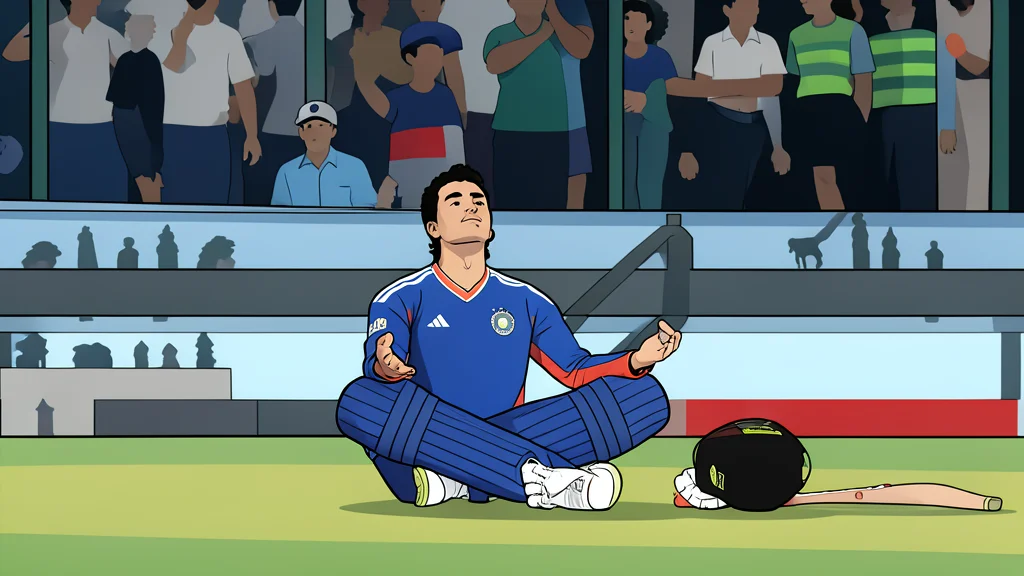
Under the heavy humidity of Delhi, Abhishek Sharma paused play to sit in serene silence, marking his record-breaking century with a meditative gesture.
The stadium air hung heavy with anticipation as Abhishek Sharma faced the final delivery of his innings. He did not raise a bat or shout. Instead, he pulled his helmet off, let it drop to the turf, and lowered his body into a perfect lotus position on the green grass. The crowd at the Arun Jaitley Stadium held its breath, then erupted. In that single, still moment, the chaos of the T20 format dissolved into a personal victory. He had just done something no Indian batter had ever achieved before.
It was a whirlwind of power. Thirty balls. That is all it took to reach the century mark, breaking the long-standing record held by Rohit Sharma. Abhishek finished on 108 off just 34 deliveries, a strike rate that defied logic. Eleven sixes. Nine fours. The ball left the bat with a violence that echoed off the floodlights. This was not just a personal best; it was the fastest hundred by any batter from a Test-playing nation, a statistical anomaly that rewrote the history books in real-time.
Silence after the thunderclap
The contrast between the aggression of his hitting and the serenity of his celebration was stark. While other players might have charged the boundary rope or lifted their bats to the sky, Abhishek chose stillness. His father, visible in the stands, clapped with a wide grin, the pride evident in his hands. Coach Gautam Gambhir shared that smile, watching his player transform the pitch into a personal sanctuary. The yoga pose was a deliberate act, a statement of control and calm amidst the roaring noise of the crowd.
According to Yahoo Sports, this performance marked Abhishek's third century in T20 cricket, adding to a tally that now includes twelve half-centuries. His consistency in the short format had been building, but this innings was the culmination. It was a display of raw power wrapped in a veneer of tranquility, a unique blend that captured the imagination of fans and rivals alike. The record stood firm, a testament to a single, extraordinary afternoon in Delhi.
Shattering the previous benchmark
Rohit Sharma’s record from 2017 had seemed unbreakable for years. He had reached the milestone in 35 balls against Sri Lanka, a feat that had defined a generation of Indian cricketers. Abhishek shaved five balls off that time, a margin that feels small on paper but represents a quantum leap in intensity. He reached the hundred in the ninth over, a single shot sealing the deal. The speed of his accumulation was unmatched, leaving the Afghan bowlers with little time to adjust or regroup.
The statistical landscape of T20 cricket is shifting. With names like Sikandar Raza and Finn Allen also holding fast records in recent years, the bar for excellence keeps rising. Abhishek’s 30-ball century places him at the very top of the table, alongside the elite of the format. It is a record that will be cited in every future discussion of speed and power in white-ball cricket. The image of him sitting on the grass, helmet discarded, will likely become one of the defining visuals of the 2026 season.
A new standard for speed
The match itself became a footnote to the individual achievement. The third and final T20I was the stage, but Abhishek was the actor, delivering a performance that transcended the game. His ability to combine explosive hitting with a grounded, almost spiritual celebration set him apart. It was a moment of pure, unadulterated joy, free from the tactical calculations that usually govern international cricket. The crowd’s reaction, a mix of awe and delight, confirmed that they had witnessed something special.
As the sun set over the Arun Jaitley Stadium, the memory of that yoga pose remained. It was a pause in the storm, a reminder that even in the fastest form of the game, there is room for stillness. Abhishek Sharma had not just broken a record; he had redefined what it means to celebrate a century in T20 cricket. His 108-run knock was a masterpiece of timing and power, a performance that will be studied, replayed, and remembered for years to come.
Meditative pause marks historic century
Following his explosive innings against Afghanistan, Abhishek Sharma chose a moment of stillness over traditional celebration. In the thick, humid air of the Arun Jaitley Stadium, he stopped the momentum of the match to sit on the ground, offering a striking contrast to the chaos of the game.
This meditative pause served as his unique signature on the milestone, shattering the previous fastest T20I century record for an Indian batter. By grounding himself in silence, he highlighted the personal focus behind his rapid-fire 108-run knock.