Ecuador Seizes Gold in Rosario Dressage Finals

Rosario’s arena held its breath as Ecuador’s team secured the continental crown, their rhythm unbroken under the Argentine sun.
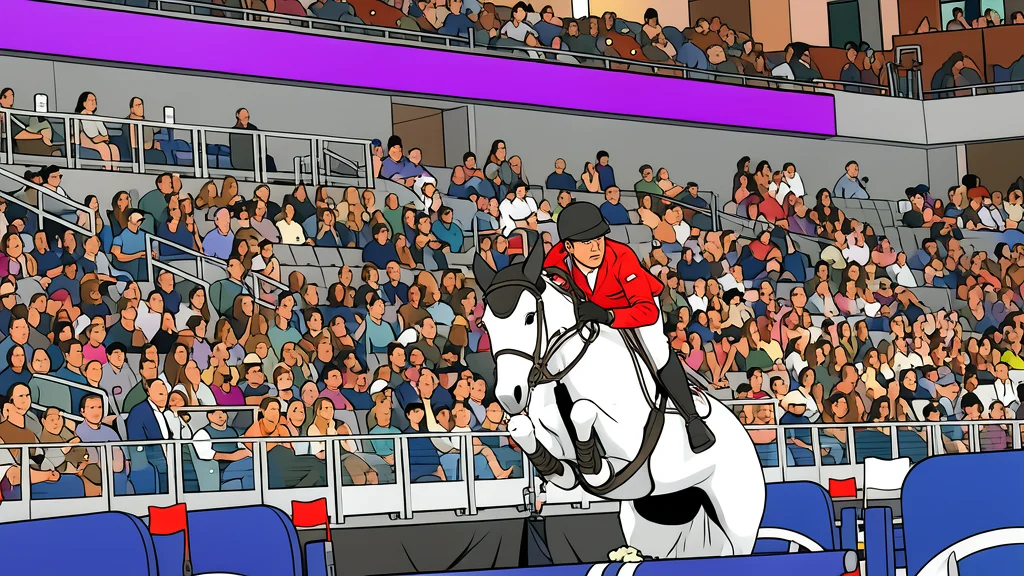
The polished wood of the Rosario arena reflected the late September light, a mirror for the precision unfolding above it. Team Ecuador did not merely compete; they carved their victory into the silence of the venue. Julio Mendoza Loor, the team’s anchor, guided Deparon through the final movements with a fluidity that seemed to defy the gravity of the moment. The crowd, sparse but attentive, felt the weight of the final score landing on the board. It was a definitive statement, a gold medal secured not by luck, but by the relentless discipline of preparation.
This triumph at the 2026 South American Games, organized by ODESUR and recognized by the International Olympic Committee, stands as a peak in a continental history that has only sporadically embraced equestrian sport since 1978. With just eighteen riders participating, the field was intimate, the stakes high. Mendoza’s performance was the linchpin. He won the Prix St Georges with a commanding 72.412%, a lead that set the tone for the rest of the competition. In the Intermediaire I, his margin narrowed to 1.6% over teammate Carolina Espinoza, yet the cumulative points were enough to outdistance Brazil. The Ecuadorian team was a cohesive unit, supported by Franziska Klinkicht and Maria Jose Granja, their contributions weaving together to form a tapestry of consistent excellence.
Brazil Defends with Quiet Precision
Silver went to the title defenders from Brazil, a team that stayed tightly knit in their scoring. Riders Eduardo Alves De Lima, Paulo Cesar dos Santos, and Jeferson Rodrigo Pereira maintained a consistent range between 67 and 68 percent in both mandatory tests. Their stability was a testament to their depth. Three of their mounts came from the same stud farm, bearing the VO suffix, a lineage traceable to the family of Brazilian Olympian Jose Victor Marcari Oliva. This shared bloodline suggested a strategy rooted in known quality, a calculated risk that paid off in silver.
Argentina, the host nation, claimed bronze in a contest marked by attrition. Uruguay’s team fractured early, with eliminations in the Prix St Georges and a retirement from the Grand Prix leaving them with only one rider in contention. This allowed Argentina to take the final podium spot. Their squad, including Federico De Michelis and Grand Prix rider Leonardo Antonio Godoy, navigated the pressure of home expectations with steady hands. The elimination of rivals was not a gift, but a reality of a small field where every mistake is magnified.
Mendoza’s Individual Crown in Freestyle
The individual gold was a foregone conclusion for Mendoza, riding Deparon, a twelve-year-old Hanoverian gelding. He had taken over the horse two years prior from Eliane Cordia-van Reesema, who had decided to leave the sport. The connection was already forged. On Wednesday morning, September 16, the atmosphere shifted as twelve riders entered the kur to music finals. The judges, including Mariano Santos Redondo and Sandra Hotz, watched from the rail as Mendoza and Deparon moved to the beat. The freestyle was a conversation between horse and rider, a dialogue of extension and collection that resonated with the judges.
Mendoza and Deparon topped the board with a total score of 76.420%, a figure that reflected not just technical accuracy, but artistic expression. Carolina Espinoza, riding BAK Conde, followed closely with 73.150%, continuing her streak of second-place finishes. The gap was clear, the hierarchy established. The event, covered by GN sports/equestrian, highlighted the unique format of the South American Games, where mixed levels of competition create a dynamic and unpredictable landscape.
A Continent’s Equestrian Identity
The 2026 Games in Rosario near Santa Fe served as a microcosm of South American dressage. It is a sport that has grown in stature since its inclusion in 1978, yet it remains a niche within the multi-sport event. The presence of only three riders at Grand Prix level this year underscores the specialized nature of the discipline. Ecuador’s double gold is a milestone, a signal that the continent is producing world-class talent. Mendoza’s words capture the essence: "Four combinations, one team and one flag. Behind this gold are years of preparation, discipline, sacrifice and, most of all, that extraordinary connection between horse and rider."
The arena in Rosario, surrounded by white fences and green grass, has witnessed this moment of triumph. The polished floor, the scent of sweat and hay, the rhythmic clip-clop of hooves—all contribute to the sensory experience of the sport. Ecuador’s victory is not just a medal count; it is a narrative of dedication and unity. As the competitors dismounted and shook hands, the tension dissolved into camaraderie. The gold medals hung heavy with significance, a symbol of what is possible when discipline meets passion.