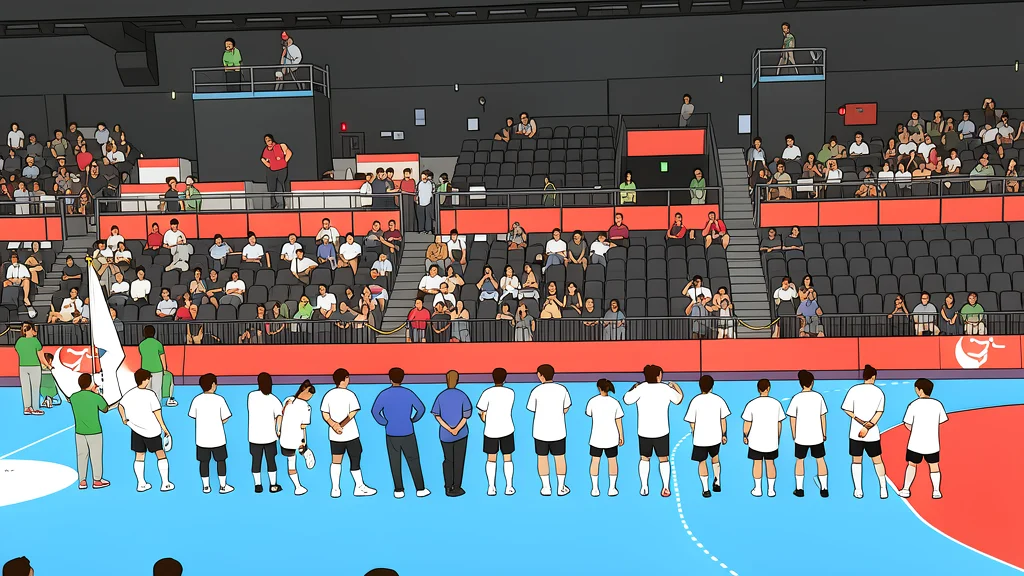
South Korea's 42-18 Handball Rout Signals Championship Ambitions

South Korea's dominant 42-18 victory over Kazakhstan in Nagoya underscores the team's fierce drive to reclaim the Asian Games title.
The air inside the Kasai Comprehensive Sports Gymnasium tasted of rubber and sweat, the polished wooden floor reflecting the harsh overhead lights in long, pale strips. For the first minutes, the contest was a tightropes walk, the score hovering at a fragile 5-4, every pass a calculated risk. Then the rhythm shifted. A save here, a block there, and the balance snapped. By the time the first half ended, the gap had widened to 18-8, the sound of the ball striking the floorboards echoing with a new, decisive weight.
South Korea, steered by coach Lee Gye-cheong, did not merely win; they dismantled the opposition. Defeating Kazakhstan 42-18 in their second match of the 2026 Aichi-Nagoya Asian Games, the team extended their winning streak to two consecutive victories. The performance was a physical statement, a display of dominance that signaled their intent to reclaim the title they have held for decades. It was not a close call, but a controlled execution of power, leaving no room for doubt about their standing in the tournament.
Defense breaks the early stalemate
Kazakhstan offered stiff resistance in the opening minutes, their defense compact and their attack disciplined. The game was a stalemate, a breathless exchange where neither side could find the seam. The breakthrough came not from a single hero, but from a collective tightening of the net. Goalkeeper Park Sae-young became a wall, consecutively blocking shots that sought to find the back of the net. Her saves cleared the air, allowing Lee Yeon-kyung and Woo Bit Na to strike with confidence. The transition from defense to offense was seamless, each blocked shot feeding directly into a goal, widening the lead with brutal efficiency.
By the end of the first half, the momentum had fully shifted. South Korea controlled both ends of the court, their movement fluid and their timing precise. The scoreline of 18-8 was not just a number; it was a testament to their ability to suffocate an opponent who had started strong. The physicality of the game was evident, every tackle and every jump carrying the weight of the team's collective will.
Fast breaks exploit slow recovery
The second half began with a similar pattern, Kazakhstan digging in behind the saves of Damira Zaparova. But South Korea’s response was immediate and sharp. They launched shots over the goalkeeper’s reach, finding angles that were impossible to block. Then came the fast breaks. Exploiting the opponent’s slow defensive recovery, the South Korean players surged forward, their speed a stark contrast to the heavier, more cautious movements of their rivals. Goals piled up, one after another, the rhythm of the game now dictated entirely by the home favorites.
With the outcome sealed, the focus shifted to the players. Kang Eun-hye, who had been sidelined due to injury, was checked for her condition, a moment of quiet concern amidst the chaos. Yet the attack never wavered. South Korea maintained their intensity until the final whistle, concluding the match with a 42-18 victory. The final score was a reflection of their total control, a comprehensive display of skill and strategy that left no stone unturned.
Road to the gold medal
The tournament structure is simple: seven countries, round-robin format, no knockout stages. Medals are determined by final standings. South Korea’s next challenges are formidable. They face China on September 25, Vietnam on September 26, and finally, host nation Japan on September 27. Japan, who defeated South Korea in the final of the Hangzhou Games, will be a tough test. That final match is likely to decide the fate of the gold medal, a rematch of a recent heartbreak.
South Korea’s history in this sport is rich. They won five consecutive gold medals from the 1990 Beijing Asian Games until the 2006 Doha Games. They also secured gold in 2014 and 2018. The silver at the Hangzhou Games was a setback, but this tournament is their chance to reclaim the crown. With 90 goals scored in two matches, their offense is firing on all cylinders. As reported by GN sports/handball (en-US), their performance suggests they are ready to challenge for the title once again, their skills and determination undimmed by past defeats.
Nagoya Arena Witnessed Championship Ambition
The clash took place at the Kasai Comprehensive Sports Gymnasium in Nagoya, where South Korea's performance signaled more than just a routine win. The 24-point margin against Kazakhstan highlighted the team's tactical discipline and physical superiority on the court. This result serves as a clear statement of intent for the remainder of the tournament.
With the gold medal firmly in their sights, the South Korean squad is positioning itself as the primary challenger in the seven-team field. Their consistent scoring and defensive stability suggest they are ready to challenge the historical dominance of rival Japan. The upcoming schedule, which includes a decisive final match against the host nation, will test whether these ambitions can be converted into another continental crown.