Blue Lines and Heavy Fines: The LA28 Road Network
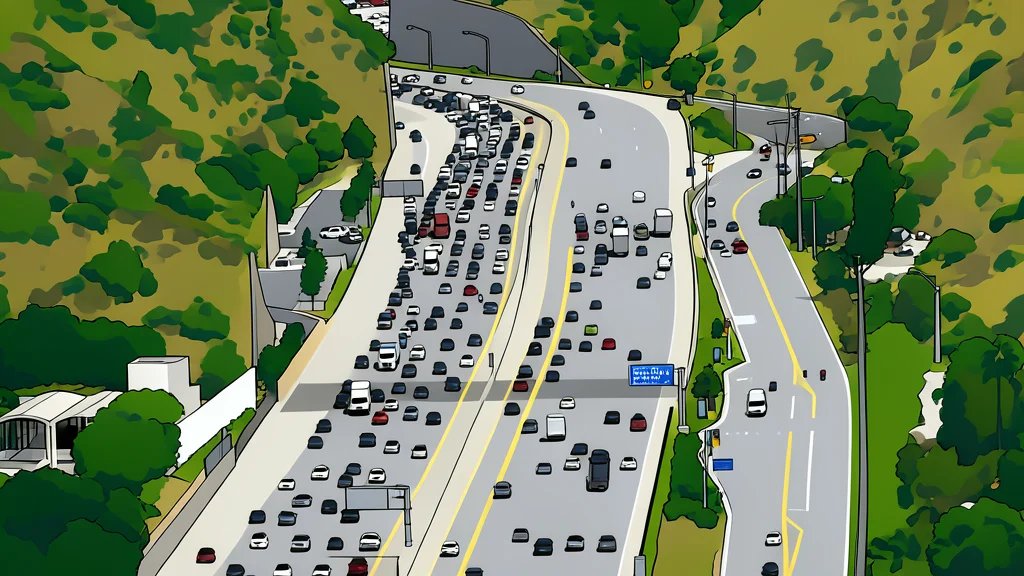
The asphalt of Southern California is being reimagined as a high-speed artery for athletes, where a single lane deviation costs nearly three hundred dollars.
The sun beats down on the concrete, shimmering heat waves rising off the multi-lane expanse. In the distance, the horizon blurs into a haze of exhaust and anticipation. This is not just a highway; it is a corridor of control. The blue markings are fresh, stark against the gray pavement, cutting through the chaos of daily traffic like a surgical incision. They are the visual anchors of a new order, designed to carve a clear path through the dense urban sprawl of Los Angeles, Orange, and San Diego counties. The air smells of hot tar and diesel, a sensory backdrop to the quiet, bureaucratic machinery of enforcement that is quietly waking up along these 369 miles of road.
For the next two weeks in July 2028, and again in late August, these roads belong to the Games. The network, detailed by GN auto sports/multisport: Olympic Games sources, transforms familiar freeways into exclusive channels for athletes, coaches, and officials. The stakes are high. A driver who strays into these designated lanes risks a $293 fine, a penalty enforced not by human eyes but by an automated web of cameras and sensors. The system is cold, precise, and unforgiving. It does not negotiate. It simply records, identifies, and cites. The rhythm of the city’s commute will be disrupted, replaced by the synchronized movement of permitted vehicles gliding through their reserved space.
Automated Eyes On The Road
Enforcement is a digital net cast over the asphalt. Governor Newsom’s signature on California Senate Bill 169 provided the legal framework, allowing state and local authorities to reserve high-occupancy vehicle lanes and other corridors specifically for the 2028 Olympic and Paralympic events. The technology behind this is invisible yet omnipresent. Cameras mounted on overpasses and poles scan the traffic flow, algorithms processing license plates and vehicle identifiers in real-time. There is no room for error in this digital watch. The system distinguishes between the authorized, bearing the specific LA28 decal, and the unauthorized, who are merely passing through. It is a surveillance architecture designed for a specific, temporary purpose, yet its presence is a constant, humming undercurrent in the traffic noise.
The warning period is a brief reprieve, a 30-day window where violations result in a letter rather than a fine. This is the only mercy the system offers. Once that period closes, the financial hammer drops. The fines are substantial, intended to deter casual incursions. The lanes themselves are marked with distinct blue signage, a visual cue that demands attention. For commuters who have driven these routes for decades, the change is jarring. The familiar flow is interrupted by a new hierarchy of access. The road, once a shared public space, becomes a regulated corridor, its usage dictated by a permit and a purpose.
Reshaping The Daily Commute
The impact stretches across major arteries like the 5, 10, 101, 105, 110, 134, 210, and 405. These are the veins of Southern California, pulsing with the daily rush of thousands of vehicles. During the Games, their pulse will change. The carpool lanes, the ramps, and selected lanes will be repurposed, their function narrowed to serve the Olympic mission. The blue markings serve as a boundary, a line in the sand that separates the ordinary from the exceptional. For those without the required permit, the road becomes a maze of restrictions, a landscape where the wrong turn carries a heavy price. The city’s routine is suspended, replaced by the disciplined movement of a global event.
The temporary nature of these restrictions does not diminish their immediate effect. For the duration of the Olympics, running from July 14 to 30, and the Paralympics from August 15 to 27, the road network is a stage. The athletes are the performers, moving in a choreographed dance through the reserved lanes. The spectators are the drivers, watching the blue lines and the fines, feeling the weight of the regulation. It is a moment where infrastructure becomes a narrative, telling the story of a city preparing to host the world, using the only language it knows: the road, the rule, and the consequence.