Shelton and Gauff Carry the Torch for a New Era of American Tennis
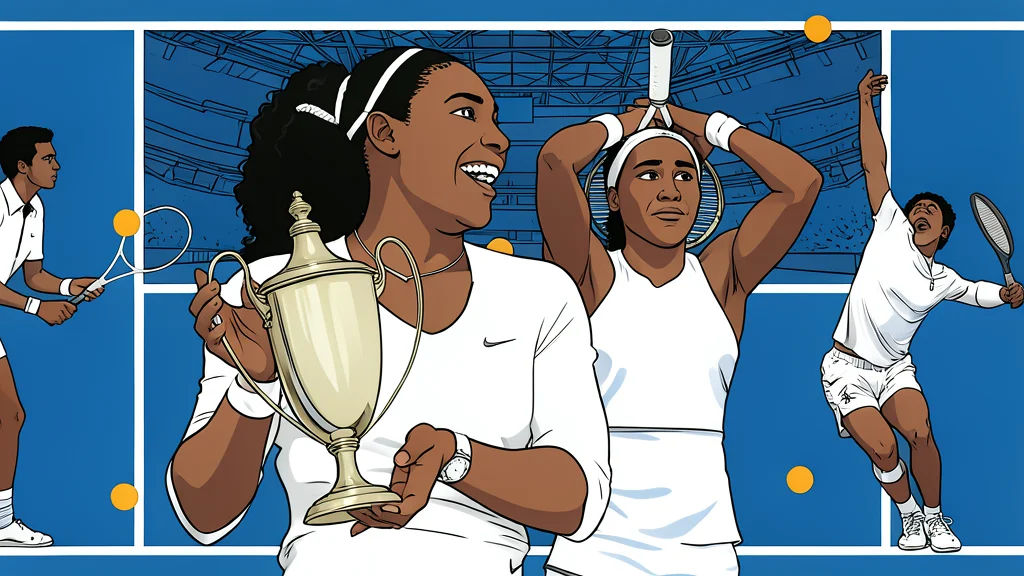
The center court lights hum over a pristine white surface, a stage set for history. Ben Shelton and Coco Gauff stand at the threshold of a legacy forged by those who broke the silence before them.
The air in the stadium is thick with anticipation, the kind that settles over a crowd when the weight of history meets the pulse of the present. On the white clay, the game is more than points and lines; it is a conversation across decades. Ben Shelton and Coco Gauff move with a fluid certainty, their shadows stretching long under the high-arc lights. They are not playing alone. Every swing echoes the rhythm of those who fought for the right to be here, turning a personal victory into a collective testament.
For Shelton, this moment marks a milestone that has waited fifty-two years. He is the first Black man to reach the U.S. Open final since Arthur Ashe in 1972. The stadium that bears Ashe’s name now hosts a player who carries that same quiet defiance. It is a physical continuation of a story that began in the mid-twentieth century, where barriers were not just social but structural. The net stretches across the center, a simple piece of cord yet a profound symbol of the division that has been slowly, stubbornly, dismantled by talent and tenacity.
A Lottery Ticket and a Hard-Won Place
The path to this moment was paved with exclusion. In 1990, a young James Blake stood outside a tournament in central Connecticut, his number lost in a draw that felt rigged against him. The organizers promised a spot later, then refused it. His mother’s anger was the only thing that kept him in the game. He won that match, but the memory of being turned away stayed with him. It was a visceral reminder that access to the sport was not guaranteed for Black players. That struggle created a resilience that defines the current generation. They do not just play; they prove their right to be there, again and again.
The Flag Bearer’s Quiet Reflection
Coco Gauff sits in a quiet room in Paris, the weight of the American flag a physical and symbolic burden. She was chosen to carry it at the 2024 Olympics, a vote that reflected her stature as a defining star of her generation. The tears that fell then were not just for the honor, but for the lineage. She sees herself as a thread in a tapestry woven by Althea Gibson, the Williams sisters, and Sloane Stephens. Their presence in a sport once considered exclusively white is no longer an anomaly; it is an expectation. Gauff’s journey from a young player to a flag bearer mirrors the broader shift in who gets to represent the nation on the global stage.
The narrative is reinforced by the doubles court, where Taylor Townsend and Robin Montgomery stand as evidence of a deepening talent pool. Townsend’s victory with Kateřina Siniaková completes her career Grand Slam in doubles, a feat that underscores her versatility and endurance. Montgomery, recovering from injury, brings a fresh energy to the field. These are not isolated achievements; they are part of a sustained surge in Black American tennis. The sport is no longer a single spotlight but a broad beam, illuminating multiple paths to excellence. The juniors watching from the stands see a future where their presence is not a surprise but a certainty.
A Semifinal That Redefines the Court
The first Grand Slam semifinal between two Black American men, Frances Tiafoe and Ben Shelton, played out with a intensity that transcended the score. It was a clash of styles, of personalities, of generations. Tiafoe’s aggression met Shelton’s precision, and the crowd felt the electricity of a moment that had never been seen before. This match was not just about who would advance; it was about who would carry the torch next. The outcome matters, but the fact that it happened is the true victory. It signals that the narrative is no longer about breaking barriers but about defining them. The sport is evolving, and these players are the architects of its new form.