Legion Go Gets External GPU Boost via Thunderbolt
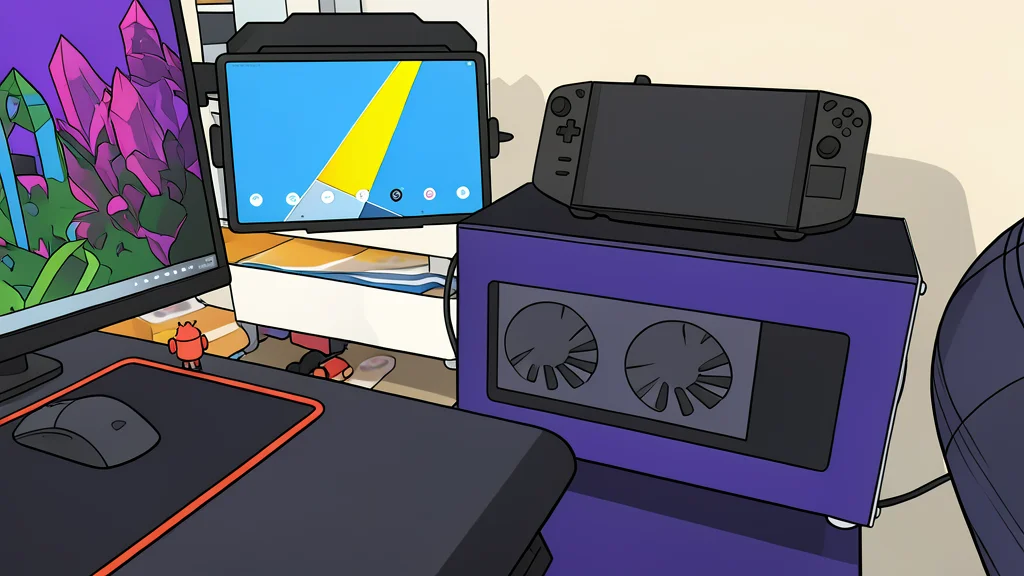
A user pairs a Lenovo Legion Go with an external Radeon RX 9060 XT to bypass handheld performance limits.
Key points
- A Lenovo Legion Go is connected to an external XFX Radeon RX 9060 XT via Thunderbolt 4.
- The external GPU enables higher resolution gaming by offloading tasks from the console's integrated graphics.
- Thunderbolt 4 bandwidth limits prevent the use of top-tier cards, creating a performance bottleneck.
Handheld gaming consoles offer portability but often compromise on graphical fidelity. To resolve this, a user detailed a setup that connects a Lenovo Legion Go to an external graphics card, effectively turning the portable device into a more powerful desktop-class gaming machine.
The project, reported by root-nation.com, uses a Thunderbolt 4 connection to offload processing tasks from the console’s integrated graphics to a dedicated external unit. This approach allows for higher resolution and smoother frame rates in demanding titles, though it introduces specific bandwidth limitations.
Integrated graphics face resolution limits
The Lenovo Legion Go features an AMD Ryzen Z1 Extreme processor and 16 GB of RAM, which is sufficient for everyday tasks and medium-resolution gaming. However, when pushing the screen to its maximum 2560 by 1600 resolution, performance drops significantly in modern AAA titles.
While games like GTA V and The Witcher 3 run acceptably at medium settings, demanding scenes require lowering graphical quality. The user identified this trade-off as the primary motivation for seeking an external solution to maintain high fidelity without sacrificing frame rate.
External card handles heavy workloads
To address these limitations, the setup incorporates an XFX Radeon RX 9060 XT Swift 8GB OC. This card is connected via the console’s USB-C Thunderbolt 4 port, allowing the dedicated GPU to handle the intensive graphical rendering required for high-resolution gaming.
This configuration removes the burden from the console’s integrated graphics, enabling a smoother experience on a large monitor. The result is a hybrid system that retains the portability of the handheld while delivering performance closer to a traditional desktop PC.
Bandwidth creates a performance ceiling
The effectiveness of this setup is constrained by the bandwidth of the Thunderbolt 4 connection. Because the data transfer speed between the console and the external card is limited, the system cannot fully utilize the potential of high-end graphics hardware.
Consequently, the user selected a mid-range card rather than a top-tier model to avoid a bottleneck. While the external GPU significantly improves performance over the integrated graphics, the connection speed prevents it from matching the raw power of a discrete desktop graphics card.