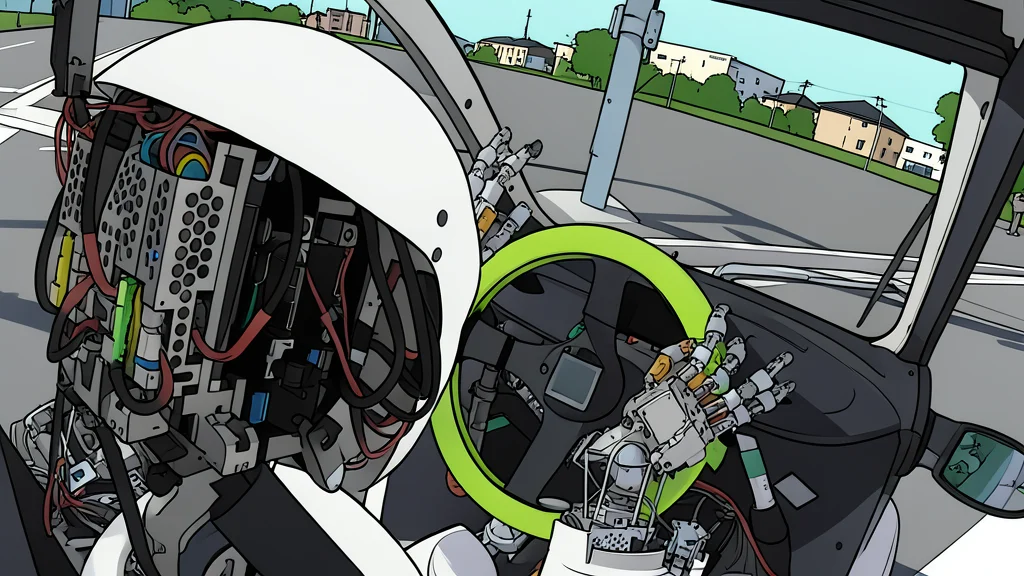
Humanoid Robots Master Sparse Structures

New research demonstrates that bipedal robots can now navigate thin, overhanging metal structures with agility, raising questions about future physical interactions in complex environments.
Researchers at ETH Zurich have developed a method that allows humanoid robots to traverse sparse three-dimensional structures, such as monkey bars. This capability requires the robot to perceive thin geometry and execute precise, whole-body motions to jump onto the structure, move across it, and land safely. The work highlights a significant step in robotic locomotion, moving beyond flat surfaces into complex spatial challenges.
The ability to navigate such environments is not merely a technical feat but a practical shift in how these machines interact with the physical world. As noted in a recent roundup of robotics advances by GN auto tech/robotics, the list of obstacles humans can use to outmaneuver robots is shrinking. This progress suggests that future deployments may involve robots operating in cluttered, non-standardized spaces where traditional wheeled or tracked vehicles would fail.
Perception Challenges in Sparse Geometries
Traversing structures like monkey bars presents a unique difficulty for visual systems. Unlike solid ground or wide beams, these bars are thin and often overhang into empty space. The robot must accurately calculate the position of these small footholds while maintaining balance. This requires a tight integration of perception and control, allowing the machine to react to visual data in real-time without relying on pre-mapped paths.
Existing methods for agile locomotion often struggle with visual occlusions or limited generalization. The new framework introduced by the ETH Zurich Robotic Systems Lab uses a unified reinforcement learning approach. By incorporating a novel attention-based map encoder, the robot can better interpret the spatial layout of the environment. This reduces the reliance on end-to-end sensorimotor models that are often hard to interpret and difficult to adapt to new scenarios.
Implications for Urban Search and Rescue
The practical stakes of this research become clear when considering disaster zones. Urban search and rescue operations, such as the documented efforts after the September 11 attacks, often involve navigating through rubble, stairwells, and collapsed structures. Robots that can climb and traverse irregular geometry could potentially access areas where human rescuers face high risk or where conventional equipment cannot fit.
While previous robots helped locate remains and search routes in the past, they lacked the agility to handle complex vertical or sparse structures independently. The ability to jump and balance on thin bars suggests a future where robots can operate in more dynamic and hazardous environments. This does not replace human intuition but expands the physical reach of automated assistance in critical infrastructure and emergency response.
Trade-offs in Generalization and Agility
There is a inherent tension between agility and generalization in legged locomotion. Methods that demonstrate high agility on specific parkour courses often rely on specialized models that do not transfer well to other terrains. Conversely, systems designed for broad generalization may lack the speed and precision needed for difficult maneuvers. The new approach attempts to bridge this gap by using attention mechanisms to focus on relevant parts of the environment, improving both adaptability and control.
However, this technology is not without limitations. The complexity of real-world environments, including unpredictable debris or changing lighting, poses challenges that controlled lab settings do not fully capture. Furthermore, the computational load required for real-time perception and control may limit battery life or processing power in field conditions. As these systems move toward industrial applications, balancing performance with reliability remains a critical engineering hurdle.