CERN Detects Unusual Gluon Behavior Inside Atomic Nuclei
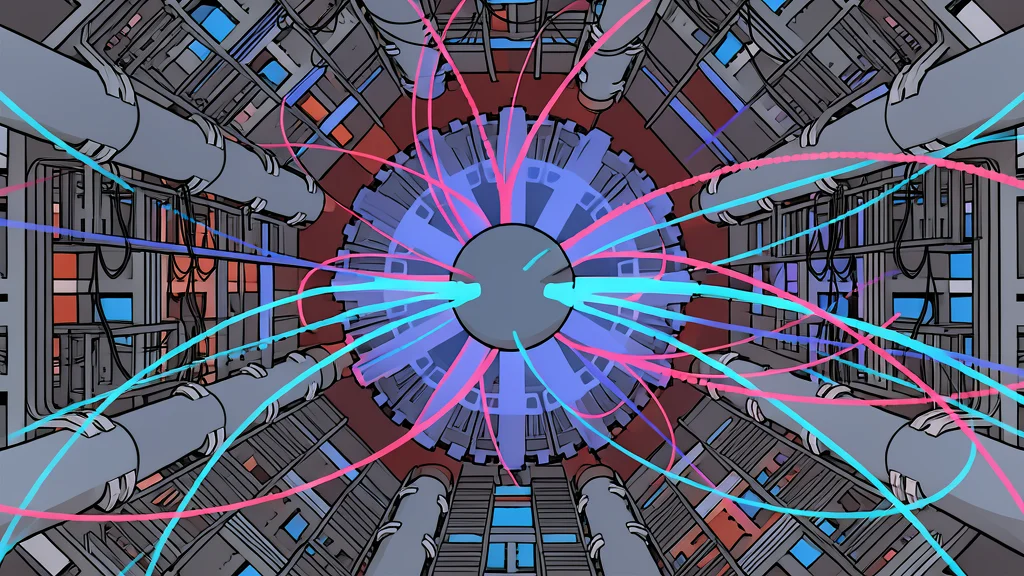
New measurements at CERN reveal that gluons inside atomic nuclei do not behave as standard models predict, offering a sharper view of how matter gains its mass.
Physicists at CERN have uncovered a surprising discrepancy in how gluons behave deep within atomic nuclei. Using the ALICE experiment at the Large Hadron Collider, researchers achieved a level of spatial resolution that allows them to see structures as small as one-quarter the size of a proton. This new capability distinguishes between two competing theories about the internal structure of matter.
The findings, reported by ScienceDaily, show a significant drop in the production of a particle called the J/ψ at these tiny scales. Conventional models of nuclear shadowing struggle to explain this observation, suggesting that our current understanding of how gluons organize themselves inside nuclei is incomplete. The study provides critical evidence that helps resolve long-standing debates in nuclear physics.
Gluons drive the mass of visible matter
While quarks are often described as the fundamental building blocks of protons and neutrons, they contribute very little to the total mass. Instead, nearly all the mass of visible matter comes from the energy associated with gluons and the strong force they mediate. Daniel Tapia Takaki, a professor at the University of Kansas, notes that understanding gluon behavior is essential to explaining how atoms and stars acquire their structure.
This makes the new findings significant because they challenge standard assumptions about how these particles interact. If the distribution of gluons is not what traditional models predict, it could impact our understanding of the strong force itself. The research team used data from lead nuclei passing close to one another, a technique that avoids direct collisions to isolate specific interactions.
High-resolution measurements reveal subtle variations
The researchers used a technique called incoherent J/ψ photonuclear production to measure particle generation with unprecedented detail. By tracking both interaction energy and momentum transfer, they could examine local changes in gluon density rather than just averaging across the whole nucleus. This approach acts like a high-resolution microscope, allowing scientists to see how gluons fluctuate and organize themselves at scales of 0.2 to 0.6 femtometers.
Previous measurements often obscured these small-scale variations, providing a blurry picture of the internal structure. The new method effectively changes the focus of this microscope, revealing distinct patterns that were previously hidden. This precision is crucial for testing theoretical predictions and refining our models of subatomic matter.
Unexplained drop challenges standard models
The most striking result was a surprising drop in J/ψ production at the smallest scales. Standard nuclear shadowing models, which describe how particles interact with dense nuclear matter, do not adequately account for this reduction. This suggests that there may be additional mechanisms at play, such as multiple scattering or saturation effects, that are not fully captured by current theories.
The trade-off for this precision is the complexity of the analysis required. Measuring these effects requires distinguishing between coherent and incoherent processes, a task that demands rigorous data filtering and statistical analysis. However, the potential to resolve these discrepancies offers a pathway to a more complete theory of the strong force, one of the fundamental interactions governing the universe.