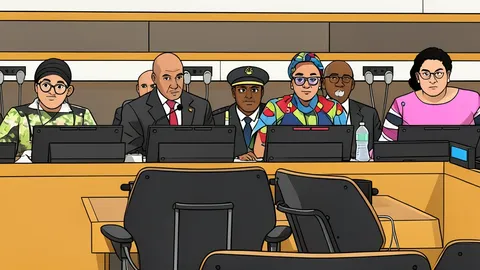
AU Council Convenes on Cross-Border Terror Threats in New York

The African Union’s security body meets in New York to address the continent's dominant role in global terrorism fatalities.
Key points
- The AU Peace and Security Council meets in New York to discuss regional responses to terrorism.
- Africa accounts for 70-75% of global terrorism-related fatalities, with six countries in the top ten.
- Militant groups exploit porous borders in the Sahel, Lake Chad Basin, and Horn of Africa.
The African Union Peace and Security Council is set to convene its 1369th session in New York on 23 September, operating at the ministerial level on the margins of the United Nations General Assembly. According to reports from Amani Africa, the agenda centers on good neighborliness and regional responses to escalating security and terrorism challenges across the continent. The session marks a shift from the originally planned heads of state level, reflecting a pragmatic approach to addressing the complex nature of cross-border instability.
Corinne Amori Brunet, the Beninese minister of foreign affairs and current PSC chairperson, is expected to lead the proceedings alongside introductory remarks from the head of the AU Commission. The meeting follows a July session where council members expressed deep concern over the expanding reach of armed groups. While global terrorism statistics have shown a slight decline in some regions, Africa continues to serve as the primary epicenter of terrorist violence, a reality that demands coordinated diplomatic and security measures.
Africa Dominates Global Terror Statistics
Recent data presented to the council indicates that Africa accounts for an estimated 70 to 75 percent of all terrorism-related fatalities worldwide. Six of the ten most affected countries globally are located on the continent, including Burkina Faso, the Democratic Republic of Congo, Mali, Niger, Nigeria, and Somalia. This disproportionate burden highlights the urgent need for effective regional cooperation, as the dynamics of conflict in these nations often transcend national borders.
Militant Networks Exploit Borderlands
Terrorist organizations such as JNIM and Islamic State affiliates are increasingly operating across the borders of Burkina Faso, Mali, and Niger, with activity spreading toward Benin and Togo. In the Lake Chad Basin, groups like Boko Haram and ISWAP utilize the porous borders shared by Nigeria, Niger, Chad, and Cameroon. The emergence of new factions, such as Lakurawa near the Nigeria-Niger border, further complicates the security landscape, demonstrating how transnational supply networks expose the limitations of state-centric responses.
In the Horn of Africa, Al-Shabaab remains a significant threat in Somalia and neighboring regions, while the Allied Democratic Forces in eastern DRC continue to operate across a frontier affected by multiple armed groups. Additionally, the insurgency in Mozambique’s Cabo Delgado province has persisted for nearly a decade, illustrating the long-term nature of these conflicts. The regional consequences of other disputes, such as the war in Sudan, are also generating displacement and security pressures that spill over into neighboring countries, evolving into a broader regional conflagration.
Challenges to Regional Cooperation Mechanisms
Despite the establishment of various continental and regional mechanisms, including the AU Counter-Terrorism Centre and the Multinational Joint Task Force, their effectiveness is often hampered by political fragmentation. Deteriorating relations among neighboring states make the cooperation required for these bodies to function effectively increasingly difficult to achieve. The upcoming session offers an opportunity to move beyond mere technical reviews of threats and focus on the political will necessary to sustain these collaborative efforts.
As the council deliberates, the focus will likely remain on how to strengthen the 'good neighborliness' required to combat groups that thrive on cross-border movement. The success of future security strategies will depend on the ability of African states to align their policies and resources, overcoming the fragmentation that has allowed militant networks to exploit gaps in national security architectures.