Egypt's Chinese Investment Surge Outpaces Trade Deficit
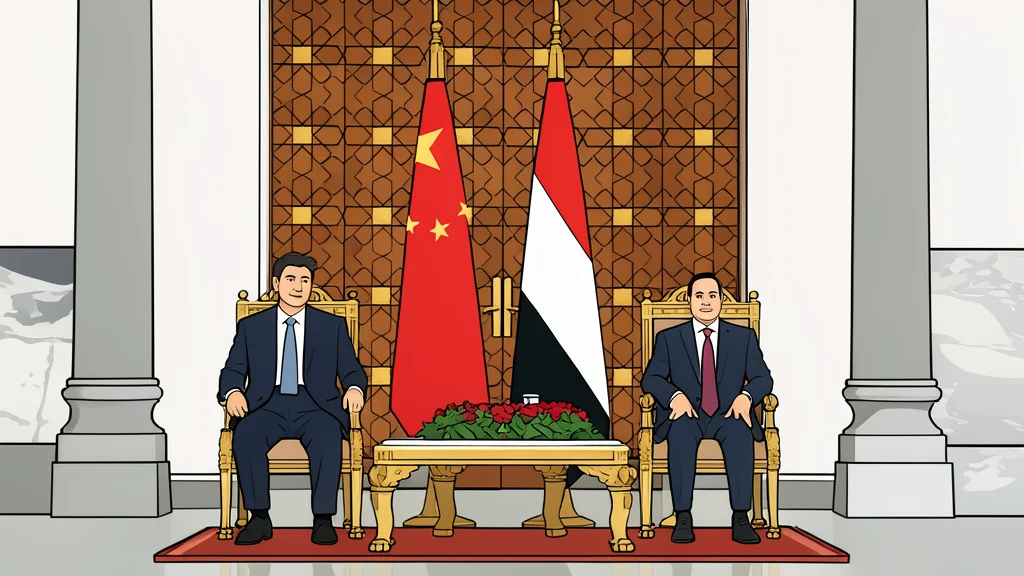
While trade imbalances persist, new Chinese capital flows into Egypt are accelerating, shifting focus toward domestic production capacity.
Key points
- Egypt’s trade deficit with China reached approximately $10.6 billion in the first half of 2026, driven by high import volumes.
- New Chinese direct investment in Egypt hit between $1.5 billion and $2 billion in early 2026, surpassing the previous year's total stock.
- Egyptian exports to China grew by 66.9 percent year-on-year in June 2026 following the implementation of zero-tariff treatment.
The economic relationship between Egypt and China is currently defined by a significant asymmetry in goods exchange, with Cairo running a persistent trade deficit. However, policymakers in the region are increasingly shifting their strategic focus away from balancing trade books and toward attracting direct foreign investment. This pivot suggests that the value of the partnership may lie less in the volume of imported goods and more in the industrial capacity and supply chain integration that such capital brings to the Egyptian economy.
According to The Diplomat, this shift represents a maturing of the bilateral relationship, which dates back to 1956 when Egypt became the first African state to establish diplomatic ties with Beijing. While the trade imbalance remains a statistical reality, Egyptian officials argue that the incoming investment offers a more sustainable path to economic modernization than trade adjustments alone could provide.
Trade deficits remain a structural feature
Chinese customs data indicates that the disparity in bilateral trade remains substantial. In the first half of 2026, Egypt exported approximately $596 million worth of goods to China, while imports from the Asian giant reached $11.2 billion. This pattern is not unique to Cairo; it mirrors the experience of South Africa, the continent's largest economy, which also maintains a persistent deficit with Beijing.
Despite this imbalance, recent policy changes have begun to impact export volumes. Following China’s introduction of zero-tariff treatment for African products, Egyptian exports to China rose by 66.9 percent year-on-year in June 2026. While analysts caution that a single month’s data is insufficient to confirm a long-term trend, the increase marks a notable departure from previous seasonal fluctuations.
Investment flows accelerate beyond historical norms
The momentum in the relationship is perhaps best captured by the surge in direct investment. Although Egypt accounts for only 3.2 percent of China’s total investment stock in Africa, the absolute value of that stock has grown steadily since 2017, reaching $1.4 billion in 2024. Recent figures suggest this growth is intensifying rather than plateauing.
Mustafa Ibrahim, vice chairman of the Egyptian-Chinese Business Council, stated that Egypt attracted between $1.5 billion and $2 billion in new Chinese investment during the first half of 2026. This amount exceeds the total investment stock recorded in the previous year, indicating a rapid acceleration in capital deployment that goes beyond routine maintenance of existing projects.
Strategic focus shifts to value addition
Egyptian economic strategy now emphasizes agricultural processing, mineral beneficiation, and broader value addition. The goal is to capture more of the supply chain within the country, allowing for the production of goods that can serve not only the Chinese market but also third-party markets. This approach decouples the success of the bilateral relationship from the need to balance the trade ledger.
As the region looks forward, the key question is whether this influx of capital will successfully transform Egypt’s industrial base. Observers will watch whether the new investments lead to tangible increases in local production capabilities and whether the recent export growth sustains beyond the initial tariff benefits.