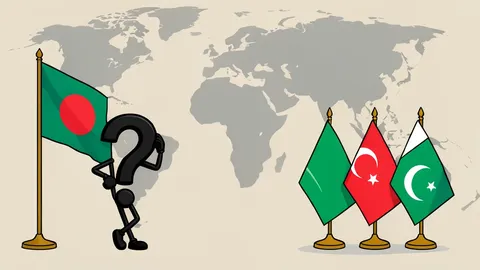
Pakistan-China Activate Border Commission, Drawing Sharp Indian Rejection
Delhi rejects the new joint mechanism as legally baseless, citing claims over the Shaksgam Valley and the unresolved Kashmir dispute.
Key points
- Pakistan and China operationalized a joint boundary commission, a move India rejected as having no legal basis.
- The commission covers the Shaksgam Valley, a 5,180 sq km area India claims as part of its territory.
- Experts note the timing reflects China's broader border demarcation efforts and Pakistan's desire for stable frontier management.
Pakistan and China have moved to institutionalize their border management by operationalizing a joint boundary commission, a step that has immediately triggered a sharp diplomatic response from New Delhi. According to BBC reporting, the two nations described the activation as a significant milestone for cooperation, but India rejected the move outright, stating it does not recognize any boundary involving territory it claims as its own.
The controversy centers on the Shaksgam Valley, a roughly 5,180 square kilometer tract that Pakistan ceded to China in 1963 but which India considers part of its territory in Ladakh. Indian officials argue that Pakistan has no legal standing to make arrangements concerning this land, while Islamabad maintains that the 1963 agreement is valid and that Kashmir remains a disputed territory.
Diplomatic friction over historical claims
India’s foreign ministry spokesman Randhir Jaiswal stated that the commission lacks any legal basis and that New Delhi rejects the arrangement entirely. The Indian position holds that the territory was illegally occupied by Pakistan before being transferred to China, rendering the 1963 treaty invalid in its eyes. This dispute complicates broader diplomatic efforts, as India and China are currently seeking to stabilize their relationship after years of military tensions along the Line of Actual Control.
Timing of commission activation
Jabin T Jacob, a professor at Shiv Nadar University, noted to the BBC that the commission is not a new entity but a revival of a mechanism provided for in the 1963 Sino-Pak Agreement. He suggested the timing may reflect China’s broader efforts to demarcate its boundaries and institutionalize movement along a frontier, especially as Pakistan’s other borders have experienced instability. Jacob argued that the activation appears to disregard Article 6 of the treaty, which allows for renegotiation once the Kashmir dispute is settled.
Strategic implications for regional security
Husain Haqqani, a senior fellow at the Hudson Institute, described the commission as both practical and political. While Pakistan and China already possess extensive infrastructure links, including the China-Pakistan Economic Corridor, the new formalization signals a deeper integration of border management. For India, the challenge is compounded by what Jacob described as China’s relative dominance in the international information landscape, allowing Beijing to project its narrative and maps globally while New Delhi’s objections often go unheard by other capitals.