Sweden's Andersson Faces Complex Coalition Build
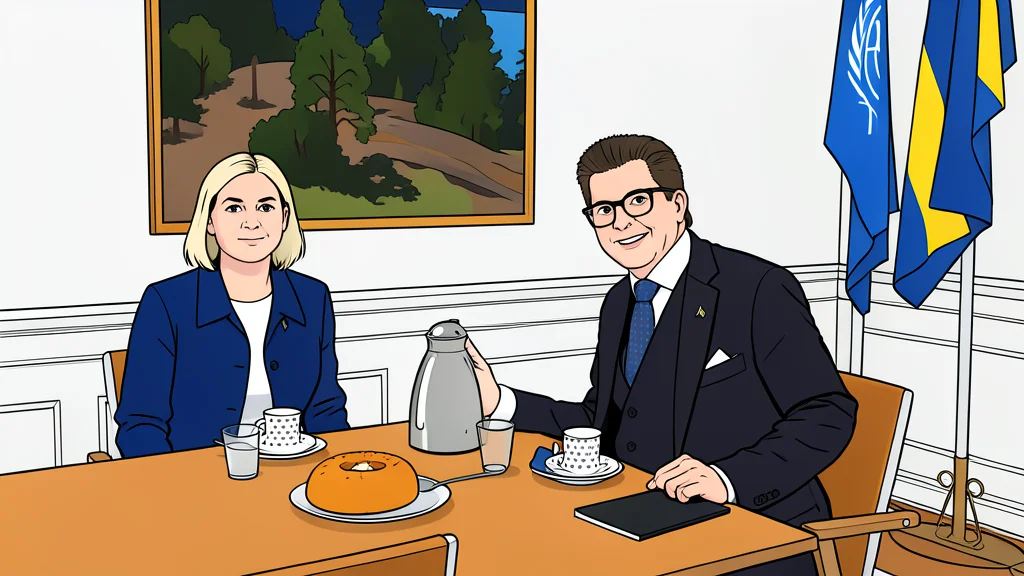
Magdalena Andersson has been tasked with forming a government after a narrow left-wing victory, facing significant ideological hurdles within her bloc.
Sweden’s political landscape has entered a delicate phase following the recent general election, with parliament speaker Ebba Busch having formally tasked Magdalena Andersson with the responsibility of forming a new administration. According to reports from GN geopolitics/politics, Andersson, the leader of the Social Democrats and former prime minister, must now navigate a fragmented left-wing bloc to secure a stable majority. The task is particularly arduous because the four parties comprising the left-wing coalition hold only a three-seat advantage in the 349-seat Riksdag, leaving little room for error in coalition negotiations.
The core challenge for Andersson lies in bridging deep ideological divides among her potential partners. The coalition includes the Social Democrats, the socialist Left Party, the liberal Centre Party, and the Greens. While the Left Party insists on cabinet representation to support any left-wing government, the Centre Party has explicitly ruled out a government that includes the Left Party in the cabinet. This fundamental incompatability creates a significant obstacle, as Andersson must find a way to unite these factions without alienating key partners, a feat that remains uncertain given the narrow margin of victory.
Ideological Divides Within the Bloc
The internal fractures within the left-wing alliance present the primary hurdle to government formation. The Centre Party, which holds the balance of power, has maintained a firm stance that it will not participate in a cabinet that includes the Left Party. Conversely, the Left Party has stated it will only support a government of which it is a member. This deadlock forces Andersson into a complex diplomatic maneuver, requiring her to either convince the Centre to drop its conditions or find an alternative configuration that satisfies the Left’s demands for ministerial posts, a scenario that many analysts view as highly precarious.
Andersson, who served as Sweden’s first female prime minister from 2021 to 2022, has acknowledged the difficulty of the task. In a statement released on social media, she expressed her intention to act constructively and form a government that reflects the direction voted for by the Swedish people. Her emphasis on unity and forward movement underscores the high stakes involved, as a failure to form a government would likely result in prolonged political instability and potentially a return to the right-wing alliance led by the outgoing prime minister.
Timeline and Potential Outcomes
The window for forming a government is constrained by the parliamentary calendar. According to parliamentary rules, Andersson is expected to report on her progress by September 28, when the new parliament convenes for its first session to elect a new speaker. Historical precedents suggest that such negotiations can be lengthy; the last government formation took 37 days, while a previous coalition process extended over four months. The pressure to meet the September deadline adds urgency to the talks, with observers closely watching for signs of compromise or breakdown.
If Andersson fails to secure a majority, the alternative path involves Ulf Kristersson, the leader of the right-wing alliance, attempting to build a government with the support of the anti-immigration Sweden Democrats. However, the current mandate appears to favor the left, making a right-wing coalition less likely but not impossible. The outcome of these negotiations will determine the direction of Sweden’s domestic and foreign policy, including its stance on European integration and defense spending, making the next few weeks critical for the country’s political stability.
Forward Outlook for Swedish Politics
As the coalition talks intensify, attention will turn to the specific policy compromises required to bridge the gap between the Centre and the Left. Key issues such as immigration policy, environmental regulations, and economic stimulus measures are likely to be central to the negotiations. The ability of Andersson to navigate these sensitive topics while maintaining the support of her party colleagues will be the deciding factor in whether Sweden achieves a stable government or faces further political uncertainty.
Ultimately, the success of this government formation process will hinge on the willingness of the four left-wing parties to prioritize national stability over ideological purity. The coming weeks will provide clear indications of whether a workable coalition can be forged, setting the stage for Sweden’s next phase of governance in a complex geopolitical environment. The political community and international observers will be watching closely for any breakthroughs or stalemates in the negotiations.