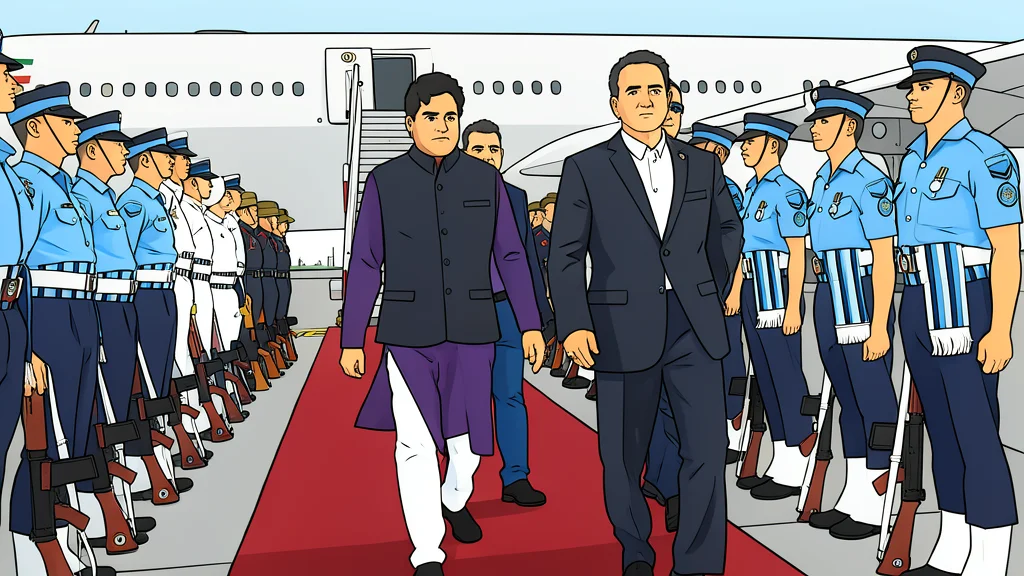
BRICS Summit in India Addresses Global Tensions and Unity

Leaders of emerging economies convened in New Delhi to address rising geopolitical conflicts and the need for a more multipolar world order, issuing statements on nuclear safety and sanctions.
The BRICS group of emerging economies gathered in New Delhi on Saturday to address intensifying global conflicts and reassert its role in international affairs. The summit brought together leaders from Brazil, Russia, India, China, South Africa, and other member states, who collectively represent a significant portion of the world's population and economic output. According to the joint statement released during the meeting, the bloc expressed deep concern over recent escalations in the Middle East and criticized the use of unilateral sanctions that have not been authorized by the United Nations Security Council.
The discussions were heavily influenced by the ongoing war in Ukraine and the recent hostilities involving Iran, which have strained relationships among member states with competing geopolitical interests. While the group sought to project a united front, the presence of leaders such as Iranian President Masoud Pezeshkian, Russian President Vladimir Putin, and Chinese President Xi Jinping highlighted the complex dynamics within the alliance. The summit serves as a critical test for BRICS' ability to maintain consensus in the face of external pressure and internal divergences regarding global security and economic policy.
Condemnation of Unilateral Sanctions
A central theme of the summit was the rejection of economic measures imposed by Western nations without UN approval. The joint statement called for the elimination of what it described as unlawful measures that undermine international law and the principles of the UN Charter. Although no specific countries were named in the condemnation, the criticism was widely interpreted as a response to the sanctions regime placed on Russia following its invasion of Ukraine in 2022. According to reports from the GN geopolitics/summit coverage, this stance reflects a broader desire among BRICS members to challenge the dominance of Western-led financial institutions and promote alternative mechanisms for global trade.
The leaders also voiced strong concerns regarding nuclear safety, specifically condemning deliberate attacks on civilian infrastructure and peaceful nuclear facilities under UN safeguards. This language was seen as an indirect reference to recent strikes on Iranian nuclear sites by the United States and Israel. The bloc emphasized that nuclear security must be protected even during periods of armed conflict, signaling a firm position against actions they view as violations of international norms and the stability of the non-proliferation regime.
India Positions Bloc as Neutral
As the host nation, India sought to clarify the group's intent to alleviate fears that BRICS is forming a direct counter-alliance to the West. Prime Minister Narendra Modi stated that the bloc is not against any specific country or group, but rather represents a
Calls for Multipolar Reforms
Russian and Chinese leaders used the platform to advocate for structural changes in global governance institutions. President Putin argued that the United Nations Security Council should be expanded to include greater representation from Asia, Africa, and Latin America, claiming that the current structure is outdated and ineffective. He accused certain nations of resisting the shift toward a multipolar world by using tariffs, sanctions, and force to contain emerging economies. According to Russian state media, Putin maintained that Russia still views the UN Charter as the foundation of international law, despite the tensions with Western powers.
Iran has also pushed for mechanisms to reduce the bloc's reliance on Western financial systems, proposing the expanded use of national currencies in trade to shield members from economic pressure. The forward question for BRICS remains whether these diplomatic statements can translate into concrete financial and political outcomes. Observers will watch closely how the group navigates the divergent interests of its members, particularly regarding the Middle East conflict and the broader contestation of global trade rules, as it seeks to solidify its status as a major voice for the Global South.