Aliyah Boston Claims Gold Amidst Team USA's Resurgence
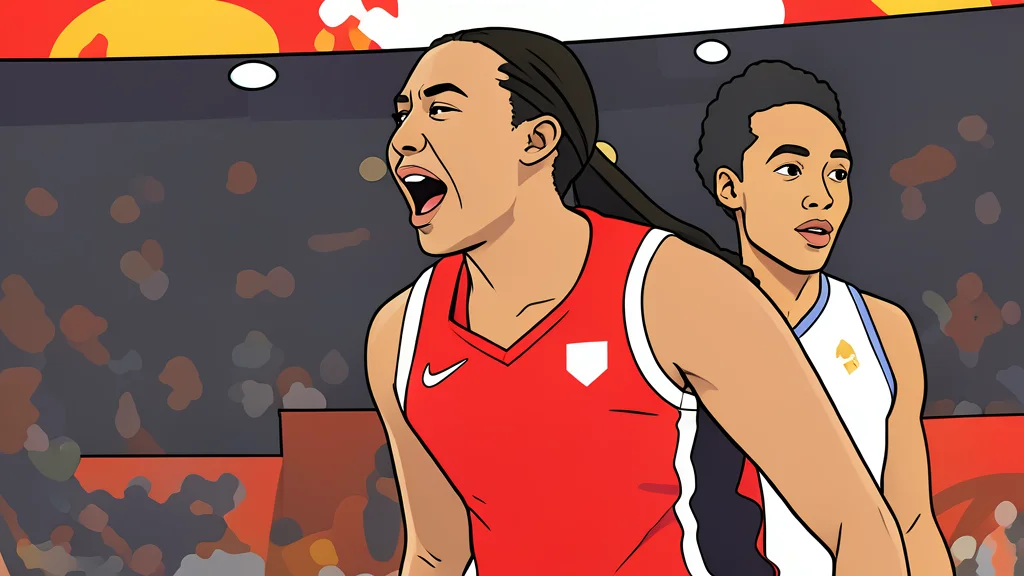
The arena air hums with tension as Team USA claws back from a double-digit deficit, culminating in Aliyah Boston's first senior gold medal.
The arena air hangs heavy, charged with the static of a rivalry. In Berlin, the scoreboard glows red as France holds a commanding lead, the French crowd roaring with the confidence of a team that has swept through the tournament. But the momentum shifts, a subtle tectonic movement in the game’s rhythm. Team USA, led by a steady hand from the bench, begins to erode the gap. The noise in the stadium transforms from a single tone of celebration to a complex, layered roar of disbelief and hope.
Aliyah Boston, the lone true post on the floor, steps into the void left by A’ja Wilson’s injury. She does not just play; she anchors the offense, driving through traffic with a physicality that reshapes the defensive geometry. The final buzzer sounds, and the gold medal is secured. It is a victory that feels less like a routine win and more like a testament to resilience, a story reported by GN sports/basketball (en-US) that highlights the depth of American talent.
The Final Quarter Shift
Coach Kara Lawson makes the call that defines the game. With the deficit at fourteen points, she turns to her veterans and Boston, the only reserve on the floor. The response is immediate and violent in its efficiency. A 23-14 run tears through the second quarter, closing the gap before halftime. The third quarter becomes a statement, the Americans outscoring France 30-12 to seize total control of the contest.
Boston’s performance is a masterclass in composure. She scores seven points in the final, her touches deliberate and precise. The team’s ability to pivot from a potential collapse to a dominant victory underscores a legacy of excellence. Since 1998, the United States has lost just one World Cup game, a statistical anomaly that speaks to the institutional strength of the program.
A New Era of Depth
The absence of A’ja Wilson and Kelsey Plum due to health concerns opened a door that might have remained closed. It allowed players like Boston, Angel Reese, and Caitlin Clark to step into the spotlight. This was a youth movement in real-time, a generational shift that France nearly capitalized on. Yet, when the stakes rose, the veterans—Breanna Stewart, Chelsea Gray, and Jackie Young—provided the necessary steadiness.
Stewart, the tournament MVP, and Young, the player of the game, were the architects of the closing minutes. Their experience balanced the raw energy of the newcomers. Boston’s role, while not that of a starter, was pivotal. She provided the interior presence that France lacked, a physical counterweight to their perimeter-heavy attack.
Gamecock Impact on Global Stage
The connection to South Carolina extends beyond Boston. Maryam Dauda, another Gamecock, made her debut for Nigeria. Though her minutes were limited, she scored her first World Cup basket in a blowout loss to France. This participation highlights the global reach of the program’s talent development.
Other current and former players, including Agot Makeer and Ayla McDowell, played for their national teams earlier in the summer. Their countries, Canada and Brazil, did not qualify for this year’s World Cup. Alicia Tournebize, a sophomore, was on France’s preliminary roster but was cut due to injury. The story of the 2026 World Cup is one of unity, resilience, and the seamless transition of leadership.