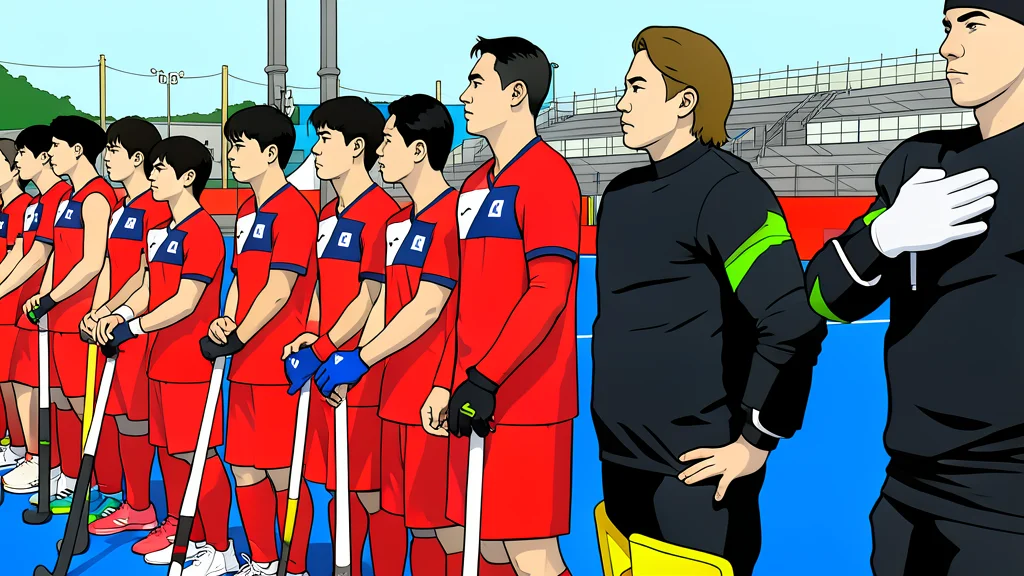
Green Stadium Sets Stage for Asian Hockey Showdown

The turf is laid, the lines are white, and the air in Kakamigahara hums with anticipation. Two tournaments, twelve teams each, and a single field where history is rewritten in strokes of green and white.
The Gifu Prefectural Green Stadium stands quiet under the Japanese sun, its artificial turf a vivid, unbroken expanse of green stretching toward the horizon. White boundary lines cut sharp, geometric paths across the surface, framing the space where twelve men’s and twelve women’s teams will soon collide in a bid for gold. The air carries the faint, chemical scent of fresh turf, a sensory marker of the high-stakes arena that awaits the Asian Games 2026.
From September 18 to October 3, this field becomes the crucible for the continent’s finest hockey talent. The competition splits into distinct men’s and women’s tournaments, each featuring twelve nations divided into two pools of six. It is a structure of pure elimination and advancement, where every pass, every drive, and every save counts toward a singular goal: the top two spots in each pool.
Defending Champions Prepare to Strike
India enters the men’s tournament as the reigning champion, their gold medal from Hangzhou 2023 still gleaming in memory. Their rivals in Pool A include host nation Japan, South Korea, Bangladesh, Sri Lanka, and Indonesia. The dynamics are tight, with every match a potential turning point. In Pool B, Pakistan anchors a group featuring Malaysia, China, Oman, Uzbekistan, and Thailand, creating a dense cluster of competitive depth where no single team holds a clear, insurmountable advantage.
On the women’s side, the People’s Republic of China holds the title, their presence in Pool A alongside South Korea, Malaysia, Kazakhstan, Chinese Taipei, and Bangladesh setting a high bar for performance. India, positioned in Pool B, faces a gauntlet of opponents including Japan, Thailand, Singapore, Indonesia, and Uzbekistan. The stakes are identical, the intensity undiminished, as both sets of teams prepare to test their mettle on the same pristine surface.
Structure Defines the Path to Gold
The format is a single round-robin pool stage, a straightforward yet unforgiving system. Each team plays every other side in its pool once, with the top two advancing directly to the semi-finals. The remaining four teams in each tournament do not falter; they pivot immediately into classification games, fighting for placement and dignity in a competition where the margin between victory and defeat is often measured in seconds.
For the men, the pool stage concludes on September 28, leading into classification matches and semi-finals on October 1. The final two days, October 3, are reserved for the bronze and gold medal matches, the culmination of weeks of grueling preparation. The women’s schedule runs slightly tighter, with pool play ending on September 27, semi-finals on September 30, and the medal matches on October 2. Every date is a milestone, every match a chapter in a larger narrative of athletic excellence.
Early Matches Signal Intense Rivalries
The opening days have already set the tone. On September 18, China dominated Oman 2-0 in Pool B, a statement of intent that echoed through the stadium. In Pool A, South Korea dismantled Bangladesh 5-0, showcasing a lethal attack that will be difficult to contain. These early results, reported by GN auto sports/multisport: Asian Games, highlight the disparity in form and the high stakes that define the tournament from the very first whistle.
Upcoming fixtures promise even greater tension. India faces Indonesia on September 20, a match that will test their ability to control possession against a resilient opponent. Pakistan meets Thailand on the same day, a clash of styles and strategies that could determine the trajectory of Pool B. As the schedule progresses, with matches like India versus Sri Lanka and Japan versus Bangladesh, the field remains a stage for emerging talents and established stars alike, all converging on the same green expanse.