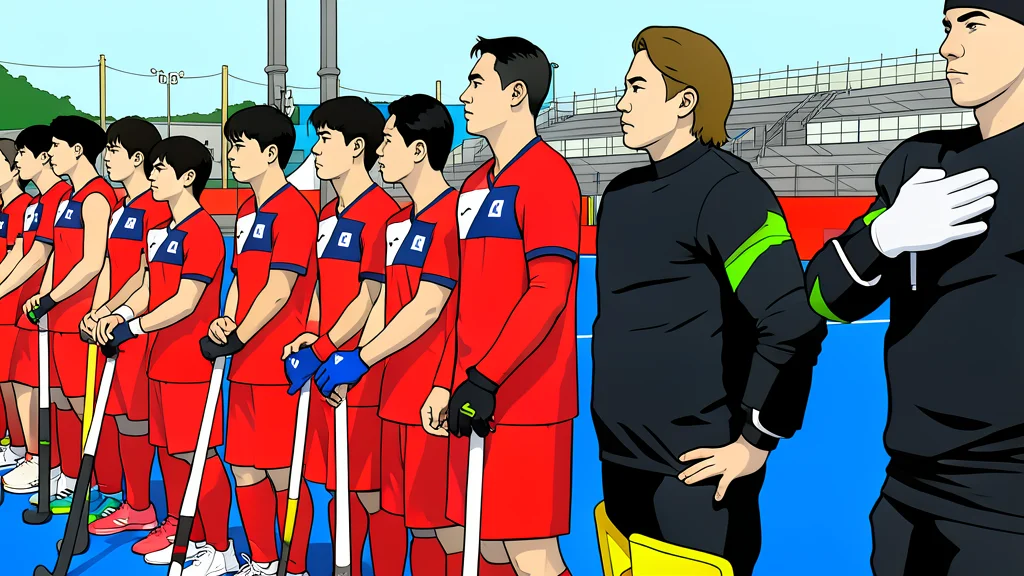
Japan Crushes Indonesia in Hockey Opener

The green turf in Gifu held its breath until the 26th minute, when a single strike shattered the silence. Japan’s road to Los Angeles begins with a seven-goal dismantling of their neighbors.
The artificial grass at Gifu Prefectural Green Stadium glistened under the afternoon sun, a flat, vibrant expanse marked by crisp white lines that seemed to hold the tension of the opening match. For the first twenty minutes, the air was thick with hesitation. Japan, ranked eleventh in the world, circled the net without finding the finish, their early shots either cleared off the woodwork or skimming wide. The silence of the crowd was a physical weight, pressing against the defenders who stood tall but uncertain. Then, in the twenty-sixth minute, the rhythm broke. Shiho Kobayakawa controlled a forward pass into the penalty circle, her body coiling before she unleashed a smash that buried the ball. The net rippled. The ice-like tension melted, replaced by the sudden, kinetic energy of a team finding its pulse.
The rout that followed was less a contest and more a demonstration of control. By the third quarter, the Japanese hosts had turned the penalty corner into a reliable engine, scoring three times in succession. Hiroka Murayama, Amiru Shimada, and Maho Ueno each found the back of the net, their strikes precise and calm. The Indonesian defense, ranked forty-fifth, could not contain the surge. It was a stark contrast to the earlier nervousness, a transformation described by Miyu Suzuki, the squad’s most experienced defender, who noted how she helped steady the team by retaining possession when space was scarce. Her leadership allowed the attackers to flow, creating a tempo that was relentless.
Late Surge Completes the Rout
The final quarter belonged to Suzuki and Hanami Saito. Saito stepped up to a penalty stroke, her motion fluid and decisive, adding to the tally. Suzuki, who had waited patiently for her moment, finished the scoreline with two late strikes. One came from a rebound off a penalty corner, the other from a penalty stroke of her own. Her goals were not just points; they were statements of confidence, capping a performance where Japan rarely faced serious threat. The final whistle marked a 7-0 victory, a clean sheet for the hosts and a clear signal of intent.
Olympic Stakes Define the Path
This win is the first step in a critical journey. Hockey is one of the sports where victory at the Aichi-Nagoya Asian Games serves as a direct qualification route for the 2028 Los Angeles Olympics. Japan holds the weight of history on its shoulders, having claimed gold in Jakarta in 2018 but slipping to fourth place in Hangzhou in 2023. The pressure is palpable, yet the team speaks with a grounded resolve. Suzuki emphasized that while beating India and topping the group is the quickest path to the final, the goal is to grind out results without slacking. The tournament, which officially opens on Saturday, is not just a competition; it is a gateway.
Challenges Await in Pool B
The road ahead is lined with formidable opponents. China, ranked fourth, and India, ranked eighth, stand as the primary rivals for the title. India sits in the same pool, making their upcoming clash a de facto semi-final. Suzuki’s strategy is clear: maintain the intensity displayed against Indonesia and exploit the attacking flow that emerged in the second half. The green field in Gifu has already witnessed one side’s dominance, but the true test lies in sustaining that rhythm against teams with greater depth and power. The stakes are high, the nerves are settled, and the pursuit of Olympic qualification has begun in earnest.