Gateway's Heat: The Brake Crisis that Defined the Race
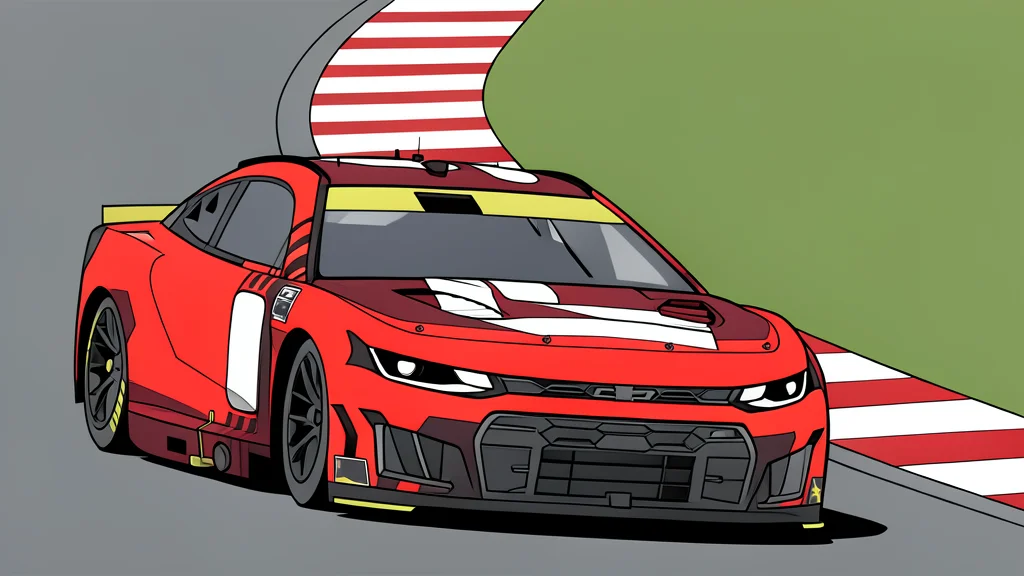
At World Wide Technology Raceway, the metal screamed under the weight of higher horsepower. For many drivers, the finish line was a distant memory as rotors failed and cars spun out, turning a championship weekend into a test of mechanical survival.
The air at World Wide Technology Raceway hangs thick with the metallic tang of overheated steel. Under the new short track rules, the cars hit the long straightaways with terrifying velocity, only to slam into the heavy braking zones where the physics of friction meet the limits of engineering. It is a violent dance. The Enjoy Illinois 300 was never just about speed; it was a gauntlet for the braking systems. As the sun dipped low, casting long shadows across the asphalt, the true story of the race emerged not from the winner’s podium, but from the garages where broken rotors were laid out on the concrete like shed skins.
The higher horsepower package stripped away the downforce that once tamed these high-speed runs, leaving the brakes to do the heavy lifting alone. What began as a competitive advantage for some became a mechanical catastrophe for others. The track, with its long backstretch and sharp turns, acts as a magnifying glass for any weakness in the brake cooling strategy. Teams that failed to account for the increased thermal load found their setups unraveling lap by lap, the pedal getting longer, the pressure fading into a terrifying mush that offered no stopping power.
Championship Contenders Hit the Wall
The chaos was not random; it targeted the very drivers with the most to lose. Zane Smith, navigating the end of Stage 2, felt the sudden betrayal of his hardware as a rotor failed, sending him into a hard impact that ended his race. The damage spread like a ripple across the field. Ryan Blaney, running sixth on Lap 155, lost control and drilled into the frontstretch wall, the carbon fiber of his nose crumpling against the concrete. Minutes later, Chase Elliott suffered a similar fate, his brake failure collecting Chase Briscoe in a chain reaction that underscored the fragility of the situation.
The final caution of the race was not triggered by a contact, but by a mechanical surrender. Chris Buescher, a competitor in the Chase for the Championship, brought out the yellow flag with just three laps remaining after his brakes gave out. For these drivers, the race was effectively over long before the checkered flag waved. The failure of their braking systems dictated their fate, turning a battle of skill into a test of component durability that the cars were not fully equipped to handle.
Engineering Limits Exposed on the Track
Jonathan Hassler, crew chief for Ryan Blaney, admitted the team had misjudged the cooling requirements. “We knew there was a little more demand with this package,” he told NASCAR.com, acknowledging that their conservative setup was still not enough. The issue was not a single defect, but a systemic challenge across the field. Drivers complained of a “long pedal,” a telltale sign of fading brake pressure that signaled imminent failure. The heat generated by the new rules package was simply too much for the standard cooling provisions, creating a perfect storm of mechanical stress.
William Byron’s crew chief, Rudy Fugle, described the strategy as a desperate act of survival. “We were monitoring it,” Fugle said on SiriusXM NASCAR Radio, explaining that they had to encourage Byron to use less pump to avoid creating more heat. It was a choice between performance and survival, a decision that defined the race for many. The ability to survive the race had become more important than the ability to win it, a stark shift in priorities driven by the physical limitations of the equipment.
Variance in Brake Performance
Not all teams suffered the same fate. Bubba Wallace, who challenged for a top five finish, reported that his car felt “brand new” at the finish. His team had spent six years refining their brake package, and that diligence paid off in a race where others crumbled. Wallace’s success highlighted the critical role of setup and strategy in managing the extreme thermal loads of Gateway. While some cars disintegrated under the pressure, others held firm, proving that the issue was not just the track, but how the teams approached it.
The choice of brake pads, allowed to be selected from various vendors, has become a focal point of post-race analysis. There is growing speculation that teams using specific brands, such as Ferodo, have faced particular difficulties at tracks like Nashville and New Hampshire. James Small, crew chief for Chase Briscoe, noted that the challenges at Gateway mirrored issues seen in other series. The data is clear: the new rules package has pushed the brakes to their absolute limit, and the variance in performance is a testament to the complex interplay of heat, cooling, and material science in modern NASCAR.