Hardware that Thinks: The Rise of Physical AI
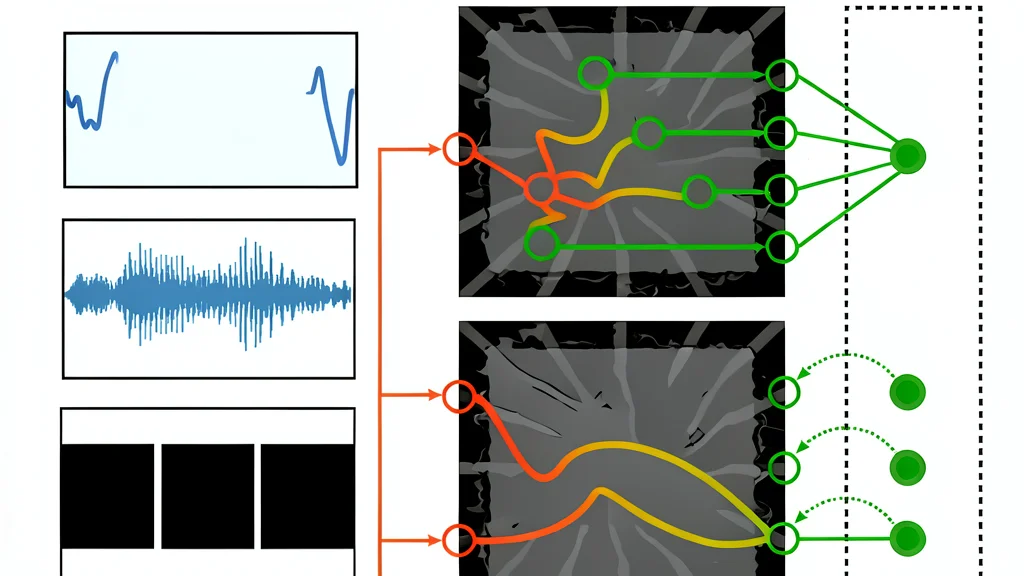
New research suggests that the future of efficient computing lies not in faster chips, but in materials that act like neural networks themselves, offering a low-power path for edge devices.
Traditional silicon chips have powered the digital revolution, but the growing energy and water demands of large-scale AI models are creating a significant strain on infrastructure. As artificial intelligence expands into remote and resource-constrained environments, such as satellites and industrial robots, the need for computing power that operates efficiently at the source of data has become critical. A new approach, detailed in recent scientific literature, proposes a fundamental shift: using physical materials that naturally organize into network structures to perform computation, rather than processing data through software on standard hardware.
This concept, often referred to as physical AI, blurs the line between the device and the algorithm. Instead of executing a neural network model via code, the hardware itself becomes the network. Researchers from UCLA and the University of Sydney have explored this complementary computing method, which utilizes self-organized networks of nanowires or nanoparticles. These microscopic structures form dense, organic-like meshes that can process complex information in real time with significantly lower energy consumption than traditional digital electronics, offering a viable alternative for edge computing applications where bandwidth and power are limited.
Material Structure Serves as Processing Unit
The core innovation lies in allowing the hardware to define the computation. In conventional systems, silicon transistors switch on and off to execute instructions, a process that generates heat and requires substantial cooling. In the new approach, the physical connections within the nanowire network change based on the data they receive. This means the model evolves within the material itself, adapting its structure to process inputs like speech or images directly. Adam Stieg, a research scientist at UCLA, notes that this eliminates the overhead of running software models, as the physical behavior of the network performs the logic. The result is a system that is inherently energy-efficient, capable of handling sensor data locally without transmitting vast amounts of raw information to a central server.
This method is particularly suited for edge computing, where devices must make decisions with limited power and connectivity. For instance, a satellite collecting environmental data currently has to transmit raw signals to Earth for processing, a task that is bandwidth-intensive and slow. With physical AI hardware, the device could filter and interpret the most relevant data on board, reducing the load on communication channels. The technology draws inspiration from the human brain’s cortex, which processes perception and reasoning with remarkable efficiency. By mimicking this biological architecture at the nanoscale, engineers aim to create systems that learn and adapt without the heavy computational footprint of traditional digital processors.
Complementing Silicon in Diverse Applications
Proponents of this technology do not view it as a replacement for silicon, but as a complement. According to a review article published in Nature Reviews Physics, these self-organizing networks are best deployed alongside traditional digital computers. While silicon excels at precise, large-scale data storage and general-purpose computing, physical AI hardware is optimized for real-time, low-power pattern recognition. This hybrid model allows for a distributed computing architecture where local devices handle immediate sensor data, and central servers manage complex, long-term analysis. This division of labor could mitigate the environmental impact of AI growth by reducing the total energy required for data processing and transmission across global networks.
Trade-Offs in Physical Computing Systems
Despite its efficiency advantages, this approach comes with distinct limitations. Unlike digital chips, which offer precise control and repeatability, physical networks are stochastic and difficult to calibrate for specific tasks. The organic nature of the self-organizing material means that each device may behave slightly differently, requiring new methods for standardization and quality control. Furthermore, the technology is still in its developmental stages, and integrating it into commercial products will require overcoming significant engineering hurdles related to stability and longevity. While the potential for energy savings is substantial, the lack of deterministic behavior poses a challenge for applications requiring absolute precision, such as financial transactions or critical safety systems. For now, this hardware remains a promising candidate for specific niche applications where power efficiency outweighs the need for rigid computational control.