Figure Robot Completes 56% of Unseen Home Tasks
Figure's Figure 03 robot handled chores in 30 new homes with a 56% success rate, highlighting significant reliability gaps.
Key points
- Figure's robot completed 56% of chores in 30 unseen homes without retraining.
- Pretraining on human behavior data boosted success from 9% to 56%.
- A 44% failure rate prevents unsupervised daily use in homes.
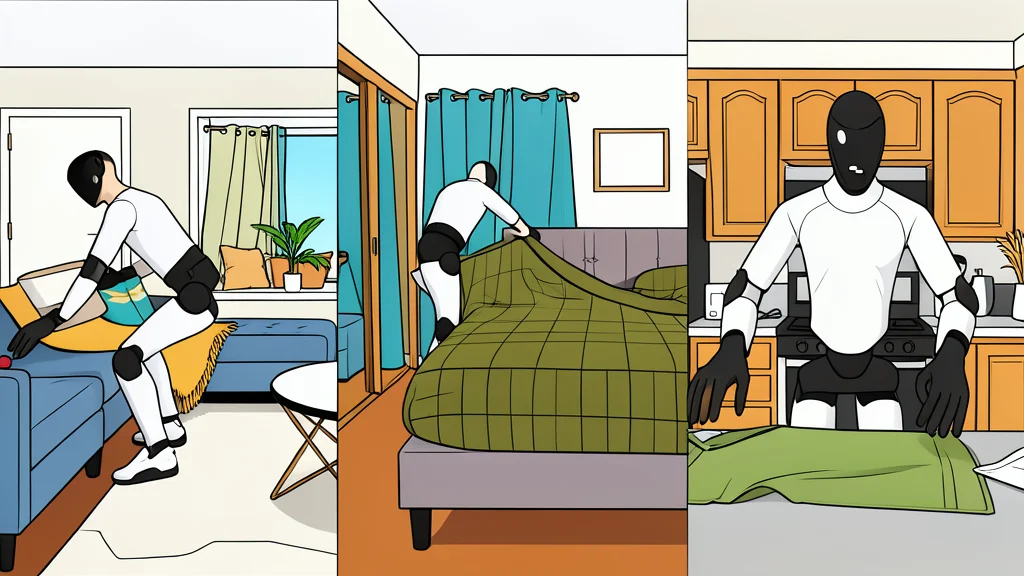
Figure has demonstrated that its Figure 03 humanoid robot can perform household chores in environments it has never encountered before. The company reports that the robot completed tasks in 30 Bay Area homes without receiving new training data or adjusting to specific layouts. This marks a step toward generalization, allowing a single model to function across different domestic settings.
However, the demonstration reveals a significant reliability gap. In 420 trials involving bed making, towel folding, and toy tidying, the robot succeeded in only 56% of cases. While this shows progress in adapting to new spaces, the high failure rate indicates that the technology is not yet ready for unsupervised daily use in private homes.
Pretraining drives behavioral transfer
The improved performance is largely attributed to Figure’s Index dataset, which captures human behavioral patterns. In a controlled comparison, a model trained from scratch without this pretraining succeeded in only 9% of trials, compared to the 56% success rate of the Index-pretrained version. This suggests that the generalization stems from broad behavioral learning rather than simply having more examples of the specific chores.
Figure notes that no single evaluation task represented more than 1.90% of the pretraining data. Additionally, the newer Helix 2.5 system required half as much adaptation data as its predecessor to achieve similar results. This efficiency suggests that the underlying architecture is better at transferring skills from observed human actions to robotic movements.
Reliability remains a major hurdle
The 44% failure rate is a critical limitation for practical deployment. Toy tidying was particularly challenging, with the robot succeeding in only 40% of attempts. While the failures may not all be equally severe, the inability to consistently complete basic tasks means the robot cannot currently be trusted to work alone in a home environment.
As reported by TechRepublic, the company acknowledges that general humanoid robotics is not solved. The current state of the technology demonstrates that robots can recognize and attempt tasks in unfamiliar settings, but the consistency required for consumer adoption is still missing. Generalization does not equate to dependable everyday performance.
Data scaling predicts future gains
Figure claims that increasing its pretraining data leads to predictable improvements in robot action prediction. Experiments covering an eightfold range of data showed that smaller runs could accurately predict the test loss of the largest run to four decimal places. This provides a measurable framework for determining if additional human data and computing resources are effectively improving the model.
While these scaling laws do not guarantee that doubling data will double real-world success rates, they offer a path toward higher reliability. If Figure can close the gap between 56% and near-perfect accuracy, the robot could potentially learn a chore once and apply it across diverse homes, reducing the need for extensive setup per location.